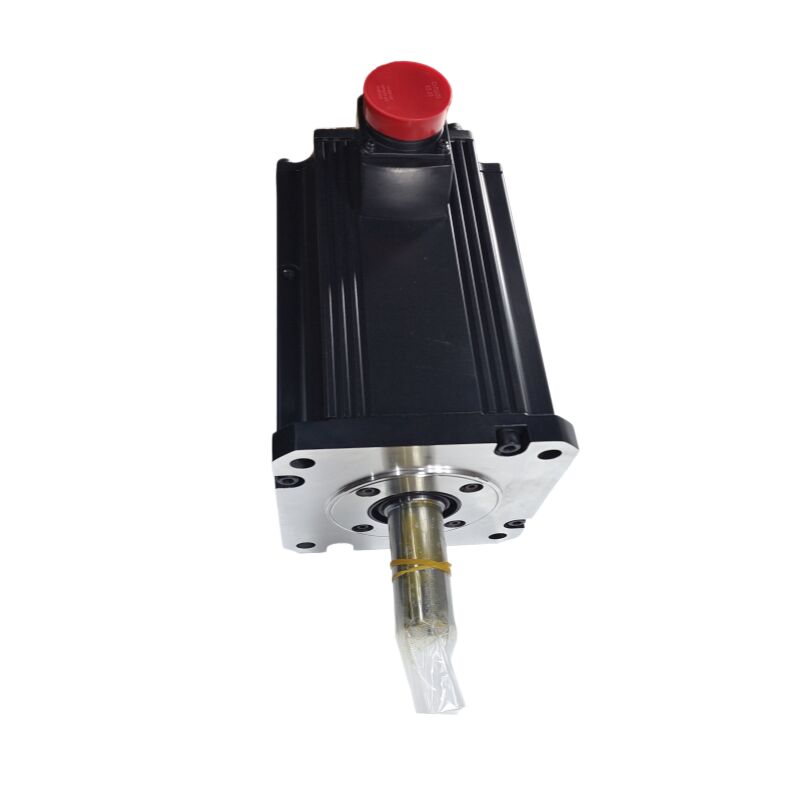
Mitsubishi HC-SFS702BK (HCSFS702BK) — 7kW AC Servo Motor, Keyed Shaft with Electromagnetic Brake, MELSERVO-J2S Series
Product Identification
Part Number: HC-SFS702BK
Also Searched As: HCSFS702BK, HC-SFS-702BK
Series: Mitsubishi MELSERVO HC-SFS (J2-Super Generation)
Motor Type: AC Brushless Servo Motor — Keyed Shaft, Electromagnetic Brake
Condition: New In Box
What You're Looking At
The Mitsubishi HC-SFS702BK is the highest-capacity motor in the standard 2,000 rpm HC-SFS family — a 7kW medium-inertia AC brushless servo motor that combines two features demanded by the toughest machine tool and industrial automation axes: a keyed shaft for positive torque transmission, and a spring-applied fail-safe electromagnetic brake for secure mechanical hold on servo-off.
At 33.4 Nm of continuous rated torque and a peak of 100 Nm, this is a serious workhorse. It pairs with the MR-J2S-700 class amplifiers from Mitsubishi's J2-Super servo platform, which means it benefits from the full J2S feature set: 17-bit absolute encoder feedback at 131,072 ppr, speed loop bandwidth exceeding 550 Hz, real-time adaptive tuning, and an absolute position system that eliminates homing cycles after power interruptions.
The "BK" suffix captures both defining features in two letters: B for the electromagnetic brake, K for the keyed shaft. This particular combination is specified wherever the axis carries a large inertia load, transmits torque through a keyed coupling or pulley, and must hold position reliably when the servo goes offline.
Technical Specifications
| Parameter |
Value |
| Part Number |
HC-SFS702BK |
| Rated Output |
7,000 W (7 kW) |
| Supply Voltage |
200V AC class (3-phase) |
| Rated Current |
35 A |
| Power Facility Capacity |
10 kVA |
| Rated Speed |
2,000 rpm |
| Maximum Speed |
3,000 rpm |
| Rated Torque |
33.4 Nm |
| Maximum Torque |
100 Nm |
| Encoder |
17-bit absolute (131,072 ppr) |
| Shaft Type |
Keyed (with keyway) |
| Electromagnetic Brake |
Spring-applied, 24V DC release, fail-safe |
| Inertia Class |
Medium inertia |
| Flange Size |
176 × 176 mm |
| Protection Rating |
IP65 |
| Oil Seal |
Fitted |
| Motor Weight |
32 kg |
| Ambient Temperature |
0°C to +40°C |
| Compatible Amplifiers |
MR-J2S-700A / MR-J2S-700B |
| Series |
MELSERVO J2S (J2-Super) |
| Origin |
Made in Japan |
| Product Status |
Discontinued — new-in-box stock available |
7kW at 2,000 rpm: The Top of the HC-SFS Range
Within the HC-SFS 2000 rpm family, capacity steps from 500W up through 1kW, 1.5kW, 2kW, 3.5kW, 5kW, and finally 7kW at the HC-SFS702BK. Each step up in the table brings more torque, higher power facility requirement, and a physically longer motor body — the 7kW model weighs 32 kg, roughly triple the 5kW motor, reflecting the additional copper, laminations, and mass required to sustain 33.4 Nm continuously without thermal trouble.
That torque figure — 33.4 Nm rated, 100 Nm peak — tells you something important about where this motor gets used. A peak-to-rated ratio of 3:1 means the motor can produce three times its continuous rating for short bursts, giving the axis the acceleration torque it needs to move heavy loads to speed quickly while sustaining the moderate torque needed to maintain that speed through the work cycle. For a heavy pallet, a large-diameter rotary table, or a high-mass Z-column, that combination of high peak and solid continuous rating is exactly what the application requires.
The 176 × 176 mm flange matches the standard heavy-frame mounting footprint shared across the upper HC-SFS range (352, 502, and 702 capacity points). Machines designed for the 3.5kW or 5kW variant can accommodate the 7kW motor without modifying the mounting arrangement — only the power and cable connections change.
The Keyed Shaft — Built for High-Torque Transmission
At 7kW and 33.4 Nm continuous, the torque at the shaft coupling interface is substantial. Friction-clamp couplings work reliably for many servo applications, but at this capacity level — particularly on axes that see frequent reversal, shock loading from cutting, or high pre-tension from timing belts — the keyed shaft eliminates the risk of slip entirely.
A keyway creates a positive form-fit between motor shaft and hub. The key bears the shear load directly rather than relying on clamping friction to transmit torque. For pulleys, sprockets, pinion gears, and coupling hubs where any rotational slip between shaft and hub would corrupt axis positioning or cause mechanical damage, the keyed interface is the correct engineering choice.
Installing correctly onto a keyed shaft matters: the key must fit the keyway with minimal clearance (a sloppy fit introduces backlash), it must be the correct length to distribute the shear load along the full depth of the hub, and the hub's retaining fastener must be torqued to specification. The Mitsubishi instruction manual notes that when fitting components onto a keyed shaft, a double-end stud in the shaft-end threaded hole should be used to draw the component on — hammering onto the shaft end is explicitly prohibited, as the shock load can damage the encoder at the motor's rear.
Electromagnetic Brake — Fail-Safe Hold for Heavy Axes
The spring-applied brake in the HC-SFS702BK is a holding device, not a deceleration brake. The operating logic is simple but critical: 24V DC energises the brake coil and holds the disc clear of the friction surface, letting the shaft rotate freely under amplifier control. Remove the 24V — by design, fault, or power failure — and the spring immediately clamps the brake disc, locking the shaft.
At 7kW, the axes this motor drives are typically large enough that gravity or process forces create meaningful unbalanced loads. A heavy spindle head on a large VMC, a gantry cross-beam, a large-format rotary table, a press back-gauge carrying a heavy stop plate — each of these has a condition where servo-off without a mechanical hold results in uncontrolled movement. The HC-SFS702BK's brake addresses that condition as a matter of fail-safe engineering rather than convenience.
Practical wiring considerations at 7kW:
The brake coil generates a significant inductive voltage spike at switch-off. A surge absorber across the coil terminals is not optional at this scale — without it, the spike can degrade relay contacts and stress amplifier I/O circuits over time. Use the MR-J2S amplifier's MBR (brake interlock) output to control the brake relay, ensuring the brake is not applied while the motor is still running under torque. Applying the brake to a spinning shaft at 7kW will wear the friction surface rapidly and create mechanical shock in the drivetrain — the MBR signal prevents that by imposing the correct deceleration-to-hold timing sequence.
For vertical axes, Mitsubishi's own guidance recommends sizing the axis so that the unbalanced torque remains below 70% of the motor's rated torque. At 33.4 Nm rated, that means the static unbalanced load should not exceed roughly 23 Nm at the motor shaft — a figure worth checking against the actual load before installation on any vertical axis.
17-Bit Absolute Encoder — Why It Matters at This Capacity
The HC-SFS702BK shares the same 17-bit serial absolute encoder used across the entire HC-SFS family: 131,072 distinct positions per shaft revolution, fed back over a high-speed serial link to the MR-J2S amplifier.
At 7kW, this matters in ways that go beyond simple positioning accuracy. The amplifier's speed loop operates on velocity data derived from the encoder — finer resolution means more precise velocity estimation, which in turn means better disturbance rejection when cutting forces, inertia variations, or load changes disturb the axis. An axis carrying a large inertia and cutting at high feed rates needs a tight speed loop to avoid hunting, oscillation, and positional error during the cut. The 17-bit encoder, combined with the J2S amplifier's 550 Hz+ bandwidth speed loop, provides that tightness.
The absolute feature keeps position data alive through battery backup — the A6BAT lithium cell in the MR-J2S amplifier. After any power interruption, the axis returns to exactly its last known position without a homing cycle. For large machines where homing a heavy axis wastes time and creates risk of fixture collision, this matters operationally.
Where the HC-SFS702BK Gets Specified
Horizontal machining centre W-axis and pallet drives. Large HMC pallet transfer systems move heavy fixtures across long travel distances. The W-axis or facing-head positioning drive needs high sustained torque, a keyed coupling to handle the pallet drive load without slip, and a brake to hold pallet position while machining or fixtured loading occurs.
Large VMC Z-column. Heavy-duty vertical machining centres with substantial spindle head mass use the 7kW class on the Z-axis. The keyed shaft connects directly to a ballscrew or rack-and-pinion drive, and the brake is essential to prevent Z-column drop on servo-off.
Large CNC lathe turret and tailstock axes. High-capacity turning centres with large-diameter turrets use servo drives at this capacity for rapid, decisive indexing. The keyed shaft engages the turret drive mechanism positively, and the brake holds the turret at the selected station while the clamp mechanism secures it for cutting.
Transfer line positioning drives. Heavy pallet transfer systems with large fixture plates and long transfer strokes use high-capacity servo drives for fast, accurate positioning between stations. The brake holds position at each station while fixturing, clamping, or processing operations take place.
Large rotary tables and trunnion axes. Direct-drive or geared servo rotary tables used for 4th-axis and 5th-axis machining on large parts require high torque for accurate positioning under cutting load. The keyed shaft connection to the worm gear or direct drive input must be positive and slip-free.
Robotic arms and heavy-payload handling systems. Industrial robots and gantry-style handling systems with payloads in the 200–500kg range use servo drives at this capacity on primary joints and travel axes. Brake hold is required at any rest position to prevent joint sag under gravity.
HC-SFS 2000 rpm Family — Full Range Summary
| Model |
Output |
Rated Torque |
Peak Torque |
Flange |
| HC-SFS52 series |
500 W |
2.39 Nm |
7.16 Nm |
130×130mm |
| HC-SFS102 series |
1,000 W |
4.78 Nm |
14.4 Nm |
130×130mm |
| HC-SFS152 series |
1,500 W |
7.16 Nm |
21.5 Nm |
130×130mm |
| HC-SFS202 series |
2,000 W |
9.55 Nm |
28.6 Nm |
176×176mm |
| HC-SFS352 series |
3,500 W |
16.7 Nm |
50.1 Nm |
176×176mm |
| HC-SFS502 series |
5,000 W |
23.9 Nm |
71.6 Nm |
176×176mm |
| HC-SFS702 series |
7,000 W |
33.4 Nm |
100 Nm |
176×176mm |
Each capacity point is available in four shaft-and-brake combinations: straight no-brake, keyed no-brake, straight with brake, and keyed with brake. The HC-SFS702BK is the keyed-with-brake variant at the 7kW top of this range.
New In Box — What the Condition Means at This Scale
A 32 kg servo motor is a significant handling and installation item. Factory-sealed new-in-box means the motor arrives in original Mitsubishi packaging with all protective covers intact — shaft end cap, connector dust covers, and inner foam support. No prior installation stress on the keyed shaft, no thermal history from previous duty, no accumulated wear on the brake friction surface.
For maintenance departments managing a large machine fleet, holding a new-in-box spare for a 7kW axis eliminates the most costly kind of downtime: waiting for a motor to be repaired or sourced while a production machine stands idle. The brake and encoder are the two components most likely to require replacement on an aged motor — a new-in-box unit has neither concern.
Storage in cool, dry, vibration-free conditions maintains full specification for several years. For storage beyond five years, periodic slow shaft rotation is advisable to redistribute bearing grease before installation.
Frequently Asked Questions
Q1: Which servo amplifiers work with the HC-SFS702BK?
The HC-SFS702BK requires a MR-J2S-700 class amplifier. The two primary options are the MR-J2S-700A (general-purpose pulse/analog command interface) and the MR-J2S-700B (SSCNET fiber-optic bus for motion controller systems). Both support the HC-SFS702BK's 17-bit serial encoder and provide the current capacity required for this motor's 35A rated current. The motor is not compatible with original MR-J2 amplifiers or with MR-J3 / MR-J4 series amplifiers without dedicated conversion hardware.
Q2: What does the keyed shaft add versus the standard straight shaft on the HC-SFS702B?
Both models are mechanically and electrically identical apart from the shaft. The HC-SFS702BK has a machined keyway in the shaft, which creates a positive shear-load connection to the coupling hub or driven component. At 7kW and 33.4 Nm continuous torque, applications that use direct-drive pulleys, sprockets, or pinion gears benefit from the keyed connection to eliminate any risk of torque-induced slip. If your coupling is a friction-clamp style (split clamp or compression hub) and there is no mechanical requirement for a key, the HC-SFS702B (straight shaft) is the equivalent model.
Q3: The "B" indicates a brake — how does it engage and what is it for?
The brake is spring-applied and fail-safe: 24V DC holds it open during normal operation, and the spring engages the brake disc the moment that voltage is removed. It is a holding device, not a deceleration brake — the servo amplifier handles all controlled deceleration, and the brake engages only after the axis has stopped. It is used on vertical axes and any application where a powered-off axis would move under gravity or process forces. Always route brake control through the amplifier's MBR interlock output to ensure the brake engages only after the motor decelerates to a stop.
Q4: Does the 17-bit absolute encoder need a battery, and where is it installed?
Yes — the serial absolute encoder requires battery backup to retain position data during power-off. The battery is not in the motor; it is the A6BAT lithium cell mounted inside the MR-J2S-700 servo amplifier. When the battery is healthy, the axis retains its absolute position through power interruptions and requires no homing cycle on restart. Monitor the amplifier's battery alarm and replace the A6BAT at the next planned shutdown when the warning appears — do not allow the battery to fully deplete, as this forces a re-homing operation.
Q5: Can the HC-SFS702BK replace an older HC-SF702 or HC-SF702B on an existing machine?
The flange dimensions and shaft geometry are compatible — the HC-SFS702BK will mount in the same location as an HC-SF702 or HC-SF702B without mechanical modification. However, the encoder interface differs: the HC-SFS702BK uses a 17-bit serial encoder that requires an MR-J2S-700 amplifier. An original MR-J2 amplifier cannot communicate with this encoder. If the machine is already running MR-J2S amplifiers at the 700A capacity, the replacement is mechanically and electrically direct. If the machine has original MR-J2 amplifiers, the amplifier must be upgraded at the same time.


 Your message must be between 20-3,000 characters!