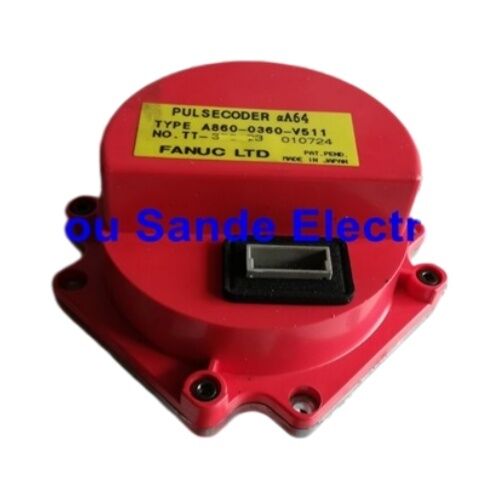
FANUC A860-0360-V511 Pulsecoder — αA64 Absolute Encoder with Super Capacitor for FANUC Alpha Series Servo Motors
Brand: FANUC
Designation: αA64 (Alpha Absolute 64K)
Part Numbers: A860-0360-V511 / A8600360V511 14-Pin Connector
Absolute Type | Super Capacitor | In Stock
The Red Cap Era — Still Running Millions of Machines
Before FANUC's αi series became the dominant platform on modern machine tools, an earlier generation of FANUC Alpha series AC servo motors ran — and continues to run — in manufacturing facilities worldwide. Identifiable by the distinctive red plastic rear cap covering the encoder assembly, these motors were installed in enormous quantities on machining centers, turning centers, and multi-axis equipment during the late 1980s through the 2000s. A great many of those machines are still in productive daily use.
The FANUC A860-0360-V511 is the αA64-type pulsecoder for the larger-frame variants of this Alpha series. It is an absolute encoder — 64,000 pulses per revolution, multi-turn position retention, no external battery required — that mounts to the rear of the servo motor inside the familiar red cap housing. When this encoder fails, the machine loses its position reference and the axis stops. The replacement path is straightforward: the correct A860-0360-V511 installed in the motor that carried it originally.
What Makes the V511 Distinct Within the A860-0360 Family
The A860-0360 series encompasses several pulsecoder variants that share the same αA64 absolute encoder designation but differ in physical configuration and position-retention technology. Understanding where the V511 sits prevents a costly ordering error.
The critical distinguishing feature of the V511 is its built-in super capacitor for absolute position retention. Where other variants in this series rely on an external battery on the servo amplifier to preserve absolute multi-turn position data through power-off periods, the V511 carries its own internal capacitive energy storage. When machine power is removed, the super capacitor provides the energy needed to maintain the encoder's internal position count through the power-off interval, eliminating the external battery dependency for this function on the encoder side.
The practical consequence at the machine level depends on how the system was originally configured — but for motors that shipped with the V511, the position-retention architecture is part of the system design. Like all pulsecoder replacements, matching the exact part number on the motor's encoder label is the correct verification procedure before ordering.
Technical Reference
| Parameter |
Detail |
| FANUC Part Number |
A860-0360-V511 |
| Encoder Designation |
αA64 (Alpha Absolute 64K) |
| Encoder Type |
Absolute pulsecoder |
| Resolution |
64,000 pulses per revolution (64K) |
| Position Retention |
Super capacitor (built-in) |
| Connector |
14-pin male |
| Housing |
Red plastic cap assembly |
| Compatible Motor Series |
FANUC Alpha series (larger frame — α3 and above) |
| Compatible Motor Range |
α3/2000, α3/3000, α6/2000, α6/3000, α12/2000, α12/3000, α22/2000, α22/3000, α30/2000, α30/3000, and related variants |
| Motor Identification |
Motor model numbers ending in Bx75 (12-digit FANUC format) |
| Origin |
Japan |
| Application |
CNC machine tool servo axes |
64K Absolute — What the Resolution and Type Mean in Practice
Two properties define how a pulsecoder behaves as a feedback device: its resolution and whether it is absolute or incremental. Both matter for day-to-day machine operation.
Resolution: 64,000 ppr. Each full motor shaft revolution is divided into 64,000 discrete measurement intervals. On a servo axis driving a ball screw with a 10mm pitch, 64,000 counts per revolution gives the feedback loop a position granularity of approximately 0.16 micrometers per count at the screw output — well beyond the accuracy of the mechanical components in the typical machine tool this encoder serves. The encoder resolution is not the limiting factor in these systems' positioning performance. What the 64K resolution does influence meaningfully is velocity feedback quality at low feed rates, where the count density keeps the speed control loop supplied with fine, regular feedback data rather than coarse pulse bursts.
Absolute type. An absolute encoder maintains a full position address across power-off cycles. When the machine powers on after a shutdown — whether planned or unplanned — the servo system reads the encoder's stored position and knows immediately where the axis is. No reference return, no homing motion, no operator intervention. The machine is ready to run from wherever it stopped. This is a meaningful operational advantage on equipment that may stop unexpectedly due to power interruption, E-stop, or fault condition, and where re-homing all axes before resuming production adds time and procedural complexity to the recovery.
The super capacitor in the V511 is the mechanism that makes the absolute property work through power-off intervals — it stores sufficient energy to maintain the encoder's internal position tracking electronics while external power is absent.
The Alpha Series Red Cap Motor Family
The A860-0360-V511 belongs to the larger-frame group within the FANUC Alpha encoder range. FANUC manufactured two distinct physical sizes of αA64 pulsecoder:
The smaller variant — found in very compact Alpha motors including the α1, α2, and αM2.5 frame sizes — uses the A860-0360-T001 part number and a different physical housing. It is not interchangeable with the V511.
The larger variant — used across the broader Alpha motor range from the α3 frame upward — is the A860-0360 series in its T201, V501, and V511 forms. These share the same physical housing and coupling geometry. The suffix differences within this group reflect generation, connector configuration, and position-retention method. Motors fitted with A64 encoders in the FANUC part numbering system are identified by the digits "75" at the end of the motor's 12-character model number (for example, A06B-0xxx-Bx75), which is a reliable cross-check method when the encoder label itself is unclear or damaged.
A860-0360 Variants — Navigating the Family
Several part numbers share the αA64 designation and the same Alpha series motor compatibility. The differences between them matter for sourcing:
| Part Number |
Position Retention |
Notes |
| A860-0360-T001 |
External battery |
Small frame only (α1/α2) — not compatible with V511 motors |
| A860-0360-T201 |
External battery |
Standard larger-frame absolute, earlier production |
| A860-0360-T021 |
External battery |
Larger-frame absolute variant |
| A860-0360-V501 |
External battery |
Larger-frame, later connector variant |
| A860-0360-V511 |
Super capacitor (built-in) |
Larger-frame, self-contained position retention |
Why These Encoders Fail — and What to Expect
FANUC Alpha series red cap encoders have been in continuous production use for decades, and failure modes are well understood within the FANUC service community.
Optical disc contamination or degradation. The encoder works by passing light through a precision-etched optical disc. Contamination by coolant vapor, oil mist, or metallic dust that enters the endbell — whether through seal wear, cable entry points, or repeated thermal cycling — can degrade signal quality over time. Early signs include marginal alarm conditions that appear intermittently and clear on restart; eventually the signal drops below the amplifier's acceptance threshold and a hard encoder alarm results.
Super capacitor degradation. In the V511, the capacitor that maintains absolute position through power-off has a finite service life. A capacitor that has degraded sufficiently will no longer hold position data through even brief power interruptions. The symptom is the machine losing its absolute position reference after power cycling — requiring a reference return that should not be necessary with a functional absolute encoder. The capacitor is internal to the encoder assembly and is not a field-replaceable component separately.
Mechanical coupling wear. The coupling between the motor shaft and the encoder's input transfers rotation without allowing shaft runout to apply radial force to the encoder's internal bearing. Coupling wear over time allows misalignment to reach the encoder bearing, producing noise, increased bearing drag, and eventually encoder signal errors.
When an encoder-related alarm appears, the diagnostic sequence should still begin with the encoder cable — verify connection integrity and cable condition before concluding the encoder itself is the fault. If cable inspection is clear and the alarm persists, the encoder is the next candidate for replacement.
Handling and Installation Notes
The A860-0360-V511, like all FANUC optical pulsecoders, requires handling appropriate to a precision optical instrument. The internal disc assembly and bearing are the components that determine encoder performance, and both are sensitive to mechanical shock and contamination.
Keep the encoder in its packaging until the moment of installation. Do not strike the housing or apply axial force to the encoder shaft. When removing the old encoder from the motor, note the coupling orientation — the replacement coupling (recommended to install new with each encoder change) must be positioned correctly to engage the motor shaft drive features before the encoder is seated.
The red plastic cap housing should be handled without touching the optical window or the coupling interface surfaces. Once installed, verify the cap's sealing condition before returning the motor to service — the endbell protection depends on the cap being correctly seated and sealed.
FAQ
Q1: The A860-0360-V511 has a super capacitor instead of relying on an external battery. Does this mean the amplifier battery is no longer needed at all?
The super capacitor in the V511 handles position retention within the encoder itself, but the overall servo system's battery configuration depends on how the FANUC amplifier and CNC controller manage absolute position data at the system level. FANUC servo amplifiers from this era typically maintain their own battery for backup functions beyond just the encoder — including parameter storage and, in some configurations, multi-turn absolute count tracking at the amplifier level. Whether the amplifier still requires its battery when the V511 is installed depends on the specific amplifier model and system configuration. The encoder's self-contained capacitor eliminates the battery dependency for encoder-level position retention, but before removing the amplifier battery based on this assumption, verify the amplifier's battery function requirements in its own instruction manual. Removing a battery that the amplifier depends on for parameter or count retention can cause additional data loss.
Q2: Can the A860-0360-V511 be substituted with the A860-0360-V501 or A860-0360-T201 if the V511 is unavailable?
Physical fitment is compatible across the larger-frame A860-0360 variants — the housing dimensions and coupling interface are the same for T201, V501, and V511. The functional difference is the position-retention method: the V511 uses a built-in super capacitor, while the T201 and V501 rely on the external amplifier battery for absolute position retention. Substituting a T201 or V501 into a system designed around the V511 means the absolute position retention through power-off events will now depend on the amplifier battery rather than the encoder's own capacitor. If the amplifier battery is present and functional, absolute position should still be maintained correctly. However, for installations where the V511 was specified for a reason — such as applications where the amplifier battery was intentionally omitted from the system design — this substitution changes the system's battery dependency in a way that needs to be considered before proceeding. Always verify the installed configuration of the specific machine before assuming direct substitutability.
Q3: My machine is showing an encoder alarm on startup after a power outage. The absolute position was lost. Does this confirm the V511 super capacitor has failed?
Position loss after a power outage is a strong indicator that the super capacitor is no longer holding charge through the power-off period, but it is not the only possible cause. Before concluding the capacitor has failed, consider the duration of the power outage — a super capacitor stores a finite amount of energy, and a very extended outage (several hours or more, depending on the capacitor's state and the encoder's internal power consumption) can exhaust even a healthy capacitor. If position loss only occurs after long-duration power-off events but not after brief interruptions, the capacitor may still have partial capacity remaining. If position is lost even after very brief power cycling — a few seconds or less — the capacitor has failed. In either case, the encoder assembly requires replacement because the capacitor is integrated into the unit and cannot be replaced separately in the field.
Q4: How do I confirm which A860-0360 variant is currently installed in my motor without reading the encoder label?
The motor model number provides one cross-check: FANUC Alpha series motors fitted with A64 encoders carry "75" as the final two digits of their 12-character model designation — for example, a motor labeled A06B-0xxx-Bx75 has an A64 encoder. This confirms the encoder type but does not identify the specific variant suffix (T201 vs V501 vs V511). For variant identification, the encoder label on the rear endbell is the only reliable source — it will show the full A860-0360-VXXX or A860-0360-TXXX part number. If the label is unreadable due to wear, oil contamination, or physical damage, a FANUC service representative or specialist repair facility with test equipment can identify the encoder variant through functional testing. Do not assume the variant from the motor model number alone, and do not substitute across variants without understanding the position-retention implications described in the previous FAQ.
Q5: Is the A860-0360-V511 repairable if the super capacitor fails, or must the whole encoder be replaced?
FANUC Alpha series pulsecoders are generally not repairable to a standard that restores original performance reliability. The integrated optical assembly, the precision-ground coupling, the internal bearing, and the super capacitor are manufactured as a matched unit under controlled conditions. Field repair of the capacitor alone — soldering a replacement capacitor into the encoder PCB — is technically possible but carries significant risk: the optical disc and bearing are exposed during disassembly, contamination or mechanical disturbance during the repair can degrade signal quality even if the capacitor replacement itself is successful, and the repaired unit has no verified performance baseline after reassembly. Specialist servo repair facilities with appropriate test equipment and clean-room conditions do offer encoder rebuild services with varying warranty terms. For most industrial maintenance operations, outright replacement with a known-good unit and return of the failed unit for exchange credit is the faster and lower-risk path to restoring machine availability.



 Your message must be between 20-3,000 characters!