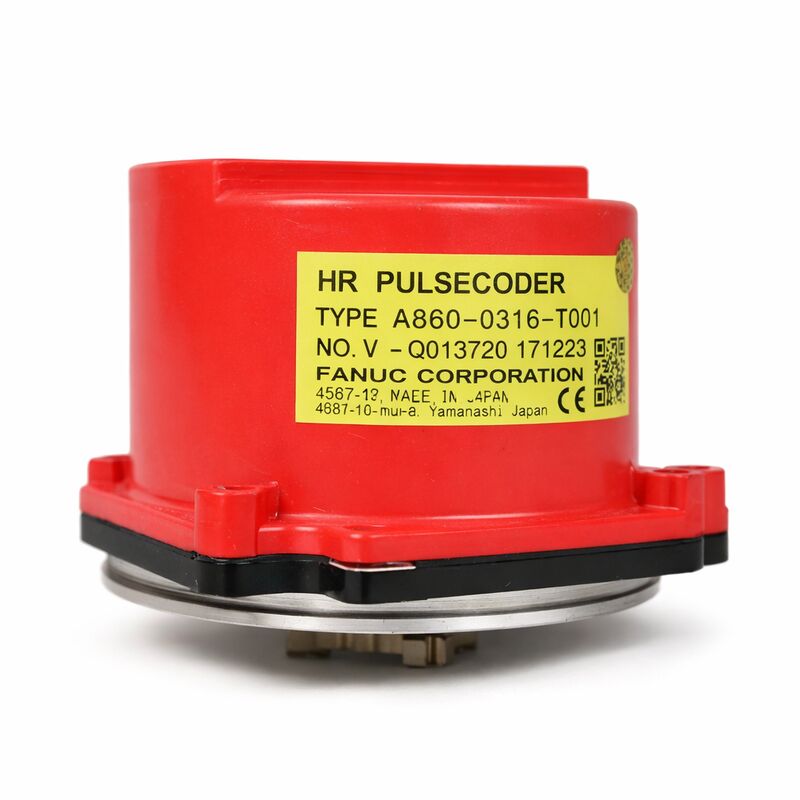
Fanuc A860-0316-T001 | High-Resolution HR Incremental Pulse Coder — 10,000P, D-Sub Interface, Fanuc S-Series AC Servo Motors
Overview
The Fanuc A860-0316-T001 is the D-Sub connector variant of Fanuc's high-resolution (HR) 10,000P incremental pulse coder for the S-series AC servo motor range.
It shares the same 10,000 ppr incremental specification as the A860-0316-T101 (red cap variant), differing in its connector type: where the T101 uses a red plastic cap housing with an integrated or Amphenol-style connector, the T001 presents a D-Sub interface — the same trapezoidal multi-pin connector format used on a range of Fanuc S-series and related encoder variants.
The HR designation marks this encoder as the higher-resolution member of the A860-0316 family, stepping beyond the 2,000P, 2,500P, and 3,000P incremental coders that serve the broader S-series motor population.
The 10,000P specification was applied to S-series motors where the application's velocity control quality requirements demanded finer position sampling than the standard 3,000P encoder could deliver — higher-speed precision axes, tooling spindles, and similar demanding applications within the S-series motor range.
At 10,000 pulses per revolution, the A860-0316-T001 generates 40,000 quadrature edge counts per motor shaft revolution when decoded by the amplifier's 4× edge-counting circuit. At 3,000rpm, this represents 2 million count updates per second — a velocity estimate data density that supports smooth, low-noise speed regulation across the motor's operating range.
For comparison, a 3,000P encoder at the same speed produces 600,000 quadrature counts per second — adequate for many applications but with a proportionally coarser velocity estimate per control sample period.
As an incremental encoder, the T001 requires a reference return at every machine power-up.
The motor shaft position is unknown to the CNC at power-on; the reference return procedure drives the axis to its hardware reference switch, detects the encoder's Z-pulse (one per revolution), and establishes the axis datum before any production movement is permitted.
For machines where this is a standard startup step, the T001 operates as reliably as any absolute encoder for day-to-day production.
Key Specifications
| Parameter |
Value |
| Encoder Type |
HR Incremental |
| Resolution |
10,000 ppr (40,000 edge counts with 4× decode) |
| Connector |
D-Sub |
| Compatible Motors |
S-series AC servo |
| CNC Compatibility |
Zero-C/D, 16A, 18A, 21A |
| Feedback Type |
Incremental (A/B/Z) |
| Battery Required |
None |
| Reference Return |
Required at every power-up |
D-Sub Connector — Installation and Cable Notes
The D-Sub connector on the A860-0316-T001 is its primary physical differentiator from the T101 variant within the HR encoder family.
D-Sub connectors on Fanuc S-series encoders were a common specification choice during the S-series production run, and machines with T001 installations have a D-Sub socket at the motor end of their encoder cable assembly.
A T101 (Amphenol/red cap style) encoder cannot plug into this socket without cable adaptation.
When sourcing a T001 as a replacement, inspect the motor's existing encoder cable at the motor end — if it terminates in a D-Sub socket, the T001 is the correct variant.
If it terminates in an Amphenol or hardwired connector, the T101 or another variant is required. Ordering based on part number alone without checking the installed cable's motor-end connector is a common sourcing error that results in a non-fitting encoder.
HR Incremental vs Serial Absolute — System Context
The A860-0316-T001 (incremental) and the Serial A/Serial C absolute encoders from the same S-series era represent different feedback philosophies that were matched to different servo amplifier types.
HR incremental encoders fed into analogue servo amplifiers or early digital servo amplifiers that processed quadrature A/B/Z signals directly. Serial absolute encoders communicate via a proprietary serial protocol that requires a digital servo amplifier with the serial encoder decode circuit.
These two systems are not interchangeable at the amplifier level.
A machine built with an HR incremental encoder and the corresponding amplifier type cannot be directly upgraded to a serial absolute encoder without replacing the amplifier as well.
Understanding this system-level dependency is important when evaluating any encoder replacement or upgrade scenario.
FAQ
Q1: How does the 10,000P resolution of the T001 compare to the Serial C (1,000,000P) encoder in the same motor era?
The Serial C absolute encoder (A860-0346, A860-0356 families) at 1M ppr delivers 100 times the raw resolution of the 10,000P HR incremental.
However, the two encoder types operated with different amplifier architectures — the HR incremental with quadrature decode on analogue/early digital servo amplifiers, Serial C with dedicated serial decoder circuits on digital servo amplifiers.
The resolution gap reflects the technology generation difference.
For the analogue servo amplifier systems the T001 was designed for, 10,000P was the practical resolution ceiling, and it was sufficient for the applications those systems served.
Q2: What is the effect on servo parameters when replacing a 3,000P S-series encoder with the 10,000P T001?
The CNC's servo parameters include the encoder pulse count (typically the CMR — command multiplier ratio — and DMR parameters) that relate encoder counts to commanded movement units.
Changing from a 3,000P encoder to a 10,000P encoder changes the ratio between motor shaft rotation and encoder count, so these parameters must be updated to maintain the correct relationship between the CNC's position commands and the actual motor movement.
Failing to update servo parameters after a resolution change produces incorrect position scaling — the axis will move the wrong distance for a given command, and the servo loop may become unstable.
Q3: Can the A860-0316-T001 serve as a direct replacement for the A860-0316-T101 with cable adaptation?
Yes, in principle. Both T001 and T101 are 10,000P HR incremental encoders with the same electrical specification.
The only difference is the connector type. A cable adapter that converts the T001's D-Sub output to the T101's Amphenol connector format (or vice versa) allows either variant to serve in the other's installation.
This adapter approach works reliably in practice and is a legitimate service solution when only one connector variant is available in the aftermarket at the time of a machine-down event.
Q4: What are the main failure modes for the A860-0316-T001 in long-term service?
Bearing wear is the most age-dependent failure mode — the encoder bearing supporting the optical disc and shaft coupling gradually develops play, which introduces signal noise in the A/B quadrature outputs and eventually produces erratic position counting or encoder alarms.
Optical disc contamination from coolant mist, cutting fluid aerosol, or swarf particles that bypass the motor shaft seal is the second most common failure path.
D-Sub connector pin corrosion, particularly in humid machine environments where condensation is possible, can cause intermittent signal dropouts that mimic bearing or disc faults until the connector is properly inspected.
Always start fault diagnosis at the cable and connector before concluding the encoder body has failed.
Q5: Does the incremental nature of the T001 pose any risk to workpiece quality if the machine loses power during a cutting operation?
Yes — unplanned power loss during active cutting means the axis position is unknown at the next power-up.
The CNC will require reference return before any production movement, and the machining operation that was in progress at the time of the power loss is typically incomplete or scrapped.
For machines with absolute encoders, the position is recovered at power-up and the operator can assess the state of the interrupted operation before deciding whether to continue or scrap the workpiece.
This is the fundamental operational argument for absolute over incremental feedback on production machine tools.
Whether the T001's incremental behaviour is acceptable depends entirely on the frequency of unplanned shutdowns and the cost of the workpiece material being machined.


 Your message must be between 20-3,000 characters!