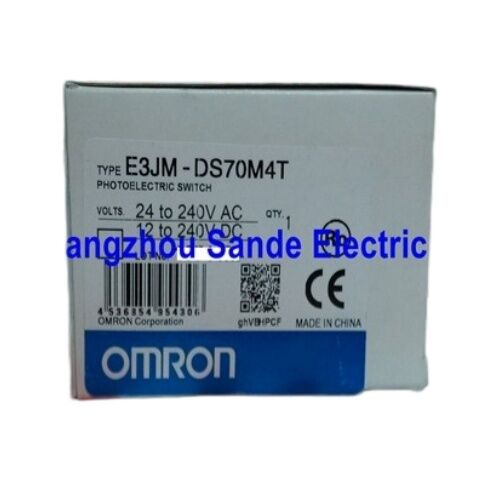
Omron E3JM-DS70M4T Photoelectric Sensor — AC/DC Universal, 700mm Diffuse, Relay Output with Timer
Brand: Omron
Series: E3JM
Part Number: E3JM-DS70M4T (Also referenced as: E3JMDS70M4T / E3JM-DS7OM4T)
Type: Built-in Power Supply Photoelectric Switch Sensor
In Stock — Fast Shipping Worldwide
One Sensor. Any Voltage. Any Job.
Most photoelectric sensors ask you to decide upfront: AC or DC? The Omron E3JM-DS70M4T doesn't. With a power supply range spanning 12 to 240V DC and 24 to 240V AC, it wires directly into virtually any control panel in any facility — no voltage matching, no special power supply, no extra hardware. That flexibility alone makes it one of the most practical sensing solutions in the E3JM family.
Add a 700mm diffuse-reflective sensing range, a built-in relay output, and a selectable timer function with adjustable delay, and you have a sensor that handles a wide range of object detection tasks right out of the box.
Confirmed Technical Specifications
All data below is sourced directly from Omron's official E3JM datasheet (CSM_E3JM_DS_E_12_6).
| Parameter |
Specification |
| Sensing Method |
Diffuse-reflective |
| Sensing Distance |
700 mm (white paper, 200 × 200 mm reference target) |
| Light Source |
Infrared LED, 940 nm wavelength |
| Power Supply Voltage |
12 to 240 VDC ±10%, ripple (p-p) 10% max. / 24 to 240 VAC ±10%, 50/60 Hz |
| Power Consumption |
2 W max. |
| Control Output |
Relay (SPDT): 250 VAC, 3A (cosφ=1) max. / 5 VDC, 10 mA min. |
| Operation Mode |
Light-ON / Dark-ON (switch selectable) |
| Response Time |
30 ms max. (operate or reset) |
| Timer Function |
ON-delay / OFF-delay / One-shot delay (DIP switch selectable) |
| Timer Delay Range |
0.1 to 5 seconds (adjustable) |
| Differential Travel |
20% max. of sensing distance |
| Ambient Illumination (Receiver) |
Incandescent lamp: 3,000 lx max. |
| Operating Temperature |
−25°C to 55°C (no icing or condensation) |
| Storage Temperature |
−30°C to 70°C |
| Operating Humidity |
45% to 85% RH (no condensation) |
| Storage Humidity |
35% to 95% RH (no condensation) |
| Insulation Resistance |
20 MΩ min. at 500 VDC |
| Dielectric Strength |
2,000 VAC, 50/60 Hz for 1 minute |
| Vibration Resistance (Destruction) |
10 to 55 Hz, 1.5 mm double amplitude, 2 hours each in X/Y/Z |
| Shock Resistance (Destruction) |
500 m/s², 3 times each in X/Y/Z directions |
| Shock Resistance (Malfunction) |
100 m/s², 3 times each in X/Y/Z directions |
| Degree of Protection |
IEC 60529: IP66 |
| Relay Life — Mechanical |
50,000,000 operations min. (18,000 times/h) |
| Relay Life — Electrical |
100,000 operations min. (1,800 times/h) |
| Connection Method |
Terminal block |
| Conduit Thread Size |
PF 1/2 |
| Case Material |
ABS |
| Lens Material |
Methacrylic resin |
| Cover Material |
Polycarbonate |
| Weight (packed) |
Approx. 160 g |
| Accessories Included |
Mounting bracket (with screw), nuts, terminal protection cover, cable connection nuts, instruction manual |
The Timer Feature — More Useful Than It Sounds
The "T" in E3JM-DS70M4T designates the built-in timer — and it's worth understanding what that actually enables on the factory floor.
Three modes are available, selected by DIP switch:
ON-delay — The output doesn't switch on until the object has been present for the set delay period. Useful for filtering out fast-moving objects or vibration-triggered false detections. If something passes in front of the sensor and disappears before the delay expires, the output never fires.
OFF-delay — The output stays active for a set time after the object leaves the sensing zone. Common in applications where a brief output hold is needed — for example, keeping a downstream gate open slightly longer after a part has passed, or maintaining a signal to a reject mechanism.
One-shot delay — The output pulses for a fixed duration regardless of how long the object remains in the sensing zone. Useful for generating consistent output pulses from objects of varying size or speed.
The delay time is adjustable between 0.1 and 5 seconds via a potentiometer on the sensor. Note that on timer-equipped models, the timer function is always active — it cannot be disabled.
IP66 — What It Actually Protects Against
The E3JM-DS70M4T carries an IP66 rating per IEC 60529. Breaking that down: the first digit (6) means the enclosure is fully dustproof — no ingress from particulates of any size. The second digit (6) means it withstands powerful water jets from any direction.
In practical terms, this sensor can handle washdown environments, outdoor installations subject to rain exposure, dusty cutting or grinding areas, and food processing lines where routine hosing down of equipment is standard. It is not rated for submersion, but for surface mounting in harsh environments, IP66 covers the vast majority of real-world conditions.
Light-ON / Dark-ON — Choosing the Right Mode
Every E3JM-DS70M4T ships with the ability to switch between Light-ON and Dark-ON operation via a DIP switch on the sensor body. No tools required, no separate model to order.
Light-ON (L-ON): The relay output energizes when the sensor detects a reflected signal — that is, when an object is present in the sensing zone. This is the mode most applications use for standard object detection.
Dark-ON (D-ON): The relay output energizes when the reflected signal is absent — when no object is detected. This mode is used for detecting missing parts, monitoring for gaps or breaks in material flow, or any application where the absence of an object is the meaningful event.
The current operating mode is shown by the red indicator LED on the sensor housing.
Sensitivity Adjustment
A one-turn adjuster on the sensor body controls the detection sensitivity, allowing fine-tuning of the sensing distance within the 700mm range. This is useful when working with materials that have low reflectivity — dark objects, matte surfaces, or translucent materials — where the default sensitivity may need to be increased. It also allows the effective sensing distance to be deliberately reduced to avoid detecting background objects beyond the intended detection zone.
Where This Sensor Gets Installed
The combination of universal voltage, IP66 protection, relay output, and built-in timer makes the E3JM-DS70M4T a strong fit across a wide range of applications:
Conveyor and parts presence detection — Confirm parts are present at a station before initiating a process step, with ON-delay filtering to ignore minor vibration or part bounce.
End-of-travel and position sensing — Detect when a machine element reaches a home or limit position, with relay output wired directly into a safety or control circuit.
Fill level and material detection — Monitor bin or hopper fill levels for materials with sufficient reflectivity, triggering alarms or conveyor stops when levels fall outside range.
Packaging and labeling lines — Detect product gaps, missing labels, or absent packaging, with timer modes to generate consistent output pulses for downstream counters or PLCs.
Outdoor and harsh-environment installations — Any outdoor machine, agricultural equipment station, or exposed mounting location where weather and dust exposure are routine operating conditions.
Wiring Notes for Installation
The E3JM-DS70M4T connects via a terminal block — no connector required. Omron recommends a conductor cross-section of 0.3 mm² with a cable outer diameter between 6 and 8 mm.
The relay output is SPDT (single-pole double-throw), providing both normally-open (NO) and normally-closed (NC) contacts simultaneously. When using both contacts on the same load with inductive devices such as contactors or solenoid valves, a surge suppressor should be applied to the load to prevent relay contact interference between the NO and NC sides during switching transitions. This is noted explicitly in Omron's installation documentation for the E3JM series.
Conduit Variant Overview
The E3JM-DS70M4T is available in three conduit thread variants to suit different regional wiring standards:
| Model |
Conduit Thread |
Notes |
| E3JM-DS70M4T |
PF 1/2 |
Standard international model |
| E3JM-DS70M4T-G |
PG 13.5 |
European / DIN installations |
| E3JM-DS70M4T-US |
1/2-14 NPT |
UL-listed, North American installations |
All three variants share identical sensing and electrical specifications — only the conduit fitting differs.
FAQ
Q1: Can the E3JM-DS70M4T be powered by both AC and DC in the same installation?
Yes — this is one of the sensor's defining features. The E3JM-DS70M4T accepts 12 to 240V DC and 24 to 240V AC on the same terminals, with no polarity sensitivity on the power supply connection. This makes it particularly useful in facilities where panel voltage varies between machines or where the same sensor model needs to be stocked for both AC and DC applications. There is no internal switching required — the sensor handles both voltage types natively.
Q2: What is the difference between E3JM-DS70M4T and E3JM-DS70M4 (without the T)?
The T suffix indicates the inclusion of a built-in timer function. The E3JM-DS70M4 (no T) is a standard relay output diffuse sensor without timing capability. The E3JM-DS70M4T adds ON-delay, OFF-delay, and one-shot delay modes, selectable by DIP switch, with a delay time adjustable from 0.1 to 5 seconds. On the T model, the timer is always active — it cannot be bypassed. If your application requires an immediate, undelayed output response, the non-T variant is the correct choice.
Q3: What objects can the E3JM-DS70M4T detect at the full 700mm sensing distance?
The 700mm sensing distance is specified against a white paper target measuring 200 × 200 mm — this is the standard reference condition used in Omron's official datasheet. For darker or less reflective materials, the effective sensing distance will be shorter. Omron's published sensing object vs. distance curves show that black carbon surfaces and SUS (stainless steel) reduce effective range significantly compared to white paper. For high-reflectivity targets like aluminum foil, the effective range approaches or exceeds the white paper baseline. When detecting dark, matte, or small objects, it is advisable to set the sensor closer than the maximum 700mm and use the sensitivity adjuster to optimize detection reliability.
Q4: Is the IP66 rating maintained after wiring if I use the terminal block connection?
IP66 integrity depends on proper installation. The sensor's conduit entry and cover must be firmly tightened after wiring to maintain the sealed enclosure. Omron specifies that the cover should be securely fastened to preserve the IP66 rating — a loose cover or improperly seated conduit fitting will compromise the seal. Omron also recommends using a cable with an outer diameter between 6 and 8 mm to ensure a proper seal at the cable entry. For the standard (PF1/2) model, cable connection nuts are provided in the package; note that UL-listed (-US) models do not include these nuts.
Q5: Can the E3JM-DS70M4T output be wired directly to a PLC input?
The E3JM-DS70M4T uses a relay output rather than a transistor or SSR output. Relay contacts are voltage-agnostic — they can switch AC or DC loads within the rated limits (250 VAC, 3A max. / 5 VDC, 10 mA min.). For PLC discrete input connections, the relay contact can be wired in series with the PLC input's supply voltage, providing a clean, isolated switching signal. The 30ms response time is adequate for most PLC-scanned applications. For applications requiring faster response, the DC SSR variant (E3JM-DS70S4T) offers a 5ms operate/reset time and should be considered instead.


 Your message must be between 20-3,000 characters!