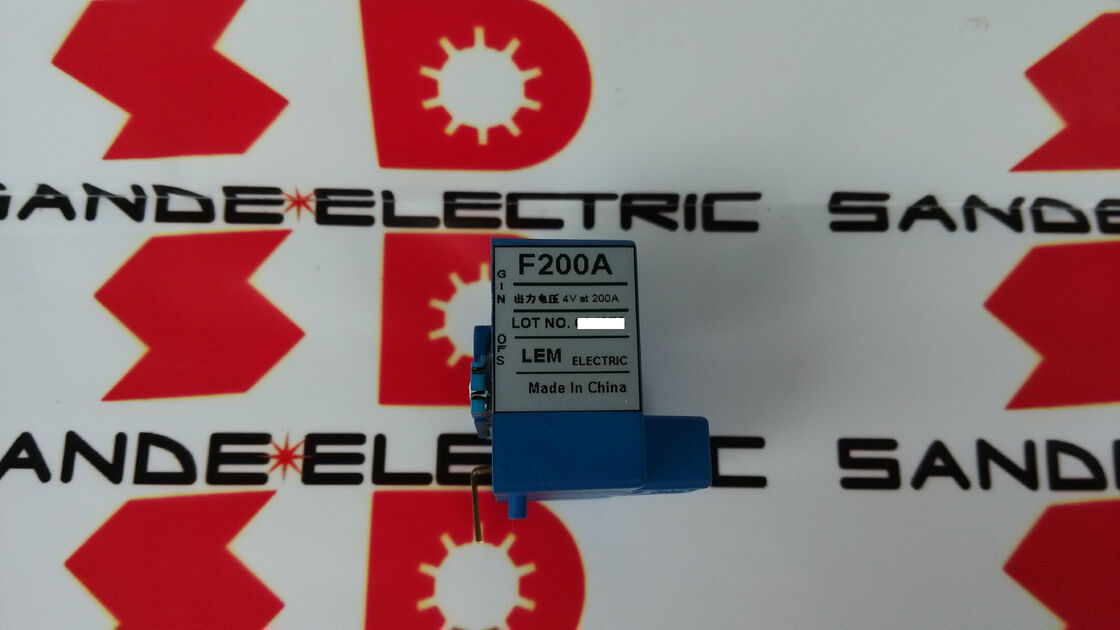
F200A Current Sensor for Industrial Control
Overview
The F200A is best positioned as a current sensor or current transformer used in industrial control and replacement applications. Publicly accessible spare-parts sources describe it as a current sensor within the transformer category, which makes it a practical fit for repair-oriented product pages focused on current feedback, cabinet servicing, and support for installed equipment rather than new-design catalog selection.
In practical terms, components in this class are usually sourced when a service team needs to restore current measurement or current-related feedback in a running system.
That makes the F200A relevant to maintenance departments, CNC repair channels, and industrial buyers who care more about correct replacement matching and dependable integration than about brochure-style feature claims.
Key Specifications
| Parameter |
Value |
| Model |
F200A |
| Product Type |
Current sensor / current transformer |
| Category |
Transformers |
| Typical Use |
Current feedback / industrial replacement |
| Weight |
Approx. 1.0 kg |
| Dimensions |
Approx. 3 × 4 × 3 cm |
| Market Positioning |
Legacy industrial spare part |
Current Feedback Role — Best Framed Conservatively
For industrial buyers, the value of the F200A lies in function rather than marketing language.
A current sensor in this category is normally used to support current monitoring, current feedback, or current-related protection behavior inside a machine or control assembly, so the most useful product-page wording is clear, careful, and replacement-focused.
That conservative positioning is especially important here because the publicly accessible data is limited.
When detailed OEM performance data is not available, engineers usually trust pages that stay close to what can actually be verified: model identity, device class, physical handling, and real-world replacement use.
Replacement Use — Why Exact Matching Matters
In older industrial systems, current sensors are often tied closely to the original control architecture.
Even when two parts seem similar in function, differences in fit, calibration context, or connection arrangement can create unnecessary risk during replacement, which is why exact part-number matching matters more than broad category similarity.
For that reason, the F200A is strongest as a maintenance and support item.
Buyers searching for it are usually trying to keep an existing machine running, restore a failed control path, or hold spare inventory for equipment that is already in service.
FAQ
Q1: What kind of product is F200A?
It is best described as a current sensor or current transformer used in industrial control and replacement work.
Public listings place it in the transformer/current-sensor category, which makes it suitable for systems where current-related feedback or monitoring is part of normal operation.
Q2: What applications is F200A suitable for?
It is suitable for repair, spare-parts replacement, and service support in industrial equipment where a current-sensing component is already part of the installed control architecture. In practice, devices like this are usually purchased to restore existing machine function rather than to serve as generic new-design measurement components.
Q3: Why is exact model verification important for this part?
Current sensors are often application-specific inside control cabinets and power assemblies. Even if another device appears similar, differences in fit or original system design can affect replacement success, so confirming the exact F200A marking before ordering is the safest engineering approach.
Q4: Is this product better suited to new projects or legacy support?
It is better suited to legacy support and replacement use. The public material available for this model comes through spare-parts channels, which usually indicates that buyers are sourcing it for maintenance continuity rather than for mainstream new-equipment specification.
Q5: How should F200A be presented on a product page?
The safest positioning is as an F200A current sensor for industrial control replacement and support. That wording is technically credible, commercially useful, and avoids over-claiming detailed performance data that is not publicly verified for the exact model.



 Your message must be between 20-3,000 characters!