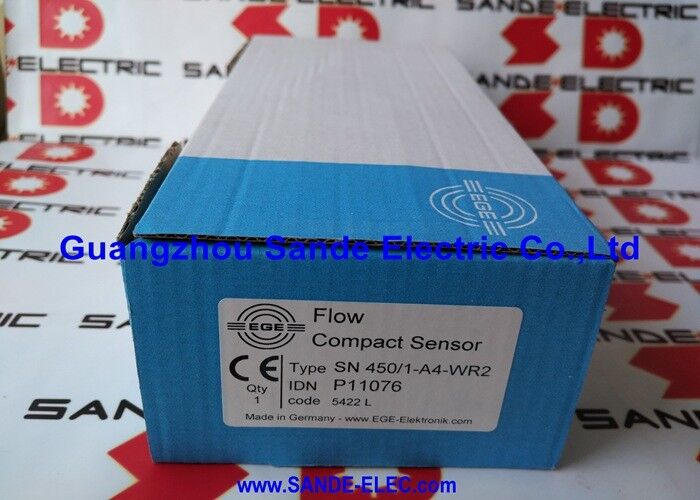
SN450/1-A4-WR2 Flow Sensor with Relay Output
Overview
The SN450/1-A4-WR2 is a compact screw-in flow sensor built for industrial monitoring of water- and oil-based media. Its G1/2 process connection, 48 mm sensor length, relay output, and 230 VAC supply make it well suited to machine systems that need dependable flow supervision without adding unnecessary control complexity.
The model sits in the SN 450 family, which is positioned for robust service in rough and corrosive environments where long-term stability matters.
In practical use, this type of sensor is chosen for cooling circuits, lubricant lines, process-water loops, and equipment protection functions where a simple switching signal is more useful than a continuous analog value.
That makes it a strong fit for industrial panels, utility skids, machine tools, and process assemblies that need a clear relay-based response when flow conditions move outside the expected range.
Key Specifications
| Parameter |
Value |
| Model |
SN 450/1-A4-WR2 |
| Product ID |
P11076 |
| Product Type |
Flow Sensor |
| Medium |
Water, Oil |
| Detection Range (Water) |
1 ... 150 cm/s |
| Detection Range (Oil) |
3 ... 300 cm/s |
| Process Connection |
G1/2 |
| Sensor Length (L) |
48 mm |
| Output Type |
Switching output |
| Output Function |
Relay / Change-over |
| Supply Voltage |
230 V AC ±15% |
| Max. Current Consumption |
30 mA |
Relay Output and AC Supply — Straightforward Panel Integration
One of the more practical advantages of this model is its relay output combined with 230 VAC operation. In real industrial installations, that combination simplifies integration with legacy control panels, interlock logic, and alarm circuits that are already built around AC control architecture.
Instead of converting sensor logic into another signal type, the installer can often wire the unit directly into the monitoring chain and keep the system design clean.
Because the unit is designed as a compact AC relay-output flow controller, it is especially useful where the goal is process protection rather than advanced data acquisition.
In many industrial setups, a stable switching response is exactly what the machine builder wants: enough information to confirm that cooling, lubrication, or process flow is present, without adding unnecessary programming overhead.
Water and Oil Monitoring — One Device, Broader Utility
The published detection ranges for both water and oil give this model broader application value than a sensor optimized for only one medium.
That matters in mixed industrial environments, where one product family may be used across several machine platforms with different fluids.
For maintenance teams and purchasing departments, that kind of flexibility can make spare-parts planning simpler and more consistent.
The G1/2 thread and 48 mm probe length also make the device easy to position in standard industrial pipework and compact process connections.
For OEMs and retrofit work alike, that balance between practical mechanical fit and durable monitoring function is a major reason sensors in this class remain widely used.
FAQ
Q1: What kind of applications is SN450/1-A4-WR2 best suited for?
It is best suited for flow supervision in cooling circuits, lubricant lines, utility water loops, and similar industrial systems where the control panel needs a reliable switching signal rather than a continuous process value.
In practice, it is often used as a protective or permissive device that confirms whether flow is present before a machine continues operating.
Q2: Why does this model list different ranges for water and oil?
The sensor responds to thermal flow conditions, so different media affect sensing behavior differently. Water removes heat more efficiently than oil, which is why the published operating range is lower for water and higher for oil.
This is normal for industrial flow sensors in this category and should be considered during application selection.
Q3: What is the practical benefit of the relay change-over output?
A relay change-over output gives the engineer flexible switching behavior for alarms, interlocks, and machine-permit logic.
It is especially useful in existing control systems where the designer wants a simple electrical contact rather than a low-level transistor signal or analog output.
Q4: Is this sensor suitable for demanding industrial environments?
Yes. The published specifications show IP67 protection, a compact industrial housing, and operating ranges that support typical machine-room and process-equipment conditions. That makes it suitable for day-to-day industrial use where moisture, vibration, and environmental variation are part of normal operation.
Q5: What should buyers verify before ordering?
Buyers should check the medium, required flow range, electrical supply, process thread, insertion length, and the way the relay output will be used in the control circuit.
For replacement work, confirming the exact part number and the original wiring concept is usually the safest approach



 Your message must be between 20-3,000 characters!