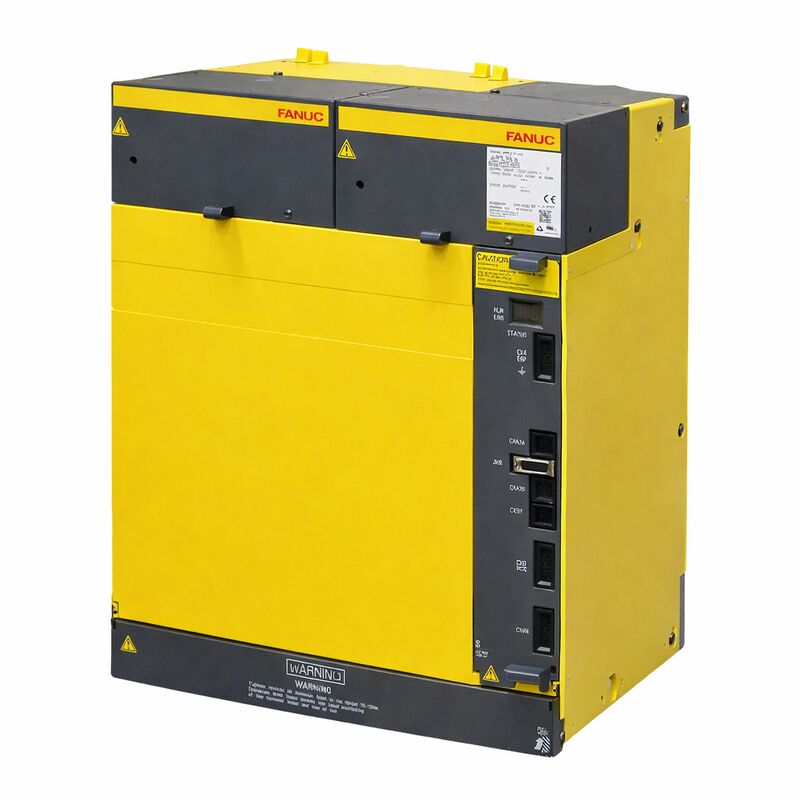
FANUC A06B-6200-H055 | Alpha i aiPS-55 Power Supply Module — 200–240V AC / 283–339V DC Output / 3-Phase
DC Bus Foundation for Alpha i Drive Systems
The A06B-6200-H055 is the aiPS-55 — the 55 kW class power supply module from FANUC's A06B-6200 Alpha i series. It accepts 200–240V AC three-phase mains input, rectifies and regulates to a 283–339V DC bus, and supplies that DC bus to the servo and spindle amplifier modules connected downstream.
Every Alpha i servo amplifier module (αiSVM) and spindle amplifier module (αiSPM) in the drive cabinet draws its operating power from this common DC bus. The PSM handles the shared power foundation for the entire drive system — sizing it correctly against the combined continuous demand of all connected drive modules is the critical installation decision.
The A06B-6200 series is the Alpha i generation, distinct from the earlier A06B-6087 (Alpha PSM) and A06B-6110 (Alpha i, lower power range). Confirm the correct series and power rating against the drive system's total continuous load before specifying a replacement.
Key Specifications
| Parameter |
Value |
| Part Number |
A06B-6200-H055 |
| Designation |
aiPS-55 |
| Rated Input |
200–240V AC, 3-phase |
| Frequency |
50/60 Hz |
| Rated Output |
283–339V DC |
| Series |
A06B-6200 (Alpha i) |
Regenerative Energy Recovery
The aiPS-55 is a regenerative power supply. When connected servo and spindle axes decelerate, the motors act as generators and return energy back to the DC bus. The aiPS-55 feeds this recovered energy back to the AC supply rather than dissipating it as heat through a brake resistor.
On machines with frequent heavy braking cycles — large-format machining centres, heavy turning centres — this regeneration actively reduces energy consumption and eliminates the thermal load that braking resistors introduce in the cabinet.
DC Bus Safety Note
The DC bus capacitors in the aiPS-55 retain dangerous voltage for several minutes after mains power is removed. The charge indicator LED on the module front face must be fully extinguished before any work on the drive system wiring or connected modules. Do not measure DC bus voltage or connect/disconnect drive modules until the LED is off and a further short waiting period has elapsed.
FAQ
Q1: What is the difference between A06B-6200-H055 and earlier Alpha PSM modules?
The A06B-6200 is the Alpha i series PSM — designed for the later Alpha i servo and spindle amplifier modules. The A06B-6087 (Alpha PSM) and A06B-6110 (Alpha i lower power) are different series. The DC bus output voltage range is similar across generations (283–339V), but the modules are not interchangeable — each series is matched to its specific generation of drive modules.
Q2: What does aiPS-55 indicate about the module's capacity?
The 55 designation identifies the module's power class within the aiPS series. Higher numbers indicate greater power capacity for larger drive cabinet configurations with more or higher-current axes. Select the PSM power rating based on the sum of continuous power demand from all connected αiSVM and αiSPM modules under normal production conditions.
Q3: Does the aiPS-55 require a separate braking resistor?
No. The aiPS-55 includes active regeneration — it returns deceleration energy to the AC supply rather than requiring a brake resistor to dissipate it as heat. A brake resistor is only needed on non-regenerative PSM variants. The aiPS-55's regenerative architecture also means there is no brake resistor to size or thermally protect in the cabinet design.
Q4: The drive system shows a bus undervoltage alarm. Could the PSM be at fault?
Bus undervoltage can originate from the PSM, the incoming AC supply, or from a connected drive module drawing excessive current. Check the incoming AC supply voltage at the PSM input terminals first. If supply voltage is correct, verify no single drive module is drawing abnormally high current (a short in one connected module loads the bus). If the PSM fails to maintain bus voltage under normal load, the PSM itself requires service.
Q5: Does replacing the A06B-6200-H055 require any CNC parameter changes?
No. The PSM stores no CNC parameters. After physical replacement, restore mains power and verify the DC bus voltage at the connected drive modules before enabling axes. Confirm all fibre connections between the PSM, drive modules, and CNC are correctly seated before the first power-up.


 Your message must be between 20-3,000 characters!