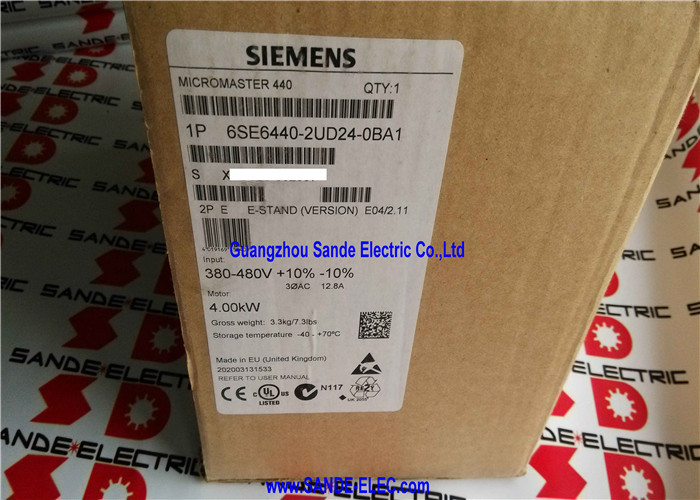
Siemens 6SE6440-2UD24-0BA1 | MICROMASTER 440 — 4 kW / 5 hp, 3AC 380–480V, 10.2A Output, IP20, Frame FSB, V/Hz and Sensorless Vector Control
Overview
The Siemens 6SE6440-2UD24-0BA1 is the 4 kW constant-torque variant of the MICROMASTER 440 in Frame Size B — the compact entry of the FSB mechanical format that places this drive's complete feature set within a housing measuring just 202mm tall, 149mm wide, and 172mm deep.
At 3.3 kg and fitting comfortably in a standard DIN-panel slot, it brings the full MM440 capability — six programmable digital inputs, bidirectional analog I/O, sensorless vector control, comprehensive motor protection, and RS-485 communication — to the 4 kW motor class that appears throughout light industrial machinery, process equipment, and HVAC systems.
What the MM440 delivered when it was released — and what still makes it relevant in installed-base maintenance — was a meaningful step up in control quality from simpler drives in its class.
The sensorless vector mode allowed 4 kW motors to develop full torque at very low speeds and respond quickly to load transients, without the shaft encoder that a true closed-loop vector drive would require.
For conveyors starting under load, small compressors, and mixer drives where the load torque profile varies significantly, this meant better speed holding and more reliable starts than V/Hz control alone could provide.
The FSB frame positions this drive neatly below the FSC frame (used for 5.5–11 kW variants in the MM440 range).
Both share the same depth and width form factor, allowing multiple drives of different ratings to sit side by side in a standard panel rail with consistent panel cutout profiles — a practical detail that simplifies panel layout when multiple drive sizes are needed for different motors in the same machine.
The -2UD24- designation in the part number identifies this as the unfiltered variant (no built-in EMC filter) at 4 kW, 380–480V.
Installations requiring conducted emission compliance at the point of installation add an external line filter sized to the drive's input current.
Key Specifications
| Parameter |
Value |
| Rated Power (HO / CT) |
4 kW / 5 hp |
| Rated Power (LO / VT) |
4 kW |
| Input |
3AC, 380–480V ±10%, 47–63Hz |
| Input Current (HO) |
12.8A |
| Output Current (HO) |
10.2A |
| Frame Size |
FSB |
| Dimensions (H×W×D) |
202×149×172mm |
| Weight |
3.3 kg |
| Protection |
IP20 |
| Ambient Temperature |
−10 to +50°C |
| Overload |
150% / 60s; 200% / 3s |
| Output Frequency |
0–650Hz (V/Hz) |
| Efficiency |
0.96 |
| Digital Inputs |
6 × isolated |
| Relay Outputs |
3 × programmable |
| EMC Filter |
Not included |
I/O Configuration and Machine Integration
The MM440's I/O complement at this power level is identical to larger MM440 variants — a deliberate design choice by Siemens that avoided a stripped-down I/O architecture for smaller drives.
Six isolated digital inputs, two analog inputs (voltage or current, switchable by DIP), two analog outputs (0–20mA), and three relay outputs give the panel designer the same wiring flexibility at 4 kW that they have at 11 kW.
In a typical machine installation, the digital inputs handle: start/stop command (DI1), run direction (DI2), JOG function (DI3), external fault input (DI4), setpoint source switching (DI5), and fixed frequency selection (DI6).
These default assignments are all parameterisable — any input can be reassigned through the parameter list to suit the specific machine's control logic without requiring external relay or wiring logic.
The two analog inputs provide setpoint commands from the machine's PLC (process variable or speed reference on AI1) and feedback or trimming signals (AI2), while the two analog outputs deliver actual speed and output current signals back to the supervisory system for monitoring or process control loop closure.
Three relay outputs handle motor-running, fault, and at-setpoint status indications to the PLC's digital inputs.
Protection Functions — Motor and Drive Safety
The MM440 integrates a multi-layer protection architecture that reduces the external relay protection components required in the switchboard.
At the motor level, the PTC/KTY interface allows direct connection of the motor's thermal sensor, giving the drive real-time motor winding temperature data for overheat warning and trip before insulation damage occurs.
Electronic thermal overload (I²t function) monitors the ratio of actual output current to motor rated current, accumulating a thermal model that approximates the motor bimetallic relay. When the accumulated thermal stress exceeds the configurable limit, the drive warns then trips.
This function adapts automatically to the reduced cooling airflow at low operating speeds — a condition where fixed overcurrent relays cannot provide adequate protection because the motor's thermal capacity is reduced by the lower cooling airflow from a shaft-mounted fan.
On the power electronics side, the drive protects itself from short circuits (output phase-to-phase and phase-to-ground), DC bus overvoltage (from regenerative energy during deceleration), undervoltage (from supply sags), and IGBT overtemperature.
The overtemperature protection responds to the drive's internal heat sink temperature sensor and initiates controlled shutdown before thermal damage occurs to the output power stage.
FAQ
Q1: The squared torque power and constant torque power are both listed as 4 kW. What does this mean for pump and fan applications?
For most MM440 models, the variable-torque (LO) rating allows a larger motor to be driven than the constant-torque (HO) rating — for example, 5.5 kW in LO vs 4 kW in HO for the next size up.
The 6SE6440-2UD24-0BA1 is an exception: both ratings are 4 kW, meaning this frame does not offer a larger motor in variable-torque mode.
The 4 kW motor rating applies regardless of whether the load is constant-torque or fan/pump. For applications requiring a 5.5 kW pump motor, the next model (6SE6440-2UD25-5CA1) must be specified.
Q2: The drive is supplied without an operator panel. Can parameters be set without a BOP or AOP?
The drive's parameter set can be accessed via the RS-485 serial interface using SIEMENS' STARTER or DriveMonitor PC software — no physical operator panel is required for commissioning in installations where a laptop connection is available at the drive.
For field access without a PC, the BOP (Basic Operator Panel, 6SE6400-0BP00-0AA0) or AOP (Advanced Operator Panel) can be plugged into the front of the drive at any time. The BOP allows parameter navigation and value change through its pushbutton interface and 5-digit LED display.
The AOP provides a plain-text menu display and can store up to ten complete parameter sets for download to replacement drives.
Q3: Can the MM440 drive be run in closed-loop speed control with a shaft encoder, or is it limited to sensorless operation?
The base MM440 drive (without optional encoder board) is limited to sensorless vector control and V/Hz control.
Closed-loop speed control with a shaft encoder (true vector control) requires the optional CB15 encoder board to be installed in the drive's option port.
The encoder board accepts TTL/RS422 incremental encoder signals and provides the speed feedback for the closed-loop velocity controller.
Most applications at this power level use sensorless vector control, which provides adequate speed regulation without a shaft encoder — typically ±0.5% speed regulation under varying load, sufficient for most conveyor, pump, and mixer applications.
Q4: What is the minimum installation clearance required above and below the drive for adequate cooling?
The MM440 FSB frame uses a convection and forced-air cooling path that runs vertically through the drive.
A minimum clearance of 100mm (approximately 4 inches) above and below the drive is required for adequate airflow.
Inadequate clearance causes the drive's heat sink temperature to rise above the design operating point, which the drive's overtemperature monitoring detects and responds to with output current derating or shutdown.
In tight panels where 100mm clearance is not achievable, the drive must be rated for the derating conditions documented in the MM440 operating instructions.
Q5: The drive's output frequency extends to 650 Hz. Is this useful, and what applications require it?
The 650 Hz maximum output frequency is relevant for high-speed motor applications — spindle drives running 2-pole motors at speeds above the standard 50/60 Hz base speed, specialized centrifuge drives, some textile machinery, and test bench applications.
For most standard 4-pole industrial motors running up to their nameplate speed (typically 1450–1480 rpm at 50 Hz), the 50 Hz output range is the normal working range.
The 650 Hz capability is available but requires appropriate motor selection — standard industrial induction motors are not designed for operation above their nameplate frequency without derating and careful consideration of bearing lubrication, mechanical resonance, and insulation class.



 Your message must be between 20-3,000 characters!