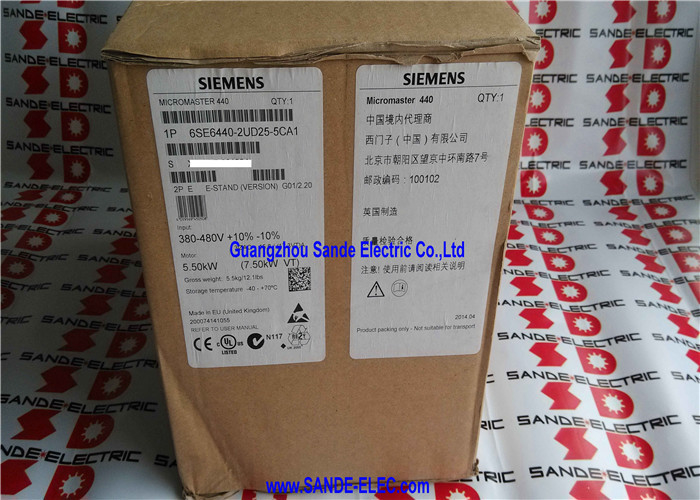
Siemens 6SE6440-2UD25-5CA1 | MICROMASTER 440 — 5.5 kW / 7.5 hp (HO), 7.5 kW / 10 hp (LO), 3AC 380–480V, IP20, No Filter, V/Hz and Sensorless Vector Control
Overview
The Siemens 6SE6440-2UD25-5CA1 is the 5.5 kW (constant-torque) MICROMASTER 440 — a well-established three-phase variable frequency drive from Siemens' most capable compact drive generation, sharing its FSC mechanical frame and full I/O complement with the 11 kW variant but sized for the motor range from 4 to 5.5 kW in constant-torque service and up to 7.5 kW in variable-torque fan and pump applications.
The 5.5 kW rating occupies a particularly common position in industrial machine design. Motors in this power band are found on medium-sized conveyor sections, small-to-medium-sized pump stages, compressor units, extruder auxiliary drives, and a wide variety of process machinery where the load requires more than a fractional kilowatt drive but falls below the larger power ranges where cabinet-mounted dedicated drive assemblies become standard.
The MM440 FSC frame — 245mm tall, 185mm wide, 195mm deep — is compact enough to fit inside a standard control panel without dominating the available space, while still offering the full parameter set and I/O architecture of the larger MM440 variants.
The drive is supplied without an integrated EMC filter (-2UD- designation in the part number).
This is the standard specification for panel-mounted drives where EMC filtering is handled at the panel level by a common-mode choke or line filter external to the drive, for installations where the applicable standard does not require conducted emission filtering, or where the supply configuration (IT or TT network) makes a built-in filter inappropriate. The 5.5 kW filtered version (-2AD- prefix) is available where on-board filtering is required.
Key Specifications
| Parameter |
Value |
| Rated Power (HO / CT) |
5.5 kW / 7.5 hp |
| Rated Power (LO / VT) |
7.5 kW / 10 hp |
| Input |
3AC, 380–480V ±10%, 47–63Hz |
| Input Current (HO) |
15.6A |
| Input Current (LO/VT) |
17.3A |
| Output Current (HO/CT) |
13.2A |
| Output Current (LO/VT) |
19A |
| Frame Size |
FSC |
| Dimensions (H×W×D) |
245×185×195mm |
| Weight |
5.5 kg |
| Protection |
IP20 |
| Ambient Temperature |
−10 to +50°C |
| Overload (HO) |
150% for 60s / 200% for 3s |
| Control |
V/Hz, quadratic V/Hz, sensorless vector |
| Digital Inputs |
6 × isolated, programmable |
| Analog Inputs |
2 × (V or mA) |
| Relay Outputs |
3 × programmable |
| EMC Filter |
Not included |
From Setpoint to Speed — How the MM440 Drives a Motor
The MICROMASTER 440's signal path from external command to actual motor speed runs through a defined sequence of processing stages that together determine how the drive behaves under varying operating conditions.
The setpoint source can be any one of several inputs: an analog voltage or current signal from a PLC analog output card, a fixed frequency selected by digital inputs, the drive's internal motorised potentiometer (which increases or decreases the setpoint by sustained activation of two digital inputs), an RS-485 serial setpoint from a PLC over the USS protocol, or the drive's own keypad via the optional BOP or AOP operator panel.
These sources can be combined — for example, a main analog setpoint summed with a trim signal from a second analog input.
The selected setpoint feeds through the programmable ramp generator, which limits the rate of speed change to configured acceleration and deceleration times.
Ramp-up and ramp-down times are independently settable, and the MM440 supports rounding (S-curve) at the start and end of the ramp to smooth the transition between steady state and acceleration, reducing mechanical stress on the driven machine.
The processed setpoint then enters the control algorithm — V/Hz or sensorless vector — which computes the required output voltage and frequency.
The drive's IGBT output stage generates the three-phase PWM output at the selected pulse frequency (4–16 kHz), with higher pulse frequencies giving quieter motor operation at the cost of slightly increased drive heat dissipation and the need for output current derating at higher temperatures.
Motor Protection Functions
The MM440 integrates a comprehensive set of motor protection functions that reduce the need for separate protection relays in the drive's panel wiring:
Electronic thermal overload protection (I²t function) continuously integrates the ratio of actual output current to rated motor current and trips the drive if accumulated thermal stress exceeds a configurable limit.
This function approximates the thermal behaviour of a motor bimetallic overload relay, but adapts faster to variable-speed operation where the reduced cooling airflow at low speeds changes the motor's thermal time constant.
PTC/KTY motor temperature monitoring allows direct connection of the motor's internal temperature sensor to the drive.
A PTC thermistor presents a characteristic resistance jump above its rated temperature; the drive detects this and can generate a warning or trip before the motor's winding insulation is damaged.
A KTY (silicon temperature sensor) provides a linear resistance-temperature characteristic for continuous temperature display and more precise threshold setting.
Stall protection monitors the relationship between output frequency and motor speed (inferred from the current model in sensorless vector mode) to detect stalled operation — a motor that has stopped moving despite the drive continuing to output current.
Stall trips prevent the sustained overcurrent that occurs when a drive continues to apply full slip current to a stalled motor.
Overvoltage and undervoltage monitoring on the DC bus protects the drive's power components from high-voltage excursions caused by regenerative braking (if no braking resistor is fitted) and from supply sags that could cause loss of control.
FAQ
Q1: The output current rating is 13.2A in CT mode and 19A in VT mode. How do I select which rating applies to my application?
The rating that applies depends on the motor's load characteristic. Constant-torque (CT/HO) mode — 13.2A — applies when the load requires approximately the same torque regardless of speed: conveyors, compressors, positive-displacement pumps, mixers, extruders.
Variable-torque (VT/LO) mode — 19A — applies when the load torque rises with the square of speed: centrifugal fans, centrifugal pumps, blowers.
In CT mode, the drive's overload capability (150% for 60s) ensures starting torque margin.
In VT mode, the overload is reduced (typically 110% for 60s) but the higher continuous current handles the larger motor rating.
Q2: What does the pulse frequency setting affect, and when should it be changed from the factory default?
The default pulse frequency is 4 kHz, which minimises drive switching losses and maximises output current capacity. Increasing the pulse frequency to 8 or 16 kHz reduces the audible electromagnetic noise from the motor (the characteristic switching frequency hum), which matters in noise-sensitive environments.
However, higher pulse frequencies increase drive heat dissipation and require output current derating — at 16 kHz, the MM440 FSC frame's output current capacity is reduced below the rated value.
A good practical compromise for most machine drives is 8 kHz, which gives significantly quieter operation with modest derating.
The MM440 parameter list provides the derating factor for each pulse frequency setting.
Q3: The drive has 6 digital inputs. Can all of them be reconfigured to non-default functions?
Yes. All six digital inputs (DI1–DI6) are fully programmable through the parameter list (P0701–P0706).
Factory default assignments include on/off1 (DI1), reverse (DI2), JOG (DI3), and fault reset (DI4/DI5), but any digital input can be reassigned to any available drive control function — including fixed frequency selection, setpoint source switching, PID enable, external fault input, and numerous motor control functions.
This flexibility eliminates the need for external rewiring logic in many applications where the standard function assignments do not match the machine's control architecture.
Q4: Is the MICROMASTER 440 suitable for hoisting or crane applications?
The MM440 can be applied to hoisting duties with appropriate engineering but is not a dedicated hoist drive.
Key considerations: the drive must have a braking resistor connected (via the built-in braking chopper) to handle regenerative energy during lowering with suspended loads — the MM440 cannot return energy to the mains and without a braking resistor will trip on DC bus overvoltage during deceleration.
The drive's sensorless vector control mode provides better low-speed torque for smooth load handling.
For safety-critical hoisting with fail-safe brake control, electromagnetic holding brake management, and the certified safety functions required by hoisting regulations, a dedicated hoisting drive or a SINAMICS variant with integrated safety functions may be the more appropriate specification.
Q5: The drive is discontinued. What is the current Siemens equivalent?
Siemens has positioned the SINAMICS G120 and G120C as the successors to the MICROMASTER 440.
The G120 in a Control Unit + Power Module configuration provides equivalent V/Hz and sensorless vector control, with PROFIBUS and PROFINET communication options, improved safety function integration, and a more modular design.
The G120C (compact) provides similar functionality in a more integrated housing. Both are active products with full Siemens support.
For a 5.5 kW, 380–480V, constant-torque application equivalent to the 6SE6440-2UD25-5CA1, the appropriate G120 or G120C ordering configuration should be confirmed using Siemens' online product configurator.


 Your message must be between 20-3,000 characters!