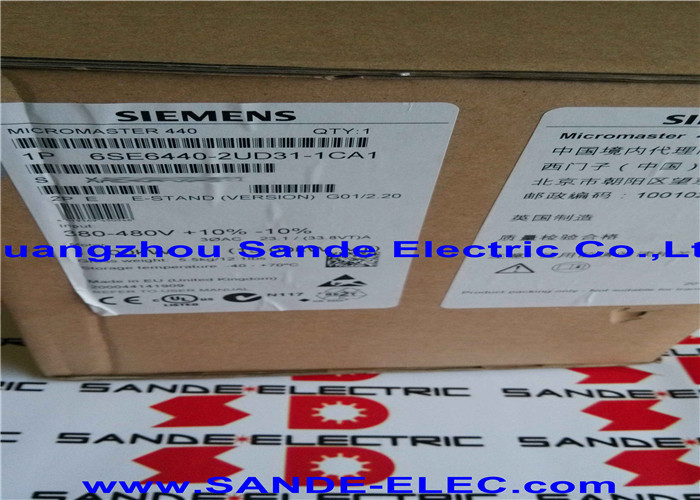
Siemens 6SE6440-2UD31-1CA1 | MICROMASTER 440 — 11 kW / 15 hp, 3AC 380–480V, 26A (CT) / 32A (VT), IP20, No Filter, V/Hz and Vector Control
Overview
The Siemens 6SE6440-2UD31-1CA1 is the 11 kW constant-torque variant of the MICROMASTER 440 — Siemens' flagship general-purpose variable frequency drive from a product generation that established itself across global industrial installations through the 2000s and 2010s.
The MM440 represented Siemens' most capable offering in the compact drive segment: broader than the MM420 in its control capabilities (adding sensorless vector control to V/Hz), and more flexible than the MM430 (which was optimised for fan and pump applications and lacked the high-overload ratings needed for constant-torque loads).
The 11 kW FSC-frame variant in this part number sits comfortably in the middle of the MM440 power range, addressing the motor sizes most commonly found on conveyor systems, compressors, centrifugal pumps, mixers, and general factory machinery.
At 26A output current in constant-torque (high-overload) mode and 32A in variable-torque (low-overload) mode, the drive's current capacity is correctly matched to an 11 kW motor in HO service and a 15 kW motor in LO applications.
The overload specification — 150% for 60 seconds and 200% for 3 seconds in HO mode — reflects the drive's ability to handle the transient current demands of loaded conveyor starts, compressor kick-starts, and other momentary high-inertia acceleration scenarios without tripping or deration.
For pump and fan applications where the load torque rises with the square of speed, the LO rating allows a more economical selection of the next drive size down compared to specifying for constant-torque duty.
The drive is supplied without an EMC filter (-2UD- in the part number), which is the correct specification for installations where an external line filter is provided at the switchgear level, where the supply network already has filtering, or where the applicable EMC standard does not require conducted emission filtering at the drive.
Where EMC compliance at the point of installation is required — typically in installations subject to EN 61800-3 Category C2 requirements — either an external filter is added to the supply cable, or the filtered variant (-2AD- prefix) of the same rating should be specified.
Key Specifications
| Parameter |
Value |
| Rated Power (HO / CT) |
11 kW / 15 hp |
| Rated Power (LO / VT) |
15 kW / 20 hp |
| Input |
3AC, 380–480V ±10%, 47–63Hz |
| Input Current (HO) |
23.1A |
| Input Current (LO/VT) |
33.8A |
| Output Current (HO/CT) |
26A |
| Output Current (LO/VT) |
32A |
| Frame Size |
FSC |
| Dimensions (H×W×D) |
245×185×195mm |
| Protection |
IP20 |
| Ambient Temperature |
−10 to +50°C |
| Overload (HO) |
150% for 60s / 200% for 3s |
| Control |
V/Hz, quadratic V/Hz, sensorless vector |
| Digital Inputs |
6 × isolated |
| Analog Inputs |
2 × (V or mA) |
| Relay Outputs |
3 × programmable |
| EMC Filter |
Not included |
Control Modes — V/Hz and Sensorless Vector
The MM440's control architecture supports two principal control modes, selectable through parameterisation:
V/Hz control maintains a constant ratio between output voltage and output frequency, approximating the motor's magnetisation curve.
Linear V/Hz is appropriate for constant-torque applications (conveyors, compressors) where the motor must develop full torque across the operating speed range.
Quadratic V/Hz — also called square-law V/Hz — reduces voltage at lower speeds in proportion to the square of frequency, matching the torque-speed characteristic of centrifugal fans and pumps and reducing motor losses at partial load.
Sensorless vector control (also called flux current control or FCC in Siemens literature) computes a real-time model of the motor's magnetic flux state and controls the output current vector to maintain optimal flux orientation without a shaft encoder.
This provides significantly better low-speed torque production, faster dynamic response to load changes, and the ability to develop maximum torque at or near zero speed — capabilities that V/Hz control cannot match.
Sensorless vector control requires a motor identification run (auto-tune) during commissioning to populate the drive's motor model with the specific motor's resistance, inductance, and slip parameters.
For most conveyor, mixer, and compressor applications, V/Hz control with appropriate motor data entry is sufficient.
For applications requiring tight speed regulation across varying loads, good starting torque at low speed, or the fastest possible response to load disturbances, sensorless vector control is the better operating mode.
I/O Architecture and Application Flexibility
The MM440's I/O complement is substantially richer than simpler drives in its class. Six isolated digital inputs, configurable through the parameter set, control functions including start/stop, direction reversal, setpoint source selection, fault reset, JOG, and fixed frequency selection.
Unlike drives where digital inputs have fixed factory functions and require external rewiring to change them, the MM440's digital inputs are fully reassignable through parameters — each input can be mapped to any available drive function from the parameter list.
Two analog inputs accept either voltage (0–10V) or current (0–20mA) signals, with the input type selected by DIP switch rather than requiring different hardware variants for different setpoint signal types.
Either input can alternatively be used as an additional digital input when a binary signal is connected — giving the drive effectively eight digital inputs when the analog channels are not needed for analog setpoint or feedback.
Three relay outputs with 30V DC / 5A or 250V AC / 2A ratings signal drive status conditions — run/stop, fault, at-setpoint, or user-defined functions — to the machine's PLC or control relay circuits.
The PTC/KTY motor temperature monitoring input connects directly to the motor's thermal protection sensor, enabling the drive to monitor motor temperature in real time and reduce speed or trip before thermal damage occurs.
FAQ
Q1: The drive is rated for 11 kW in constant-torque (HO) mode and 15 kW in variable-torque (LO) mode. Which rating applies for a conveyor application?
Conveyors are constant-torque loads — the required torque is approximately constant across the speed range regardless of speed.
This means the HO (high-overload) rating applies: the motor must be rated at or below 11 kW, and the drive will provide 26A maximum continuous output current with 150% overload capability for 60 seconds.
If the motor is 15 kW and the application profile is purely fan or pump-type (torque rising with speed squared, low starting torque), then LO mode at 32A applies — but this is an engineering decision based on actual load characteristic, not simply motor nameplate power.
Q2: The drive does not include an EMC filter. Is external filtering always necessary?
Not always. The requirement for an EMC filter depends on the installation's applicable EMC standard and the drive's deployment environment.
Industrial environments classified as Category C3 (restricted distribution, industrial zone) under EN 61800-3 often permit operation without conducted emission filtering provided the installation's supply network is not sensitive to high-frequency interference.
Category C2 environments — which include installations in the first environment (residential/light commercial) or where the supply is shared with sensitive equipment — typically require filtering.
Confirm the applicable category with the system's EMC engineer before deciding on the filter requirement.
Q3: What commissioning steps are required when installing the MM440 on a new motor?
Minimum commissioning requires entering the motor nameplate data into parameter group P0 (rated voltage, frequency, power, current, speed, power factor, and motor type).
Once motor data is entered, a Quick Commissioning procedure (P1910 parameter) performs a standing auto-tune to measure motor stator resistance and improve V/Hz accuracy.
For sensorless vector control, a rotating auto-tune (requiring the motor to run freely) measures rotor parameters and populates the full motor model.
After commissioning, verify the acceleration and deceleration ramp times (P1120/P1121) suit the application's inertia and speed range.
Q4: The drive has an RS-485 serial interface. What communication protocols does it support natively?
The MM440's built-in RS-485 interface supports the USS (Universal Serial Interface) protocol — Siemens' proprietary serial communication standard for drive control and parameterisation.
USS allows connection of multiple drives on a single RS-485 bus (up to 31 nodes at 19,200 baud, or fewer at higher baud rates), with the PLC or master controller polling each drive for status and sending setpoint commands.
For PROFIBUS DP connectivity — required for integration into SIMATIC S7 or other PROFIBUS-based control systems — the optional CB15 PROFIBUS communications module plugs into the drive's option port.
Q5: Can the 6SE6440-2UD31-1CA1 be upgraded from V/Hz to vector control after installation, or does that require a different drive?
Both V/Hz and sensorless vector control are software control modes within the same drive — switching between them is a parameter change (P1300), not a hardware change.
The drive arrives with V/Hz as the default (P1300 = 0), and can be changed to sensorless vector control (P1300 = 20) after performing the required auto-tune commissioning.
No additional hardware or firmware upgrade is needed.
The transition is reversible at any time.


 Your message must be between 20-3,000 characters!