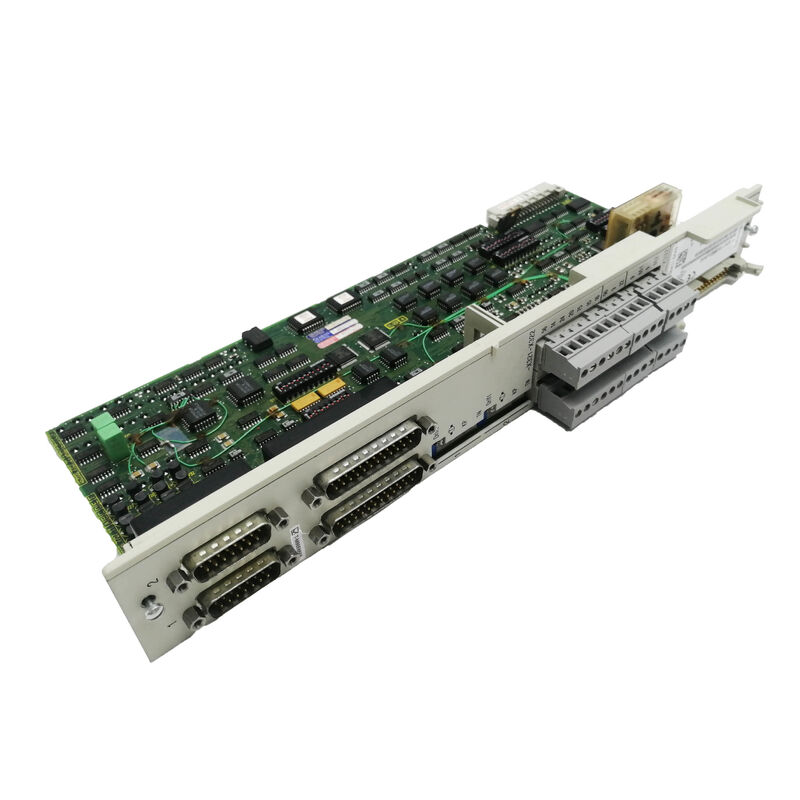
Siemens 6SN1118-0DK23-0AA2 — SIMODRIVE 611 Digital High Performance 2-Axis Control Loop Block with Direct Measuring System, Sin/Cos 1 Vpp
What This Module Is
The Siemens 6SN1118-0DK23-0AA2 is a two-axis, High Performance closed-loop control board for the SIMODRIVE 611 digital drive system. Siemens' official description for this order number is: SIMODRIVE 611 Digital Control Loop Block High Performance 2 Axes Sin/Cos 1 Vpp Direct Measuring System NC Software, Required from 06.04.09.
This control board is the intelligence inside a SIMODRIVE 611 drive axis. It plugs into the drive power section, processes encoder feedback from both the motor and a separate direct measuring system, runs the current and speed control loops digitally, and communicates with the CNC or host controller over the drive bus. The -0AA2 suffix identifies this as the latest hardware revision of the 0DK23 series — superseding the earlier -0AA1 revision — and is the correct replacement part for machines that originally specified either revision.
Verified Specifications
| Parameter |
Value |
| Siemens Order Number (MLFB) |
6SN1118-0DK23-0AA2 |
| Series |
SIMODRIVE 611 Digital |
| Performance Class |
High Performance |
| Number of Controlled Axes |
2 |
| Motor Encoder Interface |
Sin/Cos 1 Vpp |
| Direct Measuring System (DMS) |
Yes — Sin/Cos 1 Vpp |
| Minimum NC Software Version |
06.04.09 (SINUMERIK 6.4.9) |
| Compatible CNC Systems |
SINUMERIK 810D, 840D / 840D powerline |
| Installation Orientation |
Vertical |
| Operating Temperature |
0°C to +40°C |
| Storage Temperature |
−40°C to +70°C |
| Weight |
0.53 kg |
| Certifications |
CE, cULus |
The SIMODRIVE 611 Digital Architecture
SIMODRIVE 611 is Siemens' modular DC-bus drive system, built as a row of modules that share a common power bus inside the machine control cabinet. An infeed/regenerative module at one end of the row supplies the DC bus; individual power module and control board assemblies downstream each handle one or two motor axes. The control board is a separate plug-in unit within each drive module — physically removable and replaceable without disturbing the power wiring, motor cables, or encoder connections. This architecture is a practical advantage in the field: a faulty control board can be swapped in minutes, while the rest of the drive hardware stays in place.
In the SIMODRIVE 611 digital variant, the control boards are fully digital from encoder input through to drive bus output. There are no analog speed setpoint connections to an external CNC; instead, the SINUMERIK 840D or 810D communicates with each control board over a high-speed digital drive bus, downloading firmware into the board at every power-up and exchanging position, speed, and current data in real time during operation. This tight digital integration between CNC and drive is one of the defining characteristics of the SIMODRIVE 611 digital system and is the source of the precise synchronisation that high-end machining centres require.
High Performance Class: What It Means in Practice
Within the SIMODRIVE 611 digital range, control boards are available in two performance grades: High Standard and High Performance. The distinction is not cosmetic — there are concrete functional differences that determine which class a given machine requires.
The most significant difference is spindle motor support. Two-axis control with a 1PH main spindle motor (induction-type spindle) is only possible with the High Performance class. A High Standard two-axis board is restricted to feed drive (servo) motors on both channels. In a typical CNC machining centre where one drive module is shared between a feed axis and the main spindle, the High Performance board is mandatory.
High Performance boards also carry additional computational headroom that benefits high-dynamic feed applications — grinding machines, high-speed milling centres, and five-axis machining cells where the position loop bandwidth and current loop cycle time directly influence surface finish and contouring accuracy.
The 6SN1118-0DK23-0AA2 is the High Performance, 2-axis, with-DMS variant — the most capable configuration in the 0DK-series range.
Direct Measuring System: The Second Encoder Channel
The defining hardware feature of the 0DK23 relative to the 0DJ23 (its counterpart without DMS) is the Direct Measuring System interface. Every axis channel on the 6SN1118-0DK23-0AA2 accepts two encoder inputs simultaneously:
Motor encoder (indirect measuring): The sin/cos 1 Vpp encoder mounted on the motor shaft. This encoder feeds the speed and current control loops and provides the primary feedback signal for motor commutation and torque control.
Direct measuring system (linear or rotary scale): A second sin/cos 1 Vpp encoder physically located on the machine axis itself — a linear glass scale, magnetic scale, or a high-accuracy rotary encoder fitted to the ball screw or table. This signal feeds the position control loop at the CNC level.
The reason both exist simultaneously is the machine's thermal and mechanical compliance. Even a precision ballscrew stretches under load, its nut has backlash, and the entire mechanical transmission between motor shaft and table deforms slightly with temperature. A motor encoder alone measures motor shaft angle and infers table position through the known mechanical ratio — it cannot detect or correct for these transmission errors. The direct measuring system measures actual table position independently of the mechanical transmission, and the CNC closes the position loop on this signal while the drive board closes the speed loop on the motor encoder. The result is that thermal expansion, backlash, and leadscrew pitch errors are continuously corrected in real time, not just calibrated out at machine warm-up.
For precision machining operations — boring, jig grinding, fine turning, and multi-axis simultaneous contouring — the DMS capability of the 6SN1118-0DK23-0AA2 is essential. Machines specified without DMS capability cannot take advantage of linear scale feedback regardless of what scales are fitted mechanically; the control board must support it.
NC Software Requirement: Version 06.04.09 and Later
The specification note NC Software Required From 06.04.09 refers to a minimum SINUMERIK NC software release: version 6.4.9 of the SINUMERIK 810D or 840D CNC software. Control boards in this revision series introduced features — including specific DMS processing algorithms and drive bus protocol enhancements — that required corresponding NC software support. A CNC running an older software release will not correctly initialize or operate this control board.
This is a commissioning-level consideration, not a reason to avoid the module. Machines that were originally built with SINUMERIK 840D powerline systems have typically been running software well beyond version 6.4.9 for many years. The requirement primarily matters when sourcing a replacement board for an older machine: if the machine's NC software predates version 6.4.9, the software must be updated before or alongside the board replacement. This is standard maintenance practice for any SINUMERIK 840D CNC and is covered in Siemens' standard commissioning documentation.
Compatible Motor Families
The 6SN1118-0DK23-0AA2 supports the full range of Siemens servo and spindle motors used in the SIMODRIVE 611 digital system:
Synchronous servo motors (feed drives): 1FT6, 1FK6/1FK7, 1FN1, 1FN3 (linear motors), 1FE1 (built-in motors), 1FM6 (torque motors), 2SP1 (motor spindles)
Asynchronous induction motors (main spindle drives): 1PH4, 1PH6, 1PH7 — spindle motors. As noted above, two-axis 1PH spindle operation requires the High Performance class, which this board provides.
All of these motor families use sin/cos 1 Vpp encoder signals as standard, which matches the encoder interface of the 6SN1118-0DK23-0AA2.
Firmware Download Architecture
One practical aspect of the SIMODRIVE 611 digital system that catches engineers unfamiliar with it: the control board itself contains no persistent drive firmware. At every power-up or reset cycle, the SINUMERIK 840D downloads the complete drive software into the control board's RAM via the drive bus. The board is a hardware platform; the drive personality comes from the CNC.
This architecture has an important maintenance implication. Replacing the control board does not require loading software onto the new board. The CNC handles this automatically on the next power-up. What it does require is that the drive data — motor parameters, current limits, speed controller gains, encoder parameters, and all axis-specific settings — are correctly stored in the CNC's NC data set and will be re-written to the new board at startup. Before removing a faulty board, a data backup of the NC drive parameters to a PC Card or external medium is standard practice.
Variant Matrix — 0DK23 Series
| Order Number |
Performance Class |
DMS |
Axes |
Notes |
| 6SN1118-0DH23-0AA1 |
High Standard |
Yes |
2 |
Standard performance with DMS |
| 6SN1118-0DJ23-0AA1 |
High Performance |
No |
1 |
HP single-axis, no DMS |
| 6SN1118-0DK23-0AA1 |
High Performance |
Yes |
2 |
Earlier hardware revision |
| 6SN1118-0DK23-0AA2 |
High Performance |
Yes |
2 |
Current hardware revision |
The 6SN1118-0DK23-0AA2 is pin-for-pin and functionally compatible with the 6SN1118-0DK23-0AA1. Where the earlier -0AA1 revision is specified in a machine's replacement parts list, the -0AA2 is the correct modern equivalent.
FAQ
Q1: What is the difference between the 6SN1118-0DK23-0AA2 (High Performance) and the 6SN1118-0DH23-0AA2 (High Standard), and can one substitute for the other?
The core functional difference is spindle motor capability and processing performance. With the High Performance board (0DK23), two-axis operation using a 1PH induction-type main spindle motor on one of the channels is supported. With the High Standard board (0DH23), both channels are restricted to feed drive (servo) motors; a 1PH spindle motor on either axis is not permitted in a two-axis configuration. Both boards accept a Direct Measuring System on the 0DK23/0DH23 variants. In a machine that uses one channel for a feed axis and one for a main spindle motor, only the High Performance board (0DK23) is compatible — the High Standard board cannot substitute. In a machine that uses both channels purely for servo feed axes with no spindle motor involved, the two boards are functionally interchangeable, though it is always safer to replace like-for-like using the same performance class originally specified.
Q2: My machine has a direct measuring system (linear scales) on the axes, but they are not currently active. Does using this board automatically enable DMS, or is additional configuration required?
The 6SN1118-0DK23-0AA2 provides the hardware interface — the DMS encoder connector — but the function must be explicitly enabled in the SINUMERIK CNC configuration. The DMS input needs to be assigned to the correct axis in the drive machine data, and the position control loop must be switched from motor encoder to DMS feedback in the CNC axis parameters. If the machine was shipped with DMS hardware fitted but DMS control not activated, the board alone does not change the active feedback path. Enabling DMS requires a commissioning session covering axis machine data, encoder parameter assignment, and potentially speed/position controller retuning once the position loop is closed on the scale rather than the motor encoder. The relevant procedure is covered in the SINUMERIK 840D axis commissioning documentation.
Q3: The board requires NC software version 06.04.09. How do I check whether my SINUMERIK 840D meets this requirement?
The NC software version on a SINUMERIK 840D can be read from the operator panel by navigating to the system diagnostics display — typically accessible under the Service menu. The version string will be displayed in the format x.x.xx; a value of 6.4.09 or higher confirms compatibility. On 840D powerline systems, which introduced the powerline hardware generation in the early 2000s, software levels are typically well above this threshold on any machine maintained with periodic software updates. If the machine has been running older software on the original control board, a software update is necessary before installing the 6SN1118-0DK23-0AA2. In this situation, the NC data backup should be taken before the software update, not after, to ensure the parameter set is compatible.
Q4: Is this board compatible with both SINUMERIK 810D and 840D CNC systems?
Yes. The 6SN1118-0DK23-0AA2 is compatible with both SINUMERIK 810D and SINUMERIK 840D / 840D powerline CNC systems, provided both are running NC software version 6.4.9 or later. The SINUMERIK 810D integrates the NC, PLC, and drive interface on a single CCU hardware platform, while the 840D uses separate NCU modules, but both communicate with the SIMODRIVE 611 digital control boards using the same drive bus protocol. Board installation, axis commissioning, and parameter management follow the same procedures on both CNCs. If the machine is a SINUMERIK 810D, note that the maximum number of drive axes that can be connected to a single 810D CCU is more limited than on an 840D — consult the 810D hardware configuration data before adding axes.
Q5: Can a used or refurbished 6SN1118-0DK23-0AA2 be safely installed in a production machine, and what checks should be done before installation?
A refurbished or tested-used control board is a legitimate and widely used approach for SIMODRIVE 611 maintenance, given that the board holds no persistent data and receives its complete drive firmware from the CNC at power-up. The key conditions are: the board must have been tested under load on a SIMODRIVE 611 drive bus (not just powered up in isolation), all connector pins must be intact, and the board must show no visible signs of thermal stress, burnt components, or physical damage to the encoder connector area. Before installing any replacement board, back up the complete NC drive data to an external medium. After installation, confirm that the CNC downloads firmware to the board successfully at power-up, verify that both encoder channels are reading correctly using the CNC's diagnostic displays, and carry out an axis test run at reduced feedrate before returning the machine to full production. Do not perform a megohm test on the encoder signal connectors with the board fitted.


 Your message must be between 20-3,000 characters!