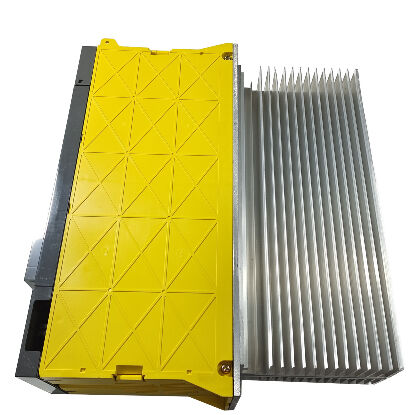
FANUC A06B-6079-H105 | Alpha Servo Amplifier Module SVM1-80 — Single Axis, 4.75 kW, 18.7 A Rated Output, 230 V Max Output, Alpha Series, Japan Origin
Part Number: A06B-6079-H105
Manufacturer: FANUC Corporation (Japan)
Product Category: Servo Amplifier Module — Alpha Series (SVM)
Model: SVM1-80
Manual Reference: B-65162
Overview
The FANUC A06B-6079-H105 is the SVM1-80 — a single-axis servo amplifier module from FANUC's original Alpha series drive system.
It is the specific amplifier module used to drive one servo axis in a FANUC Alpha series drive rack, controlling a compatible Alpha series AC servo motor in response to position and speed commands from the CNC controller via the FSSB (Fibre-optic Serial Servo Bus) or the earlier serial servo interface used with this generation.
The model designation SVM1-80 follows FANUC's Alpha series amplifier naming: SVM indicates servo amplifier module, 1 indicates single-axis configuration, and 80 indicates the amplifier's continuous output current class in the Alpha series numbering.
The A06B-6079 series covers single-axis Alpha series servo amplifier modules across the full current range produced by FANUC — the -H105 variant is the SVM1-80 within this family.
This module draws DC bus power from the shared PSM (Power Supply Module) in the same drive rack.
It converts this DC bus power to a three-phase AC output at variable frequency and voltage to drive its connected servo motor.
The output frequency and voltage are controlled precisely in real time by the CNC's servo control algorithm, which commands position, speed, and torque through the servo interface.
The Alpha series represents the first generation of FANUC's widely deployed digital servo drive system — a generation that brought FSSB optical communication, high-resolution pulse coder feedback, and integrated drive intelligence to FANUC machine tool applications. Many machines built on this generation remain in production today, making the SVM1-80 an active maintenance item globally.
Key Specifications
| Parameter |
Value |
| Model |
SVM1-80 |
| Axis Configuration |
Single axis |
| Rated Input Power |
4.75 kW |
| Maximum Output Voltage |
230 V |
| Rated Output Current (L-axis) |
18.7 A |
| Series |
Alpha (A06B-6079) |
| Manual |
B-65162 |
| Weight |
10 lb (approx. 4.5 kg) |
| Dimensions (H × L × W) |
8 × 21 × 18 in |
| Origin |
Japan |
Single-Axis Architecture
The SVM1-80 controls one servo axis — one motor, one motion axis on the machine. This is the simplest and most physically specific servo amplifier configuration: a direct one-to-one relationship between amplifier and motor.
FANUC also produces dual-axis servo amplifier modules (SVM2) that handle two axes within a single module enclosure — a compact configuration that reduces the number of modules in the drive rack.
The single-axis SVM1 is used when the motor's power requirement makes a single-axis dedicated module the appropriate choice, or when the machine configuration calls for individual axis modules rather than shared dual-axis units.
In the drive rack, the SVM1-80 installs alongside other SVM and SPM modules, all connected to the common DC bus from the PSM module.
Each SVM1-80 handles its own axis's motor control entirely independently — it receives torque and speed reference data from the CNC and implements the servo control loop using feedback from the motor's pulse coder.
The CNC's axis control software operates at the system level; the physical current control, PWM switching, and motor flux management all execute within the SVM1-80 module itself.
Motor Compatibility
The SVM1-80 is designed to work with compatible Alpha series servo motors.
The 18.7 A rated output current and 230 V maximum output determine which motor ratings are appropriate for this amplifier:
The current rating represents the amplifier's continuous safe output current.
Instantaneous peak currents during acceleration exceed the rated continuous value — FANUC's amplifier design accounts for this headroom in the motor-amplifier matching specification.
The motor and amplifier must be matched using FANUC's motor-amplifier pairing tables, which account for both the motor's current requirements and the amplifier's current capacity across the full speed-torque curve.
An undersized amplifier (too little current for the motor's demand) will trip on overcurrent during heavy acceleration.
An oversized amplifier (far more current capacity than the motor needs) introduces unnecessary cost and rack space.
Correct sizing targets the amplifier's rated current near the motor's continuous stall current requirement.
Integration in the Alpha Drive System
The A06B-6079-H105 occupies one slot in the Alpha series drive cabinet. Its physical dimensions (8 × 21 × 18 inches, 10 lb) determine the cabinet space it requires.
These dimensions are consistent with the Alpha series module form factor — modules are designed to be mounted side by side in a drive cabinet, sharing the DC bus and communicating individually with the CNC.
The drive system connection path for the SVM1-80:
Input: DC bus from PSM module via bus bar connection.
Motor output: Three-phase variable-frequency AC to the servo motor (U, V, W motor leads).
Feedback input: Pulse coder feedback from the servo motor encoder connector.
CNC interface: Serial servo interface (for original Alpha generation) or FSSB optical fibre (for installations using FSSB-capable CNCs).
Status/power signals: Control power from the PSM, emergency stop, ready signals.
FAQ
Q1: The SVM1-80 shows an SV alarm and the axis does not move. No other axes are affected. What is the first diagnostic step?
The SVM1-80's own LED or indicator will show an alarm number or pattern. Note the specific alarm code — FANUC Alpha series servo alarms are two-digit codes displayed on the amplifier module.
Look up the code in the B-65162 maintenance manual to identify the fault category: overcurrent, overvoltage, encoder feedback error, motor overload, or amplifier hardware fault.
This code directs the diagnosis to the motor, the feedback cable, the motor power cable, or the amplifier module itself.
Q2: The pulse coder cable was replaced but the SV431 (counting error) or feedback alarm persists. What should be checked?
Confirm the replacement cable is the correct part number for this motor and amplifier combination — incorrect pinout on the feedback cable connector produces exactly this symptom.
Check the cable shield connection at both ends; poor shielding allows noise injection into the encoder signal that triggers counting errors.
Inspect the pulse coder connector on the motor for bent or corroded pins.
If the alarm persists with a verified correct cable, the pulse coder itself or the feedback input circuit on the SVM1-80 may have failed.
Q3: Can the SVM1-80 (A06B-6079-H105) be replaced with an Alpha i series SVM amplifier?
Direct substitution of an Alpha i (SVMi) for an original Alpha (SVM) module is not a straightforward swap.
The Alpha i amplifiers have a different communication interface, different parameter structure, and different connector pinout from the original Alpha.
Replacing one Alpha series module with an Alpha i equivalent requires changes to the CNC's servo software configuration, potentially to the servo parameter settings, and verification of mechanical connector compatibility.
For a like-for-like replacement, source another A06B-6079-H105 or its direct equivalent within the A06B-6079 series.
Q4: The machine has been idle for several months. After restarting, the SVM1-80 shows an alarm immediately on power-up before any axis motion. What is likely?
Extended idle periods can lead to capacitor charge decay in the DC bus. On power-up after long storage, the PSM pre-charges the DC bus through inrush limiting.
If the pre-charge circuit or the PSM itself has an issue, the DC bus may not reach normal operating voltage, causing the SVM1-80 to see an undervoltage condition and alarm.
Also check that the emergency stop circuit is correctly released — many drive systems require a specific CNC ready state before the amplifiers arm themselves.
Confirm the power-up sequence is following the normal procedure for this drive system.
Q5: What are the heat dissipation requirements for the A06B-6079-H105 in the drive cabinet?
The SVM1-80 dissipates heat through its heat sink, which must have adequate airflow across it to prevent thermal overload.
In a standard Alpha series drive cabinet, the heat sink protrudes into the airflow channel at the rear of the cabinet, with the cabinet's cooling fan forcing air across all module heat sinks from bottom to top.
Confirm the cabinet's cooling fan is operational and that no airflow obstructions exist in the duct.
At full rated load (4.75 kW input, 18.7 A continuous output), the heat generated is significant.
Ambient cabinet temperature should not exceed the Alpha series specified operating range — typically 0–55°C depending on installation.


 Your message must be between 20-3,000 characters!