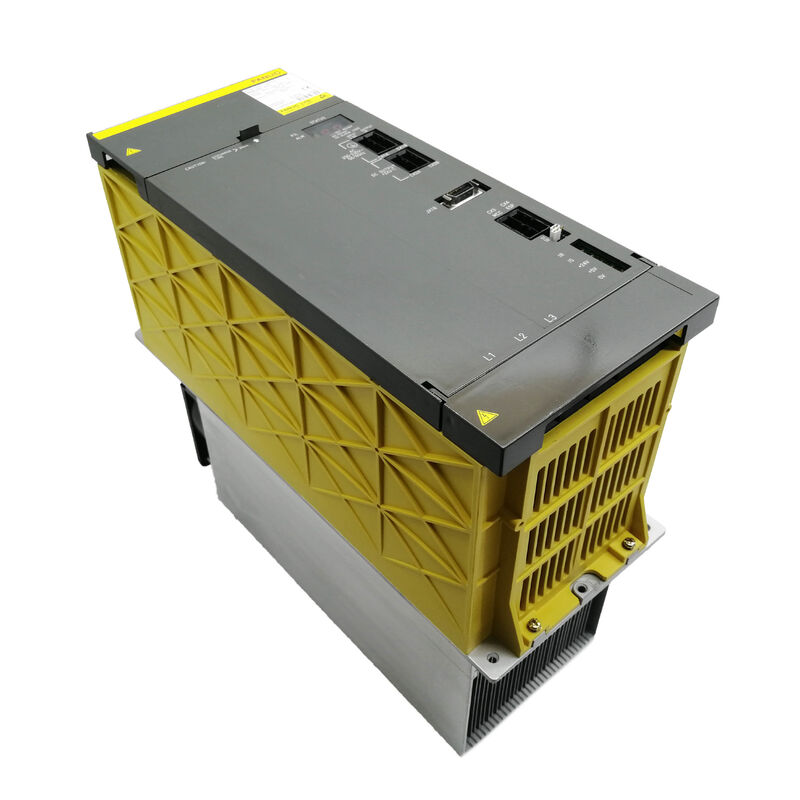
FANUC A06B-6088-H222#H500 Alpha Spindle Amplifier Module
SPM-22 | 25.2 kW | Type 1 Interface | Input 283–325 VDC | Output 230 VAC / 95A | Alpha aP40 / Model 22 Spindle Motor | 200V Series | Internal PCBs: A16B-2202-0432 + A20B-1006-0481
The Drive That Runs the Spindle
In the chain of hardware between the CNC control and a cutting spindle, the spindle amplifier module occupies the most demanding position. It takes DC bus power from the power supply module, converts it into precisely regulated three-phase AC at the commanded frequency and current, and delivers that to the spindle motor at whatever speed the control has requested — whether that's a slow 200 RPM for a threading pass or a full-speed 8,000 RPM finishing cut. Everything that defines spindle performance: acceleration to speed, speed accuracy under varying cutting loads, orientation stopping precision, and torque at the motor shaft — runs through this module.
The FANUC A06B-6088-H222#H500 is the SPM-22 variant within the A06B-6088 Alpha series: a 25.2 kW rated, Type 1 interface spindle amplifier for 200V AC systems, designed to drive FANUC's Alpha aP40 and Model 22 AC spindle motors. It is one of the most widely deployed spindle drives in the FANUC Alpha module family, and the machines that use it — machining centers, turning centers, and milling machines from the Alpha-era production period — remain active on shop floors globally.
Technical Specifications
| Parameter |
Value |
| Part Number |
A06B-6088-H222#H500 |
| Series |
FANUC Alpha SPM (Spindle Amplifier Module) |
| Model Designation |
SPM-22 |
| Interface Type |
Type 1 (simplest of the four Alpha SPM interface types) |
| Rated Power |
25.2 kW |
| DC Link Input Voltage |
283 – 325 VDC |
| AC Output Voltage |
230 VAC (maximum) |
| Rated Output Current |
95 A |
| Applicable Motors |
FANUC Alpha aP40, Model 22 AC spindle motors |
| Feedback Interface |
Standard Alpha sensor (M / MZ type) |
| Control PCB |
A16B-2202-0432 (or A16B-2203-033x) |
| Power PCB |
A20B-1006-0481 (or A20B-1006-0487) |
| External Cooling Fan |
A90L-0001-0335/B |
| Internal Cooling Fan |
A90L-0001-0422 |
| Operating Temperature |
0°C to +55°C |
| Storage Temperature |
−20°C to +60°C |
| Reference Manual |
B-65162 |
| Related Versions |
#H500, #H501, #H508, #500CS (software variants — not interchangeable) |
| Next SPM in series |
A06B-6088-H226 (SPM-26) |
The A06B-6088 Alpha Module Family: Where the H222 Sits
FANUC's Alpha module drive system organizes spindle amplifiers by their rated power output, with each "H-number" in the part number corresponding to the power class. The A06B-6088 series spans the full range of 200V Alpha spindle drives — from smaller units through the SPM-22 (22 kW designation, 25.2 kW actual rating) up to larger modules in the same cabinet-mount format.
Within that family, the H222 is the go-to drive for spindle motors in the 15–22 kW motor class. It's commonly found driving the aP40 spindle motor — a high-performance Alpha series AC spindle that appears on a wide range of machining centers from Japanese, German, and Taiwanese machine builders. Larger spindle motors require stepping up to the H226 (SPM-26) or H230 (SPM-30); smaller spindle requirements are handled by the H215 (SPM-15) or H211 (SPM-11).
All these modules share the same physical cabinet slot format and DC bus connection arrangement, which is part of what makes the Alpha module system practical for machine builders — the power supply module feeds the DC bus, servo amplifier modules and spindle amplifier modules draw from that bus, and the entire drive stack fits in a standardized enclosure layout.
Type 1 Interface: What It Means for System Integration
The #H500 suffix on this module identifies it as a Type 1 interface unit. FANUC classifies Alpha spindle amplifier modules into four interface types (1 through 4), with each type supporting progressively more advanced spindle functions:
Type 1 — the variant used in the H222#H500 — is the foundational interface. It supports the standard spindle control functions that the vast majority of machining center applications require: variable speed control, spindle orientation (M19), gear selection switching, spindle synchronization in basic configurations, and speed/position feedback to the CNC. The Type 1 interface communicates through the serial link between the CNC and the SPM and is compatible with the FANUC 0i, 6, 10, 11, 15, 16i, 18i, and 21i CNC control families that were current when this module generation was deployed.
What Type 1 does not support is the advanced Cs contour control (which requires Type 4 and a high-resolution magnetic sensor), and certain specialized synchronization modes. For the overwhelming majority of vertical and horizontal machining centers where this module is used, Type 1 capability is everything the application requires.
The significance for maintenance: when replacing an H222#H500, the replacement unit must also be Type 1 (#H500, #H501, or #H508 suffix) — a Type 3 or Type 4 variant cannot be substituted even if the rated power and motor match, because the interface connection and software are fundamentally different.
Internal PCBs: The Two Boards That Define the Module
Unlike a monolithic power drive, the A06B-6088-H222#H500 is built around two principal PCBs whose functions are distinct:
Control PCB (A16B-2202-0432 or A16B-2203-033x): This board handles the intelligence of the spindle drive — serial communication with the CNC, speed and position loop calculation, current command generation, alarm monitoring and reporting via the front-panel 7-segment display, and all parameter storage. When a spindle alarm occurs that is software or communication related (alarms in the AL-13 through AL-28 range), this is typically the board under scrutiny.
Power PCB (A20B-1006-0481 or A20B-1006-0487): This board manages the actual power conversion — the IGBT gate drive circuits, DC bus monitoring, current sensing, and the connection between the control board's current commands and the power stage that drives the motor. Alarm 12 (DC link overcurrent) and Alarm 30 (overcurrent power circuit) point toward the power PCB and its associated IGBT transistors.
FANUC specialists and reputable repair centers handle these boards as non-separable sub-components of the complete module — they are not sold or replaced independently. The module is serviced as a unit.
The #H500 Suffix and Software Version Compatibility
The suffix following the pound sign in FANUC part numbers for spindle amplifiers encodes the software version installed on the control PCB. For the H222 family, the documented Type 1 versions are:
- #H500 — the initial production software version, the most common in the installed base
- #H501 — a revised software version with updates to certain control parameters
- #H508 — a further software revision
These software versions are not interchangeable. A machine that was originally commissioned with an H222#H500 has its spindle parameters and CNC interface configuration matched to that software version. Installing an H222#H501 as a drop-in replacement requires parameter verification and may require adjustment to spindle tuning parameters at recommissioning. FANUC specialists uniformly advise specifying the exact suffix when ordering a replacement, and verifying the suffix on any unit received before installation.
The #500CS variant also appears in some supplier listings — this is a special specification variant and should be treated separately from the standard H500.
Common Alarm Codes and Their Diagnostic Direction
The 7-segment LED display on the front panel of the A06B-6088-H222#H500 shows two-digit alarm codes when a fault occurs. The most frequently encountered in the field:
AL-03 (DC Link Fuse Blown) and AL-04 (Input Fuse Blown): Often caused by motor phase-to-phase or phase-to-ground faults in the spindle motor winding. Standard diagnosis is to disconnect the U/V/W motor power leads and check megohm insulation to PE before condemning the drive.
AL-09 (Power Semiconductor Overheat) and AL-56 (Inner Cooling Fan Stopped): These point to cooling system issues — a failed 12mm external fan or a blocked/failed internal 60mm fan. Both fans are replaceable components and are the first check when these alarms appear.
AL-12 (DC Link Overcurrent) and AL-30 (Overcurrent Power Circuit): These are the most serious alarms, indicating IGBT transistor stress or failure. The diagnostic sequence documented by FANUC specialists starts with disconnecting the motor leads and commanding the spindle — if AL-12 persists without the motor connected, the IGBT modules in the power stage are likely the fault.
AL-24 / AL-25 (Serial Transfer Error/Stop): Communication fault between the CNC and SPM. Diagnosis starts at the cable and connector between the CNC control unit and the spindle amplifier, and extends to the control PCB.
Frequently Asked Questions
Q1: Can the A06B-6088-H222#H501 be used as a direct replacement for the #H500, or must the suffix match exactly?
The suffixes #H500 and #H501 denote different software versions on the control PCB. While both are Type 1 interface modules with identical hardware power ratings, the software differences can affect spindle parameter compatibility and tuning behavior on the CNC. FANUC maintenance specialists consistently advise matching the suffix exactly when sourcing a replacement, particularly for an emergency swap where there is no time for parameter re-verification. In a planned maintenance context where a specialist can inspect and verify all spindle parameters at recommissioning, crossing from #H500 to #H501 is possible but requires confirmation that all parameter settings are correct for the new software version. Never assume the two are plug-and-play interchangeable without parameter verification.
Q2: What spindle motors are compatible with the A06B-6088-H222#H500?
This module was specified for the FANUC Alpha aP40 and the Alpha Model 22 AC spindle motor, both of which use standard Alpha sensor feedback (M or MZ type sensor). The 25.2 kW rating covers the continuous power requirements of these spindle motor variants in typical machining center applications. Using the H222 with motors outside this specification — either significantly smaller motors, which risks control instability from parameter mismatch, or larger motors that exceed the module's 95A current rating — is not supported and can result in damage to the amplifier, the motor, or both. Motor parameter data is stored in the spindle amplifier's NVRAM and must match the actual connected motor.
Q3: The module shows AL-12 with the spindle motor disconnected. What does this indicate?
Alarm 12 (DC Link Overcurrent) with the motor leads disconnected from the U/V/W terminals means the overcurrent condition is occurring within the amplifier itself, not in the motor circuit. This points to failure of the IGBT power transistors in the power stage — the modules that perform the actual DC-to-AC conversion. IGBT failure in spindle drives is typically caused by cumulative thermal stress from cooling system degradation, motor-side short circuits that stressed the transistors before the protective fuse operated, or simply age-related degradation. This fault condition generally requires component-level repair of the power PCB by a qualified FANUC drive repair center, replacing the IGBT modules and checking the gate drive circuitry.
Q4: What is the practical difference between the A06B-6088-H222 and the A06B-6088-H222 in the 400V HV series?
The A06B-6088 series is exclusively 200V class (DC link input 283–325V, derived from a 200–230V AC three-phase supply). The 400V class Alpha spindle amplifiers carry different part number prefixes in the A06B-6102 or A06B-6111 series, with "HV" in their designation and DC bus voltages in the 500–700V range. The two series are not interchangeable — they require different power supply modules, different motor variants rated for the corresponding voltage class, and different cabinet wiring. If a machine runs on a 400V AC supply and uses an Alpha HV spindle system, the A06B-6088-H222#H500 is the wrong module entirely. Confirm the machine's supply voltage and the power supply module type before specifying any Alpha spindle amplifier.
Q5: What are the recommended preventive maintenance actions for this module to avoid unscheduled failures?
The two most critical maintenance items are the cooling fans. The external 12mm fan (A90L-0001-0335/B) and the internal 60mm fan (A90L-0001-0422) are both subject to wear over operating hours, and fan failure leads directly to thermal alarms and eventually to IGBT damage from overtemperature. Proactive fan replacement on a scheduled basis — typically every 2–3 years of heavy operation, or at any sign of reduced airflow or abnormal noise — is standard practice among machine tool maintenance departments. Beyond fans, periodic inspection of the module's ventilation path for accumulated swarf or coolant mist contamination, checking all DC bus and motor power terminal connections for corrosion or loosening, and inspecting the encoder/sensor cable connectors are the other routine items. When a drive has been in storage, it should be powered up gradually if possible, as electrolytic capacitors in long-stored drives can develop leakage current issues that manifest as DC bus anomalies on first power-on.


 Your message must be between 20-3,000 characters!