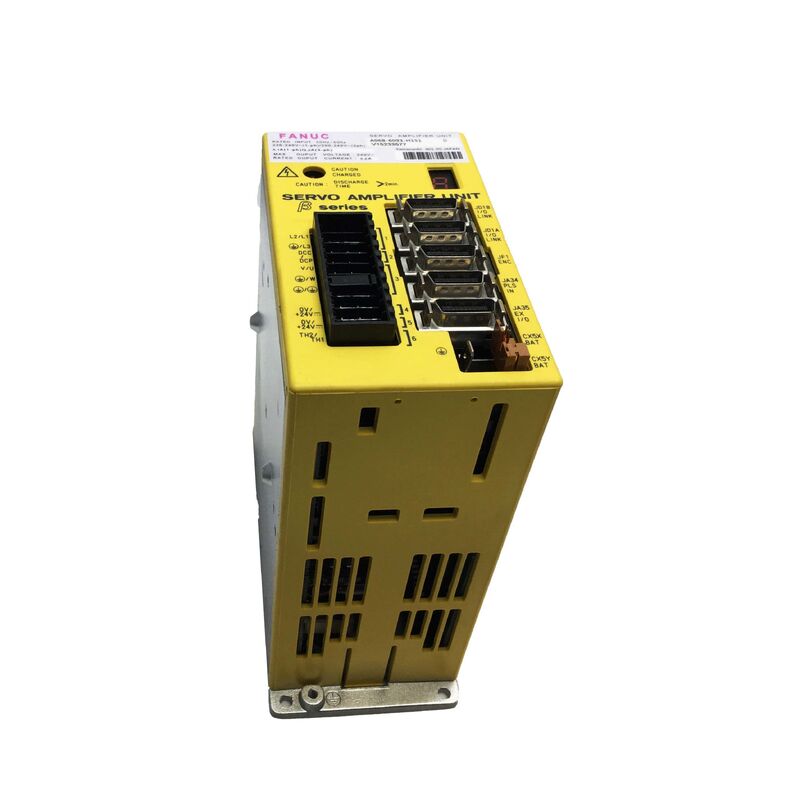
On a CNC machine tool, the servo amplifier sitting between the CNC control and the motor is not a passive component. It is the active element that translates position commands from the CNC into precisely controlled motor current — determining whether the axis moves accurately, accelerates cleanly, and stops exactly where commanded. The FANUC A06B-6093-H102 is the FANUC Beta series single-axis SVU-20 servo amplifier: a self-contained, single-channel unit with its own built-in power supply, Type B PWM interface, and all the drive electronics needed to run a Beta series servo motor from a FANUC CNC system.
| Parameter | Value |
|---|---|
| Part Number | A06B-6093-H102 |
| Model Designation | Beta Servo Unit SVU-20 / SVU1-20 |
| Series | FANUC Beta (β) Series |
| Interface Type | Type B — PWM (Pulse Width Modulation) |
| Input Voltage (1-Phase) | 220–240 V AC, 10.1 A |
| Input Voltage (3-Phase) | 200–240 V AC, 6.3 A |
| Input Frequency | 50/60 Hz |
| Rated Output Current | 5.9 A |
| Maximum Output Voltage | 240 V |
| Number of Axes | 1 (single-axis) |
| Control Type | Single-axis feed axis control |
| Power Supply | Built-in (self-contained unit) |
| Wiring Board | A20B-2100-0130 |
| Control Card | A20B-2002-032x |
| Weight | Approx. 3.99 lbs (1.81 kg) |
| Manufacturer | FANUC Corporation, Japan |
One of the defining characteristics that separates the FANUC Beta SVU series from the Alpha series drive architecture is the built-in power supply. Alpha series drives require a dedicated PSM (power supply module) to convert AC mains to the DC bus that feeds the SVM servo modules. The Beta SVU is different: it incorporates its own AC-to-DC conversion internally, making it a standalone unit that can be placed and wired independently anywhere on the machine without needing to integrate into a shared drive bus.
This self-contained architecture is precisely why the A06B-6093-H102 is the standard choice for auxiliary and secondary axis applications on CNC machine tools — automatic tool changers, turret drive axes, fourth-axis rotary tables, and peripheral equipment that need servo positioning capability but operate independently from the main feed axis drive stack.
The A06B-6093-H102 uses the Type B PWM interface — a serial pulse-width modulation link between the CNC control and the servo amplifier. This is one of the two primary interface types in the FANUC Beta SVU family; the other is the I/O Link version (H152 suffix). The Type B interface allows the drive to connect to the standard servo command bus of FANUC series CNC controls, making it compatible with the same control generations that ran Alpha series drives.
These BETA series amps are normally fitted with Series 0 CNC controls.More broadly, the A06B-6093-H102 is compatible with FANUC 15, 16, 18, 20, and 21 series CNC controls via the Type B interface. The Type B version can also bolt into Alpha series drive systems, giving machine designers flexibility when mixing drive types within a single control cabinet.
The FANUC A06B-6093-H102 SVU-20 servo amp is used on small applications within CNC machine tools or robots. This generation is the first Beta series of servo units.
More specifically, the SVU-20's 5.9A output current and single-axis configuration match the drive requirements for:
Automatic Tool Changers (ATCs) — the ATC magazine arm and tool pot selector on machining centers are frequently driven by Beta series servo motors, requiring a compact, independent single-axis drive that operates on the CNC's servo bus
CNC Lathe Turrets — powered turret indexing on CNC turning centers where the turret must position accurately to the commanded station under servo control
4th Axis Rotary Tables — auxiliary rotary axis drives on machining centers where a compact single-axis amplifier drives the rotary table motor independently from the primary X/Y/Z axis drives
Industrial Robots — smaller joint axes on FANUC robots or robot-adjacent equipment where the Beta series provides a cost-effective single-axis servo solution
Peripheral Automation Equipment — conveyor indexing, shuttle drives, and positioning axes on automated production cells where the Beta SVU operates as a standalone servo unit
The A06B-6093-H102 at 5.9A rated output is matched to the smaller Beta series motors. This H102 single channel servo amplifier drives motors such as the B2/3000.The Beta B2/3000 (2 Nm, 3,000 rpm) is the typical motor pairing, placing the SVU-20 at the right current level for compact positioning axes with moderate torque requirements.
The A06B-6093-H102 is built around two internal boards: the wiring board A20B-2100-0130, which handles the power transistor stage and motor output connections, and the control card A20B-2002-032x, which manages the servo loop computation and CNC interface. Neither board is serviced separately — the unit is maintained at the complete assembly level. The power transistor modules, battery pack, fuses, and internal cooling fan are available as individual service components for technicians performing component-level repair.
The heatsink on the drive's side face provides thermal management for continuous duty. It is extruded aluminum construction — a highly effective thermal conductor that keeps the power stage within its operating temperature limits during sustained positioning cycles.
The FANUC Beta (β) series represents FANUC's cost-optimized servo platform — designed to deliver reliable positioning performance at lower cost than the Alpha series, for applications where the extreme dynamic performance of the Alpha architecture is not required but reliable servo control definitely is. Within this philosophy, the SVU (Servo Unit) format — self-contained, with built-in power supply — is the simplest implementation: one axis, one unit, independently powered.
The A06B-6093-H102 is specifically the first-generation Beta SVU with Type B interface, preceding the newer βi series (A06B-6114-H103) which uses FSSB fiber optic interface. For machines designed around FANUC 0, 15, 16, 18, 20, or 21 series controls with Type B servo interfaces, the A06B-6093-H102 is the correct Beta SVU-20 specification.
Q1: What is the difference between the A06B-6093-H102 (Type B) and the A06B-6093-H112 (I/O Link)?
Both are FANUC Beta SVU-20 units with the same power stage and 5.9A output current. The difference is the interface to the CNC. The H102 uses Type B PWM interface, connecting via the servo command bus of FANUC Series 0/15/16/18/20/21 CNC controls. The H112 uses I/O Link interface, which is intended for auxiliary positioning axes controlled via the CNC's I/O Link network. Select based on the interface type your CNC control uses to command the axis.
Q2: Does the A06B-6093-H102 require a separate PSM power supply module?
No. Unlike FANUC Alpha series SVM modules, the Beta SVU-20 is a fully self-contained unit with its own built-in power supply. It connects directly to the AC power source (220–240V single-phase or 200–240V three-phase) and converts internally to the DC bus needed to drive the motor. No external PSM is required, which is why this drive can be placed independently anywhere on the machine.
Q3: Which FANUC CNC controls are compatible with the A06B-6093-H102?
The Type B interface on the A06B-6093-H102 is compatible with FANUC Series 0, 15, 16, 18, 20, and 21 CNC controls. It can also be used in Alpha series drive configurations that support Type B interface connections. Confirm the servo interface type of your specific CNC model before specifying this drive for a new installation.
Q4: The A06B-6093-H102 on our machine is showing an alarm — how do I diagnose it?
The Beta SVU series uses an LED alarm indication system on the drive front face. Unlike Alpha series modules that display a numeric code directly, Beta SVU alarm codes must be cross-referenced back to the CNC display or robot control screen to identify the specific fault. Check the CNC's servo alarm display for the axis number corresponding to this drive. Common failure modes include cooling fan failure, overcurrent conditions from motor or wiring faults, and power supply issues. Persistent alarms that cannot be cleared by power cycling typically indicate the drive requires component-level repair or replacement.
Q5: Can the A06B-6093-H102 be repaired, and is it worth repairing versus replacing?
Component-level repair is well-supported for this drive. The power transistors, cooling fan, battery pack, and fuses are all available as separate service parts. Repair facilities with FANUC Beta test equipment can bench-test the repaired unit under full load conditions against actual Beta motors to confirm correct function before return. For a drive with a failed transistor module or fan rather than board-level damage, repair is typically the cost-effective choice. Exchange programs — where a refurbished unit is supplied immediately while the faulty unit is returned — offer the best balance of speed and cost for production environments where minimizing downtime is the priority.
![]()
Contact Us at Any Time