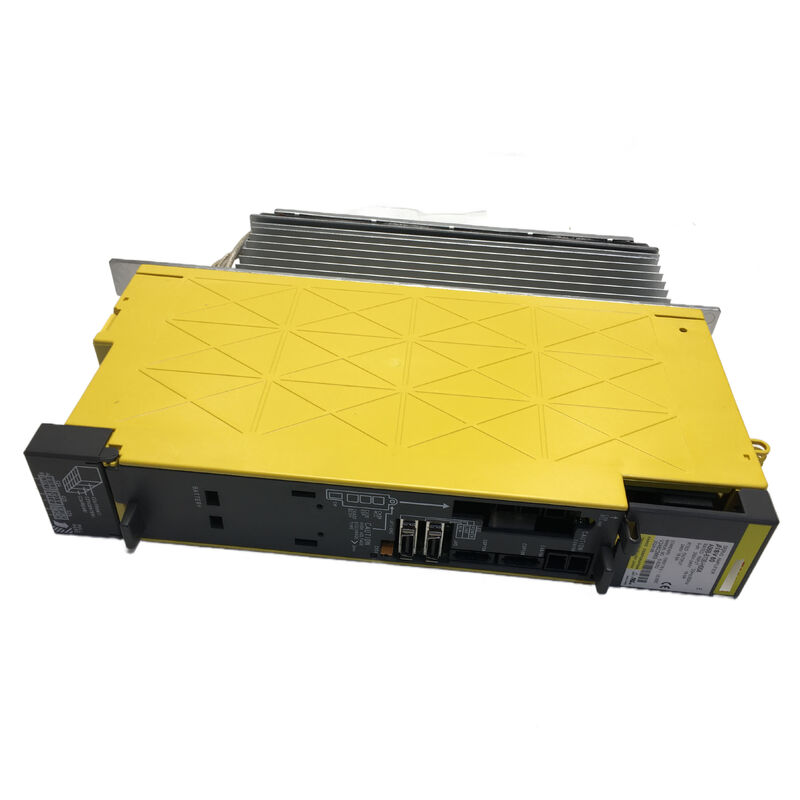
FANUC A06B-6130-H004 — Beta i Series SVM1-80i Single-Axis Servo Amplifier, FSSB Interface, 80A
Product Identification
Part Number: A06B-6130-H004
Series: FANUC MELSERVO Beta i (βi) Series
Model Designation: SVM1-80i (Single-Axis Servo Module, 80A class)
Interface: FSSB — FANUC Servo Serial Bus (fiber optic)
Reference Manual: B-65322
What This Unit Is
Among FANUC's Beta i servo amplifier lineup, the A06B-6130-H004 occupies a specific and well-defined role: it is the 80A single-axis module — the largest capacity unit in the first-generation Beta i SVM1 series. While the smaller H001 (20A) and H002 (40A) variants handle lighter-duty axes, the H004 is built for axes that demand sustained high current and rapid acceleration response: automatic tool changers, turret indexing mechanisms, and the precision rotary or linear axes common on EDM machines.
What distinguishes the entire Beta i amplifier family from the Alpha iSV series is its architecture. The A06B-6130-H004 is not a module in the traditional sense — it carries its own integrated power supply section, making it electrically self-contained. This allows it to be mounted anywhere on the machine tool, independent of an external PSM power supply unit. For machine builders designing compact control cabinets or positioning a drive close to the axis it serves, this independence is a genuine practical advantage.
Communication with the FANUC CNC runs over FSSB — the FANUC Servo Serial Bus — using a fiber optic cable. The fiber connection eliminates the noise susceptibility of electrical signal cables over the distances common in machine tool installations, and the FSSB protocol's high-speed synchronous communication is what allows the 0i-C and 0i-D control families to achieve tight multi-axis position synchronisation across all connected drives simultaneously.
Technical Specifications
| Parameter |
Value |
| Part Number |
A06B-6130-H004 |
| Series |
FANUC Beta i — SVM1-80i |
| Axes Controlled |
Single axis |
| Input Voltage |
3-phase 200–240VAC / Single-phase 220–240VAC |
| Input Frequency |
50/60 Hz |
| Input Current (rated/standby) |
19.0A / 0.9A |
| Control Power Supply |
24V DC |
| Rated Output Voltage |
240V AC |
| Rated Output Current |
18.5A |
| Peak Output Current |
80A |
| Rated Power |
5.2kW (6.5 kVA) |
| Output Frequency Range |
0–334 Hz |
| Capacity (heat generation) |
130W |
| Communication Interface |
FSSB fiber optic |
| Internal Cooling |
Built-in fan (forced air) |
| Ambient Operating Temperature |
0°C to +55°C |
| Dimensions (W × H × D) |
263 × 335 × 59 mm |
| Weight |
3.852 kg |
| Compatible CNC |
FANUC Series 0i-C, 0i-D, 30i, 31i, 32i |
| Compatible Motors |
FANUC βiS series (e.g., βiS 22/3000) |
| Internal Boards |
A16B-3200-051x (wiring board), A20B-2101-005x (control PCB) |
Built-In Power Supply: Why It Matters on the Factory Floor
The standard architecture for FANUC Alpha i servo drives involves a shared Power Supply Module (PSM) that conditions DC bus power for multiple SVM modules daisy-chained on a common bus. The Beta i SVM1 series, including the A06B-6130-H004, takes a different approach entirely. Each unit incorporates its own rectifier and DC bus stage — there is no external PSM required.
From a machine design perspective, this self-contained architecture has real consequences. Installation is simpler: one set of three-phase input connections, one 24V DC control supply line, and one FSSB fiber cable. There is no bus voltage sequencing, no shared PSM to size against a combination of axis loads, and no risk of a PSM fault taking down multiple axes simultaneously. If the A06B-6130-H004 develops a fault, the machine loses one axis — not all axes sharing a common power supply.
For maintenance teams, the same logic applies. Replacing the A06B-6130-H004 is a straightforward swap: disconnect the three-phase input, the motor power output, the FSSB fiber, the 24V control supply, and the brake cable if fitted. The replacement unit arrives with its own power supply already integrated. No PSM sizing calculations, no bus re-commissioning.
FSSB Communication: The CNC Link
FSSB — FANUC Servo Serial Bus — is FANUC's proprietary high-speed serial communication protocol for connecting the CNC to servo amplifiers. The A06B-6130-H004 connects to the CNC's FSSB port via a fiber optic cable, and the fiber optic medium is not an incidental detail. Machine tool environments generate significant electromagnetic interference: variable-frequency drives, induction heating, relay coils, and switching power supplies all create noise that can corrupt signal-level copper cabling over long cabinet-to-axis runs. Fiber carries no electrical potential and is immune to all of it.
On the communication side, FSSB operates synchronously with the CNC's interpolation cycle. Every position command, every encoder feedback packet, and every parameter exchange between the CNC and the A06B-6130-H004 happens in lock-step with the CNC's computation cycle — typically 1ms on standard 0i systems, with faster cycle options available on 30i series controls. This synchronous link is what makes smooth, accurate coordinated axis motion possible, as the CNC knows precisely when each drive will execute each position increment.
Typical Machine Tool Applications
Automatic Tool Changer (ATC) axis. The ATC arm on a vertical machining centre — the mechanism that physically pulls a tool from the spindle, swings to the tool magazine, and returns a fresh tool — must complete its cycle quickly and repeatedly, all shift. Fast acceleration to a defined position, crisp deceleration and stop, positive braking hold while the tool is exchanged. The A06B-6130-H004's 80A peak current capability provides the acceleration torque headroom an ATC axis needs, and the FSSB link delivers the position confirmation latency required for interlocking the ATC motion with the spindle orientation and tool clamp/unclamp sequences.
CNC lathe turret index axis. Tool turret indexing on turning centres is similar in character to ATC operation: short, fast, precise moves to indexed positions, executed many times per hour. High peak current for rapid acceleration, good position holding once indexed, and reliable recovery from tool-tip loads during cutting. FANUC 0i-series lathes with turrets in the βiS motor size range are well within the A06B-6130-H004's application envelope.
EDM wire and sinker machines. Wire EDM and sinker EDM machines use servo axes to control electrode position at very fine resolution and with well-damped response. The axis loads are often low but the position bandwidth requirement is high — the CNC needs the drive to respond quickly to fine position correction commands. The FSSB communication link and the βiS encoder feedback chain keep command-to-response latency tight.
Fourth and fifth axis on machining centres. Rotary table and tilting table accessories on machining centres require a servo axis matched to the motor driving the table. For smaller rotary tables in the βiS motor range, the A06B-6130-H004 provides the right current rating combined with the FSSB interface that integrates naturally into an existing 0i or 30i series control configuration.
Internal Hardware: What Is Inside
The A06B-6130-H004 is built around three functional assemblies. The power stage contains a single 50A transistor module (IGBT) that handles the PWM inversion from DC bus to three-phase motor output. The wiring board — A16B-3200-051x — provides the interconnection layer between the power stage, the connectors, and the control board. The control PCB — A20B-2101-005x — handles the FSSB communication, current loop processing, encoder feedback decoding, and all protection monitoring.
Of these three, the transistor module is the only power component available separately for board-level repair. The two PCBs are not available as standalone spare parts through standard channels; if either board fails, the economical path is either a complete unit exchange or specialist repair with appropriate test equipment. Fuses and the internal cooling fan are also serviceable as individual components, which covers the most common age-related maintenance items.
The 263 × 335 × 59mm form factor — narrow and tall — reflects the standard FANUC Beta i cabinet rail mounting footprint. Units mount vertically with the heat sink ribs oriented for vertical natural convection, supplemented by the internal forced-air fan. The 59mm depth allows relatively compact cabinet layouts even when multiple units are installed side by side.
Beta i Series Context: A06B-6130 Family
The A06B-6130 series covers the complete first-generation Beta i single-axis SVM1 amplifier range. The H004 is the highest-current variant:
| Part Number |
Model Designation |
Peak Output Current |
Typical Motor Range |
| A06B-6130-H001 |
SVM1-12i |
12A |
βiS 0.2–0.3 |
| A06B-6130-H002 |
SVM1-20i |
20A |
βiS 0.4–2 |
| A06B-6130-H003 |
SVM1-40i |
40A |
βiS 4–8 |
| A06B-6130-H004 |
SVM1-80i |
80A |
βiS 12–22 |
All four share the same FSSB fiber interface, the same self-contained power supply architecture, and the same 0°C–55°C operating range. The selection between them is determined by the rated and peak current of the servo motor being driven. Matching the amplifier current rating to the motor is essential: an undersized amplifier will hit its peak current limit during acceleration and trigger an overcurrent alarm, while an oversized amplifier offers no benefit and wastes cabinet space.
Installation and Maintenance Highlights
Cooling clearance. The internal fan pulls air through the heat sink fins. Mitsubishi's and FANUC's installation guidelines for rack-mounted drives of this type generally call for minimum clearances above and below the unit for airflow — blocked clearances lead to elevated heat sink temperatures and premature transistor module degradation. Verify that the installed position provides adequate ventilation per the B-65322 manual.
24V DC control power. The 24V DC supply for the control board should be sourced from the machine's main 24V rail, but with individual fusing for each amplifier to prevent a control board fault from pulling down the entire 24V rail and collapsing other control circuits simultaneously.
Fiber cable handling. FSSB fiber cables have a minimum bend radius specification. Sharp bends at the connector or along the cable run create insertion loss that eventually causes communication errors — axis detection alarms or synchronous communication errors on the CNC display. When routing the fiber, avoid tie-wrapping it tightly against metal edges or through sharp corners.
Fan maintenance. The internal cooling fan has a finite service life, typically cited in FANUC maintenance documentation at around 20,000–30,000 hours of operation. In machines running two or three shifts, this translates to a recommended fan inspection or replacement interval of several years. Fan failure leads to thermal trips at lower load levels than expected and, eventually, transistor module damage from sustained over-temperature.
After-replacement parameter check. On first power-up after an A06B-6130-H004 exchange, the CNC will run its servo initialisation sequence over FSSB. Verify that the servo motor type parameter is correctly set for the axis motor, that encoder feedback is active, and that the axis reference position is re-established if the machine uses an absolute encoder system.
FAQ
Q1: What CNC systems are compatible with the A06B-6130-H004?
The A06B-6130-H004 communicates via FSSB (FANUC Servo Serial Bus) fiber optic interface and is compatible with the FANUC Series 0i-C, 0i-D, 30i, 31i, and 32i CNC families. It is not compatible with older FANUC controls that predate FSSB, nor with Alpha i series SVM amplifiers that share a DC bus with a PSM power supply module.
Q2: What servo motors does the A06B-6130-H004 drive?
It is designed for FANUC βiS (Beta i S) series servo motors in the appropriate current range — primarily models such as the βiS 12/3000 and βiS 22/3000. The motor must be matched to the amplifier's 80A peak / 18.5A rated current capability. Attempting to drive a larger motor that requires more than 80A peak will cause overcurrent protection faults.
Q3: Does the A06B-6130-H004 require an external FANUC PSM power supply module?
No. Unlike the Alpha iSV series amplifiers, the A06B-6130-H004 has its own integrated power supply and connects directly to a three-phase 200–240VAC line input. No external PSM module is needed, which simplifies both the electrical installation and the cabinet layout.
Q4: What alarms indicate a failing A06B-6130-H004, and what are the first things to check?
The most common fault indicators are inverter alarms (SV alarm 401/421 on FANUC 0i), overcurrent alarms, and axis detection errors on the CNC display. Before assuming the amplifier has failed, check the following: verify the FSSB fiber cable is fully seated and undamaged; confirm the 24V DC control supply is present and within tolerance; check the internal cooling fan is running; and inspect the input fuses. If these all check out, the fault is more likely internal to the amplifier — transistor module, control board, or power board.
Q5: Can the internal boards (A20B-2101-005x, A16B-3200-051x) be replaced separately?
These PCBs are not available as standalone spare parts through standard channels. For a board-level fault, the practical options are specialist repair of the complete unit by a FANUC-experienced repair facility, or exchange for a refurbished A06B-6130-H004. The internal transistor module, fuses, and cooling fan are separately serviceable and cover the most common wear-related failures.



 Your message must be between 20-3,000 characters!