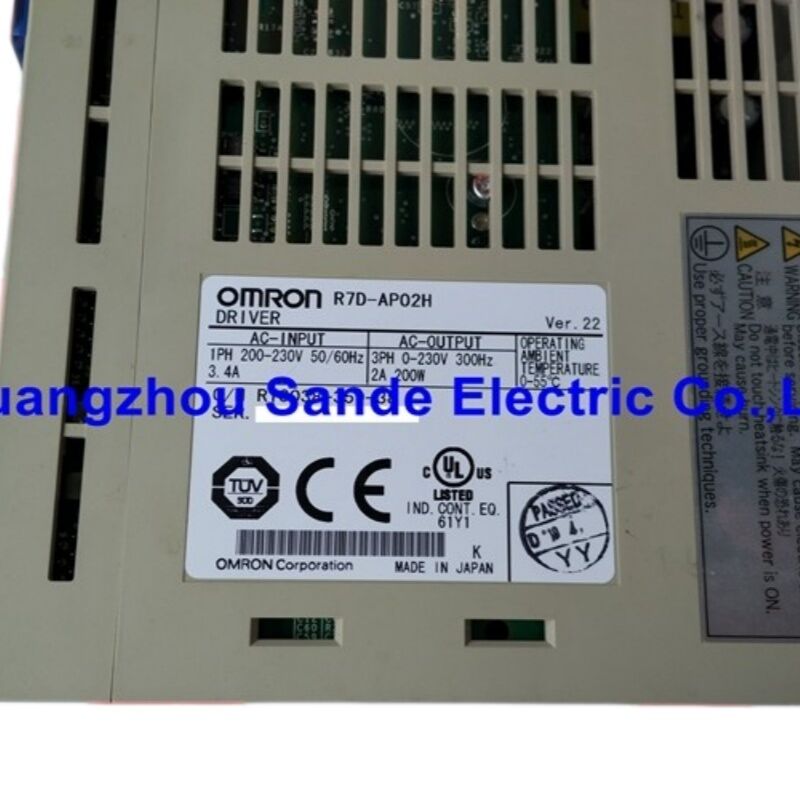
OMRON R7D-AP02H SmartStep A Series Servo Drive — 200W Single-Phase 200V AC Servo Driver
When a Stepper Motor Isn't Enough Anymore
There's a particular moment in machine design when the stepper motor that seemed like the right choice starts revealing its limits — missed steps under load, overheating at sustained speeds, or vibration that shows up in finished parts. The OMRON R7D-AP02H was built specifically for that moment.
Part of OMRON's SmartStep A Series, the R7D-AP02H is a 200W AC servo drive engineered to occupy the same cost bracket and wiring simplicity as a stepper system, while delivering the closed-loop performance of a true servo. The concept is direct: accept a pulse-string command from any general-purpose controller with pulse output — the same type of signal a stepper driver receives — and drive a brushless AC servo motor with real-time position feedback, automatic gain tuning, and protection against stall and overload that a stepper simply cannot offer.
The result is a drive that fits into existing motion architectures without rewriting PLC code, while solving the positioning accuracy and reliability problems that stepper-based systems develop under real-world load.
SmartStep A — What the Platform Was Designed to Solve
OMRON positioned the SmartStep A series at a specific gap in the automation market: applications complex enough to need servo performance but straightforward enough that the cost and programming depth of a full SGDH-class drive wasn't justified. Packaging machinery, labeling stations, small conveyors, indexing tables, and simple pick-and-place systems — equipment where the controller is a basic PLC or dedicated motion card, and the motion profile is fundamentally just go-to-position.
The SmartStep A drives operate on pulse-string input — the controller outputs direction and step pulses, the drive executes the move and verifies completion through the encoder feedback loop. The servo driver handles all the closed-loop servo mathematics internally. From the PLC's perspective, the interface is no more complex than wiring a stepper driver; the performance difference is entirely inside the drive.
Front-panel DIP switches handle the basic configuration — pulse input type, motor direction, dynamic braking behavior — without requiring software or a parameter unit for standard setups. This was a deliberate design decision: SmartStep A drives were meant to be configured by maintenance engineers on the factory floor, not servo specialists.
Technical Specifications
| Parameter |
Specification |
| Model |
R7D-AP02H |
| Cross-Reference |
R7DAP02H |
| Series |
OMRON SmartStep A |
| Rated Output |
200 W |
| Main Circuit Power Supply |
Single-phase 200/230V AC, 170–253V, 50/60 Hz |
| Control Power Supply |
Single-phase 200/230V AC, 170–253V, 50/60 Hz |
| Continuous Output Current |
2.0 A (rms) |
| Momentary Max Output Current |
6.0 A (rms) |
| Control Method |
All-digital servo |
| Inverter Method |
PWM, IGBT-based |
| PWM Frequency |
11.7 kHz |
| Speed Feedback |
Incremental encoder, 2,000 pulses/revolution |
| Regenerative Energy Absorption |
37.1 J |
| Inductance |
20.0 mH |
| Serial Interfaces |
RS-232C / RS-422A |
| Weight |
0.8 kg (1.76 lb) |
| Enclosure |
IP20 (open panel mount) |
| Voltage Class Suffix |
H = 200V AC (vs. L = 100V AC) |
| Compatible Motor Family |
R7M-A20030-□ / R7M-AP20030-□ |
| Manufacturer Status |
Discontinued (spare parts market) |
Understanding the Model Number: R7D-AP02H
OMRON's SmartStep A part numbers follow a consistent logic worth knowing when cross-referencing or sourcing alternatives:
R7D — SmartStep A Servo Driver
AP — Standard model (pulse-string input type)
02 — 200W power class (01 = 100W, 04 = 400W, 08 = 750W)
H — 200V AC voltage class (L suffix would indicate 100V AC)
The H/L suffix is not interchangeable. An R7D-AP02L is electrically incompatible with 200V supply wiring and designed for a separate 100V AC distribution environment. When sourcing a replacement, the voltage suffix must match the installation.
Compatible Servo Motors
The R7D-AP02H is matched to OMRON's 200W SmartStep A servo motors. Two body styles are available for different mechanical installation needs:
Cylindrical (standard) body:
- R7M-A20030-S1 — shaft-keyed, no brake
- R7M-A20030-BS1 — shaft-keyed, with 24V DC power-off brake
Flat (short-body) style:
- R7M-AP20030-S1 — compact footprint version
- R7M-AP20030-BS1 — flat body with brake option
Both motor families share the same 200W electrical ratings: 0.637 N·m rated torque, 3,000 r/min rated speed, and 4,500 r/min momentary maximum speed. Peak torque reaches 1.91 N·m — approximately three times the rated torque — for brief acceleration demands. The motor encoder outputs 2,000 pulses per revolution on phases A and B, with one Z-pulse per revolution for homing reference.
The encoder cable length between motor and drive affects system noise immunity. OMRON recommends standard cable for fixed routing and robot cable (flexible construction) for installations where the cable must move with the motor.
Auto Real-Time Tuning — Commissioning Without a Scope
Traditional servo commissioning involved iterative loop gain adjustment: run the motor, observe the response on an oscilloscope or motion analyzer, adjust proportional and integral gains, repeat. SmartStep A drives automate this process.
The auto real-time tuning function continuously monitors the motor's inertia and load characteristics during actual operation. The drive adjusts its internal control gains in real time to maintain optimal servo response as load conditions change — a feature that matters in machines where the load varies by cycle, such as packaging equipment that handles products of varying weight or conveyors with intermittent loading.
For machines with consistent, repeatable loads, the drive can also operate in a fixed-gain mode once the gains are established, which gives predictable, repeatable behavior across power cycles.
Input Command Flexibility and Control I/O
The R7D-AP02H accepts pulse-string position commands in three formats, selectable via front-panel DIP switch:
- Pulse + Direction — separate pulse count and direction signal (most common PLC output format)
- CW / CCW pulses — separate forward and reverse pulse trains
- 90° Phase Difference — quadrature A/B encoder-style input
Maximum pulse input frequency is 500 kpps (kilo-pulses per second), which sets the upper limit on how quickly position commands can be delivered to the drive. At 2,000 encoder pulses per motor revolution, a 500 kpps command rate corresponds to a maximum commanded speed of 15,000 r/min — well above the motor's physical limits, so the pulse input rate is never the performance bottleneck in typical SmartStep A applications.
Control I/O includes the standard servo interlock signals: Servo ON, alarm reset, forward/reverse drive inhibit limits, and general-purpose inputs and outputs for in-position confirmation and alarm status. An analog monitor output (CN4) provides real-time voltage signals proportional to motor speed and torque current — useful for oscilloscope diagnostics without connecting PC software.
Serial Communication: RS-232C and RS-422A
Both serial ports are present and functional on the R7D-AP02H. The RS-232C port (CN3) connects to a PC running OMRON's Parameter Unit software for full parameter access, monitoring, and drive setup. The RS-422A interface supports multi-drop wiring, allowing a single PC or HMI to communicate with multiple drives on a shared bus — practical for machines with several servo axes.
For basic commissioning and parameter adjustment in the field, OMRON's R7A-PR02A hand-held Parameter Unit connects directly to CN3 without a laptop. This is the tool that makes the SmartStep A genuinely maintainable in industrial environments where a PC isn't always on the floor when a fault needs to be cleared.
Dynamic Braking and Regeneration
When a servo motor decelerates, it acts as a generator, returning energy to the drive's DC bus. The R7D-AP02H manages this regenerative energy through an internal regenerative energy absorption capability rated at 37.1 J. For most 200W applications with moderate-inertia loads and normal deceleration ramps, internal absorption is sufficient.
For applications with higher-inertia loads or frequent, rapid deceleration cycles, an external regeneration resistor can be connected across the B1 and B2 terminals to provide additional dissipation capacity. The drive monitors the regeneration duty and triggers an alarm if thermal limits are approached.
Dynamic braking — the resistive braking that engages when the drive faults or loses power — is configurable via DIP switch. This determines how aggressively the motor decelerates to a stop on power loss, which has direct implications for machine safety and mechanical stress on the drivetrain.
Manufacturer Status and Sourcing Notes
The R7D-AP02H is discontinued by OMRON as a current production item. The SmartStep A series has been superseded by later OMRON servo platforms with expanded feature sets and network capability. However, the installed base of SmartStep A systems in the field remains large — the drives were sold globally throughout the 2000s into the 2010s, and many machines built around them continue operating.
Replacement units are sourced through industrial surplus and refurbished equipment channels. When purchasing, confirm that the unit has been function-tested under load rather than simply visually inspected, and verify that the firmware version is compatible with your application if parameter migration from an existing drive is planned. The core functionality of the R7D-AP02H is well-documented in OMRON's User Manual (Cat. No. I533-E1-04) and System Configuration Manual, both of which remain publicly available from OMRON's documentation archives.
Frequently Asked Questions
Q1: What controller types can command the R7D-AP02H, and does it require OMRON's own PLC?
No OMRON-specific controller is required. The R7D-AP02H accepts a standard pulse-string command input — the same type of signal output by virtually all PLCs with built-in pulse output function, dedicated motion controllers, CNC systems, and stepper indexers. The pulse format (Pulse+Direction, CW/CCW, or 90° phase-difference) is selected by DIP switch on the drive's front panel. The drive's command interface is controller-agnostic: if your controller can output digital pulses and direction signals at up to 500 kpps, it can command this drive. OMRON's own PLCs and motion controllers work naturally with this drive, but third-party controllers from Mitsubishi, Keyence, Panasonic, or other manufacturers are equally compatible as long as the pulse output signal levels are within the drive's input specifications.
Q2: What is the difference between R7D-AP02H and R7D-AP02L, and can they be substituted?
The single difference between these two models is the input voltage class:
- R7D-AP02H — Single-phase 200/230V AC (170–253V), 50/60 Hz
- R7D-AP02L — Single-phase 100/115V AC, 50/60 Hz
They are electrically incompatible and cannot be substituted for each other without also changing the power supply wiring. The H and L variants also pair with different sets of servo motors — the R7M-A20030-□ motor winding is the same, but voltage-sensitive motor parameters differ between voltage classes. The servo cables are compatible across both variants. When sourcing a replacement, always match the suffix letter to the voltage class of the original installation.
Q3: The drive is showing an alarm code. How do I diagnose and reset it without PC software?
The R7D-AP02H has a front-panel 7-segment LED display that shows alarm codes directly. When an alarm occurs, the display shows a two-character code (e.g., AL.14, AL.21, AL.40) that identifies the specific fault category: encoder fault, overvoltage, undervoltage, overcurrent, overload, regeneration error, overspeed, or position deviation excess, among others. The OMRON SmartStep A User Manual (I533-E1-04) contains a complete alarm code table with cause and corrective action for each code. After resolving the root cause, the alarm can be reset by momentarily activating the alarm reset input on the drive's control terminal strip — no PC is required for this. Do not repeatedly reset and restart without resolving the underlying cause; persisting alarms typically indicate a wiring fault, mechanical obstruction, incorrect gain setting, or failing hardware component that will not clear on its own.
Q4: Can I use an R7D-AP02H with a servo motor from a different manufacturer, or does it require OMRON's R7M motor?
The R7D-AP02H is designed and calibrated for OMRON's R7M-A20030 and R7M-AP20030 200W servo motors, which use a specific 2,000 pulse/revolution incremental encoder with a connector and wiring scheme matched to the drive's CN2 encoder input. Using a third-party servo motor with a different encoder type, different winding inductance, or different connector wiring would require careful electrical compatibility verification and is not supported by OMRON. In practice, substituting a non-OMRON motor onto this drive in a production environment is not recommended — the drive's auto-tuning algorithm and protection thresholds are calibrated to the motor parameters of the R7M series, and mismatches can cause unstable servo behavior or drive faults. If the original motor model is no longer available, an exact OMRON replacement or a tested compatible motor specified by OMRON for this drive family is the correct path.
Q5: The machine has multiple R7D-AP02H drives. Do I need separate PC connections to each drive for monitoring, or can they be networked?
Multiple drives can share a single monitoring connection using the RS-422A multi-drop configuration. The RS-422A port on each drive (CN3) supports bus wiring where several drives connect in a daisy-chain or star topology to a single RS-422A host interface. Each drive is assigned a unique unit address via its front-panel rotary switch, allowing OMRON's PC monitoring software to address and communicate with individual drives on the shared bus. For a small machine with two or three servo axes, this means a single RS-232-to-RS-422 converter on the monitoring PC can reach all drives simultaneously — practical for multi-axis diagnostics, parameter comparison across axes, or uploading a parameter set to all drives from one file. The RS-232C port is a point-to-point connection for single-drive access only and does not support multi-drop operation.
The OMRON R7D-AP02H is part of the SmartStep A servo drive series (Cat. No. I533). This model is discontinued from OMRON's current production lineup. Always verify the drive's alarm history, encoder cable condition, and motor compatibility before installation. Refer to OMRON User Manual I533-E1-04 for complete wiring, parameter, and troubleshooting documentation.



 Your message must be between 20-3,000 characters!