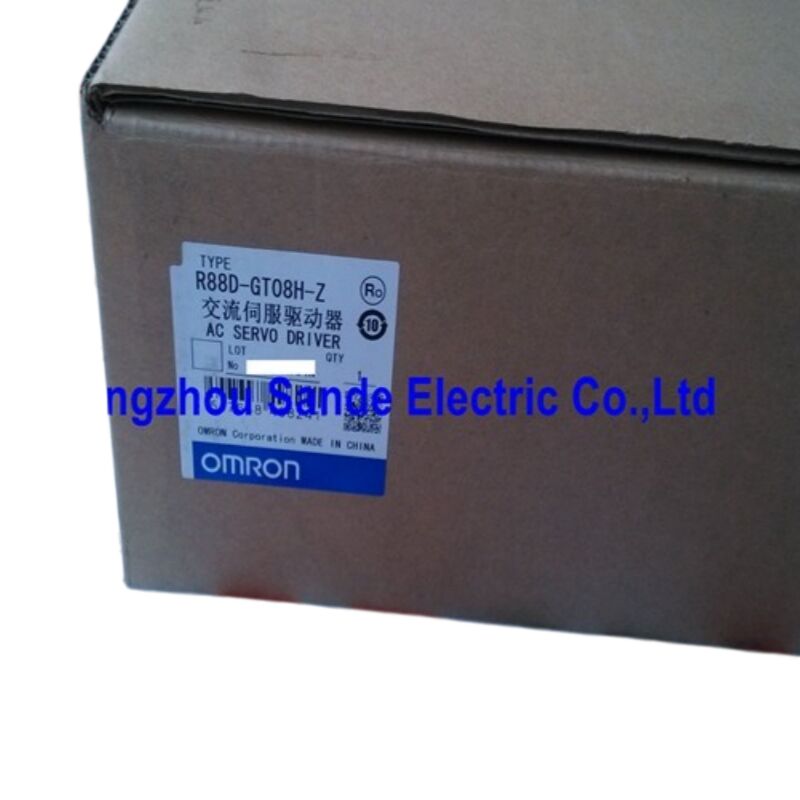
OMRON R88D-GT08H-Z — OMNUC G-Series 750 W AC Servo Drive, Analogue/Pulse Type, 200 VAC
What Sets the GT Series Apart
Within OMRON's OMNUC G-Series family, there are two drive variants built on the same servo platform. The GN-ML2 drives carry a built-in MECHATROLINK-II interface for networked multi-axis motion; the GT-series drives, by contrast, accept conventional analogue voltage and pulse-train commands — the interface format that the widest range of PLCs, motion controllers, and CNC systems already speak natively. The R88D-GT08H-Z is the 750 W member of that GT family, specified for single-phase or three-phase 200 VAC input and designed to work with external regenerative resistor capability for applications that push the internal resistor's thermal limits.
This is a drive for engineers who need proven G-Series performance — fast auto-tuning, three-mode control, real-time vibration suppression — without committing to a MECHATROLINK-II motion network. It integrates directly with OMRON's Position Control Units (CJ1W-NCF71, CS1W-NCF71) via pulse-train output, with any third-party controller capable of producing pulse or analogue command signals, and with standalone PLCs running point-to-point positioning sequences.
Electrical Specifications
| Parameter |
Value |
| Max. applicable motor capacity |
750 W |
| Main circuit power supply |
Single-phase or three-phase 200–230 V AC (170–253 V), 50/60 Hz |
| Continuous output current |
4.0 A rms |
| Momentary maximum output current |
12.0 A rms |
| PWM frequency |
11.7 kHz |
| Speed control range |
1:5,000 |
| Load fluctuation (speed) |
±0.01% max. at rated speed (0–100% load) |
| Encoder interface |
Serial (incremental 13-bit or absolute 16-bit) |
| Built-in regenerative resistor |
Yes — standard from 750 W upward in G-Series |
| External regenerative resistor |
Supported (B1–B2 terminals; disconnect B2–B3 short-circuit bar) |
| Operating temperature |
0–55°C |
| Weight |
Approx. 1.5 kg |
| Enclosure |
IP10 |
The "-Z" Suffix: External Regeneration Capability
The base R88D-GT08H already includes a built-in regeneration resistor, which handles the DC bus energy returned during motor deceleration under typical duty cycles. The -Z variant is configured and specified for operation with an external regenerative resistor, making it the appropriate choice where regenerative energy is high — frequent deceleration from elevated speeds, large inertia loads, vertical axis applications with counterbalance, or short cycle times that don't allow the internal resistor adequate cooling time between events.
When connecting an external resistor, the factory-installed short-circuit wire between terminals B2 and B3 is removed, and the external unit (from OMRON's R88A-RR@ series) connects between B1 and B2. Available external resistor options span four specifications: 50 Ω/80 W (R88A-RR08050S), 100 Ω/80 W (R88A-RR080100S), 47 Ω/220 W (R88A-RR22047S1), and 20 Ω/500 W (R88A-RR50020S) — each with an integrated thermal switch that trips at 150–200°C to protect the resistor and drive.
Compatible Servomotors
The R88D-GT08H-Z is type-tested and parameter-matched for use with the following OMRON OMNUC G-Series servomotors. Motor combinations outside this list are not supported:
3,000 r/min standard cylindrical motors (primary 750W match):
- R88M-G75030H (750 W, incremental encoder, straight shaft)
- R88M-G75030H-S2 (750 W, incremental encoder, key and tap)
- R88M-G75030T (750 W, absolute encoder, straight shaft)
- R88M-G75030T-S2 (750 W, absolute encoder, key and tap)
- Brake-equipped variants of all the above (suffix "B" before shaft designation)
Smaller motors also supported by the R88D-GT08H-Z (the drive can be used with motors below its maximum capacity): R88M-G05030@, R88M-G10030@, R88M-G20030@, R88M-G40030@ — covering the 50 W through 400 W range.
Flat-body (GP) motors: R88M-GP10030@, R88M-GP20030@, R88M-GP40030@ (100–400 W flat-profile motors in the 3,000 r/min range)
All G-Series motors use a serial encoder interface. Incremental-type motors (H-suffix) use a 13-bit encoder; absolute-type motors (T-suffix) use a 16-bit encoder and require an R88A-BAT01G backup battery (3.6 V, 2,000 mA·h) connected to the drive's CN1 I/O connector or the dedicated encoder cable with battery holder to retain absolute position data during power-off periods.
Control Modes
Three distinct operating modes are available on the R88D-GT08H-Z, selectable by parameter without hardware changes:
Position control accepts pulse-train command inputs in three formats — sign + pulse, forward/reverse pulse, or 90° phase-difference (A/B quadrature) — at up to the maximum pulse frequency supported by the CN1 interface. Electronic gear ratio is configurable so any command pulse resolution can be mapped to the motor's encoder resolution. The in-position output turns ON when position error falls within the settable threshold, giving the PLC a direct handshake for sequencing the next move.
Speed control operates from an analogue voltage command on CN1, with a speed control range of 1:5,000 from a minimum stable speed through maximum rated speed. Internal speed preset registers are also available for applications that cycle between fixed speeds using digital inputs rather than a continuous analogue reference.
Torque control accepts an analogue torque command and is used in tension control, winding, clamping, and press-fit applications where force repeatability at the load matters more than positional accuracy. Forward/reverse torque limits are independently settable, either by parameter or by a separate analogue input.
Auto-Tuning and Vibration Suppression
OMRON's G-Series auto-tuning works by estimating load inertia in real time from the relationship between the torque command and the resulting speed response. Selecting a single rigidity parameter (1–15 in the parameter table) sets the entire PID gain structure — proportional gain, integral time, derivative gain, and feedforward — from a single number that corresponds to machine stiffness. In practice, this means a first-time commissioning engineer can tune the 750 W axis to a usable state in under a minute with CX-Drive software, before making fine adjustments if the application demands tighter settling time.
The vibration suppression filter addresses the resonance peak that appears in the torque response of machines with long ball screws, belt drives, or other compliant transmissions. Rather than reducing gains across the board — which costs bandwidth — the G-Series filter attenuates at specific frequencies, allowing the overall servo gain to remain high while preventing sustained oscillation at the structural resonance frequency of the driven mechanism.
Front Panel, Connectors, and Display
The drive's front panel carries a 6-digit, 7-segment LED display that shows servo status, alarm codes (with alarm history stored internally), parameter values, and real-time feedback data without requiring a connected PC. A rotary unit-number switch on the front face sets the drive's RS-232C address (0–F) for multi-drop PC communication using CX-Drive.
Key connectors:
| Connector |
Function |
| CNA (main circuit) |
AC power input (L1, L2, L3), motor output (U, V, W), ground |
| B1 / B2 / B3 |
Regenerative resistor terminals (B2–B3 shorted from factory; open for external resistor) |
| CN1 (50-pin) |
All control I/O: pulse command, analogue reference, 10 digital inputs, 4–5 digital outputs, encoder divided output |
| CN2 |
Encoder feedback from servomotor |
| CN3 |
RS-232C for CX-Drive PC connection and analogue monitor output |
The analogue monitor output on CN3 provides two real-time voltage channels — selectable from motor speed, torque command, position error, or accumulated encoder count — directly measurable with an oscilloscope during commissioning, no software active required.
Recommended EMI filter: R88A-FIK107-RE (6.6 A rated, 3.5 mA leakage current) for CE compliance at the 750 W level.
Mounting bracket: R88A-TK03G L-bracket (shared with R88D-GT04L), for front-panel (rack) mounting in addition to standard wall-mount installation.
Availability note: The R88D-GT08H and R88D-GT08H-Z were discontinued by OMRON, with production ended on 31 October 2024. For new installations requiring the same power class and analogue/pulse interface, OMRON's G5-Series (R88D-KT08H) provides the closest functional equivalent with updated encoder support and expanded auto-tuning. Existing G-Series installations are well served by sourcing the GT08H-Z through the industrial surplus and specialist CNC parts market, where stock continues to circulate.
FAQ
Q1: What is the practical difference between the R88D-GT08H and the R88D-GT08H-Z?
Both are 750 W G-Series servo drives sharing the same electrical specifications, motor compatibility list, and control architecture. The core R88D-GT08H includes a built-in regenerative resistor as standard — sufficient for most applications at this power level operating with moderate duty cycles and moderate inertia loads. The -Z variant is specifically configured and supplied for use with an external regenerative resistor, making it the right choice when the application involves frequent high-speed deceleration, large load inertia relative to motor inertia, or short cycle times that do not allow the internal resistor adequate recovery time between deceleration events. If the internal resistor of the standard model would alarm on regenerative overload in your duty cycle, the -Z is the appropriate selection.
Q2: Can the R88D-GT08H-Z accept command signals from a non-OMRON controller?
Yes — this is one of the strengths of the GT (analogue/pulse) variant over the GN-ML2 (MECHATROLINK-II) version. The CN1 input accepts standard pulse-train formats (sign + pulse, CW/CCW, or A/B quadrature) and 0–10 V analogue speed/torque references, both of which are standard outputs from virtually any PLC, motion controller, or CNC system on the market. Siemens, Mitsubishi, Allen-Bradley, Delta, Keyence — any controller that produces pulse-train or analogue outputs can command this drive. The drive's electronic gear function takes care of any resolution mismatch between controller output and encoder feedback.
Q3: How does the absolute encoder battery work with this drive, and what happens if it is not installed?
When the drive is paired with an absolute-encoder G-Series motor (R88M-G75030T or similar T-suffix motor), the absolute position data is retained during power-off by an R88A-BAT01G lithium battery (3.6 V, 2,000 mA·h). The battery can connect either to the CN1 I/O connector directly or via a dedicated encoder cable that includes a battery holder. Without a battery installed, the encoder operates as a high-resolution incremental device — position is accurate during operation, but the system must perform a home-position return every time power is cycled. With the battery, the absolute position is preserved across outages and startups, eliminating home-position return for most machine configurations. OMRON specifies a typical battery service life of around five years under normal conditions.
Q4: What OMRON Position Control Units are compatible with the R88D-GT08H-Z?
The GT-series drives accept pulse-train position commands, making them directly compatible with OMRON's NC-series Position Control Units that produce pulse output — specifically the CJ1W-NCF71, CS1W-NCF71, CJ1W-NC413/433, and the older C200HW-NC series. These units output pulse commands on their axis channels, which connect directly to the R88D-GT08H-Z's CN1 pulse input terminals. The drive's in-position output feeds back to the PCU's input to confirm positioning complete, enabling standard point-to-point and interpolation sequences. The MECHATROLINK-II-based PCUs (CJ1W-NCF71 in MECHATROLINK mode) require the GN-ML2 version of the drive, not the GT-series.
Q5: What alarm codes should be checked first when the R88D-GT08H-Z faults on startup?
The 6-digit LED display on the front panel shows the active alarm code directly. The most common faults encountered during initial commissioning and troubleshooting fall into a few categories. An overvoltage alarm on the regenerative circuit typically means the built-in resistor is undersized for the duty cycle — adding or upgrading to an external R88A-RR@ resistor (after removing the B2–B3 short) resolves this. An encoder error on first power-on usually points to a connector seating issue at CN2 or a mismatch between the parameter setting for encoder type and the actual motor installed (incremental vs. absolute). An overload alarm that appears under load indicates either a gain that is too high for the inertia ratio or an application load that exceeds the drive's continuous output current of 4.0 A rms — verify that the mechanical load matches the motor's rated torque before adjusting gain. Full alarm code definitions and troubleshooting procedures are documented in OMRON User's Manual Cat. No. I562-E1 (OMNUC G-Series Analogue/Pulse type).


 Your message must be between 20-3,000 characters!