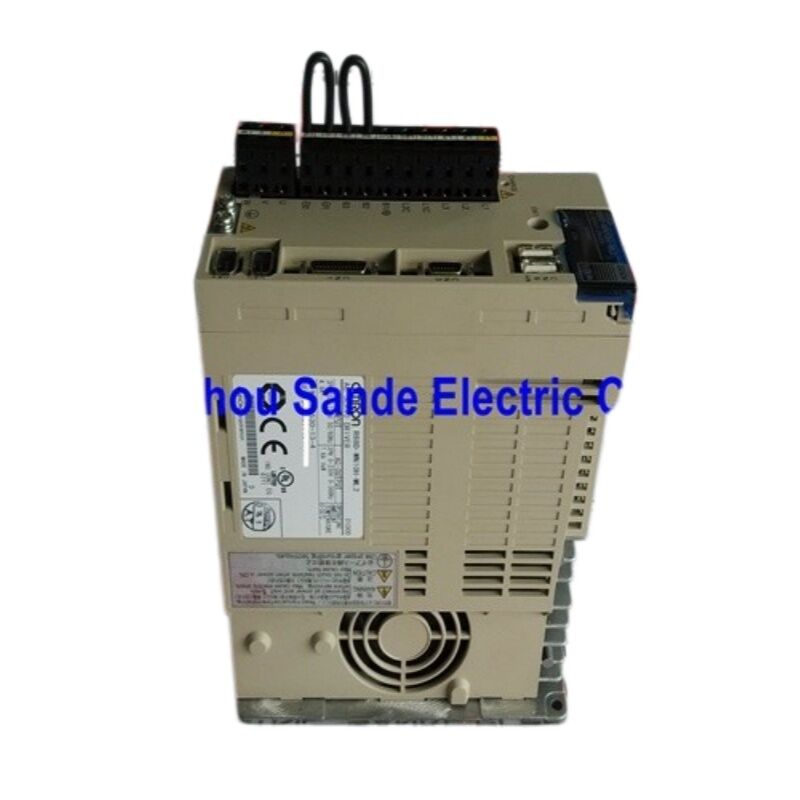
OMRON R88D-WN10H-ML2 — OMNUC W-Series 1 kW Servo Drive with Built-in MECHATROLINK-II
Overview
The R88D-WN10H-ML2 is a 1 kW AC servo drive from OMRON's OMNUC W-Series, distinguished by its factory-integrated MECHATROLINK-II communications interface. Where older W-Series drives required a separate FNY-NS115 application module to participate in a MECHATROLINK-II network, the WN-ML2 family embeds that capability directly into the drive housing — reducing panel footprint by approximately 60% compared to an equivalent WT-series unit with an add-on module.
Rated for three-phase 200–230 V AC input and pairing natively with 1 kW W-Series servomotors running at 3,000 r/min, this drive covers a broad range of motion-control tasks: electronic camming, high-throughput pick-and-place, coordinated multi-axis packaging lines, and precision semiconductor handling. All control data — position commands, speed references, torque limits, I/O status — travels over the MECHATROLINK-II bus rather than through discrete wiring, simplifying cabinet design and eliminating many of the analogue noise issues common in traditional pulse-train installations.
Electrical Specifications
| Parameter |
Value |
| Max. applicable motor capacity |
1,000 W (1 kW) |
| Main circuit power supply |
Three-phase 200–230 V AC, +10% / −15%, 50/60 Hz |
| Continuous output current |
5.9 A rms |
| Momentary max. output current |
18.0 A rms |
| PWM frequency |
11.7 kHz |
| Speed control range |
1:5,000 |
| Load regulation (speed) |
±0.01% max. at rated speed |
| Encoder interface |
Serial — 13-bit incremental or 16-bit absolute |
| Protective enclosure |
IP10 |
Dimensions & Weight
The R88D-WN10H-ML2 shares its housing with the 500 W R88D-WN05H-ML2, both measuring approximately 125 mm (W) × 170 mm (H) × 105.5 mm (D) in wall-mount configuration. Approximate weight is 1.9 kg. Two M5 mounting holes are provided on the back plate for panel installation; minimum clearance between adjacent drives is 10 mm on each side to maintain adequate airflow.
Compatible Servomotors
This drive is factory-matched to the following W-Series servomotors only. Third-party motor substitution is not supported — encoder protocol, motor parameter tables, and gain settings are all pre-configured for the W-Series combination.
3,000 r/min standard-frame motors:
- R88M-W1K030H-@ — 1 kW, 3.18 N·m rated, incremental encoder
- R88M-W1K030T-@ — 1 kW, 3.18 N·m rated, 16-bit absolute encoder
Both variants reach a maximum speed of 4,500 r/min and deliver a peak torque of 9.55 N·m (momentary). The "@" suffix accommodates shaft options (straight, key-and-tap), brake variants, and oil seal specifications — all selectable from the standard W-Series accessories catalogue.
Built-in MECHATROLINK-II — What It Changes in Practice
The heart of the WN-ML2 design is its integrated MECHATROLINK-II slave controller, accessible through two RJ45-style connectors: CN6A (upstream, toward the master) and CN6B (downstream, to the next slave). Up to 30 axes can share a single MECHATROLINK-II network, with each drive assigned a unique node address via the front-panel rotary switch.
The bus runs at 10 Mbps with a 0.5 ms or 1 ms transmission cycle, allowing the motion controller to update every axis simultaneously rather than polling each drive in sequence. For multi-axis applications — an X-Y gantry, a four-axis pick-and-place, a six-station rotary indexer — this synchronous update model is a significant advantage over traditional analogue or pulse-train architectures.
Compatible OMRON motion controllers:
- CS1W-MCH71 / CJ1W-MCH71 (Motion Control Units, synchronous control)
- CJ1W-NCF71 / CS1W-NCF71 (Position Control Units, point-to-point and interpolation)
Control Modes and Performance
The R88D-WN10H-ML2 operates in three distinct modes, selectable via the MECHATROLINK-II command set without hardware rewiring:
Position mode — The drive executes position commands sent by the master controller over the bus. Settling time is minimised by a built-in less-deviation control function that reduces position error during deceleration, and a predictive control algorithm that compensates for mechanical compliance before the servo even receives feedback.
Speed mode — Speed reference values are transmitted digitally over ML-II; the drive's 1:5,000 speed control range handles everything from slow-feed indexing to high-speed continuous rotation without the resolution loss inherent in 10 V analogue references.
Torque mode — Torque commands are issued directly from the controller, making this mode appropriate for winding applications, press-fit assembly, and tension-control systems where force repeatability matters more than position accuracy.
Connector Map
| Connector |
Function |
| CN1 |
Control I/O (emergency stop, latch inputs, alarm output, brake release) |
| CN2 |
Encoder feedback from servomotor |
| CN3 |
RS-232C — PC connection for CX-Drive software |
| CN5 |
Analog monitor output (speed, torque, position error) |
| CN6A / CN6B |
MECHATROLINK-II network (upstream / downstream) |
| CN8 |
Absolute encoder battery backup (3.6 V lithium) |
The CN5 analog monitor is particularly useful during commissioning: an oscilloscope connected to the speed monitor pin (SP) or torque monitor pin (IM) gives real-time visibility into drive behaviour without requiring a laptop or MECHATROLINK-II master active on the network.
Installation Notes
- Line filter: An external noise filter is required for EMC compliance (CE). OMRON recommends selecting from the R88A-FIW@ footprint filter series based on supply current.
- Regenerative resistor: The R88D-WN10H-ML2 includes an internal regeneration resistor. Applications with frequent deceleration from high speed or high inertia loads may require an external regeneration resistor (R88A-RR@ series) to stay within thermal limits.
- Grounding: Frame ground must be connected to a class-3 earth (100 Ω or less). Shared ground loops between multiple drives in the same cabinet should be avoided.
- Parameter software: CX-Drive (Windows) connects via CN3 for parameter upload/download, oscilloscope tracing, auto-tuning, and alarm history review.
- Reference manual: Cat. No. I544-E1-06, OMNUC W-Series AC Servomotors/Servo Drivers with Built-in MECHATROLINK-II Communications
Availability note: The R88D-WN10H-ML2 has been discontinued by OMRON. Stock is available through industrial automation distributors and certified surplus suppliers. For new designs, OMRON's G5-Series (R88D-KN10H-ML2) offers a direct MECHATROLINK-II equivalent with updated encoder support and expanded parameter sets.
FAQ
Q1: What is the difference between the R88D-WN10H-ML2 and the R88D-WT10H?
Both are 1 kW, 200 V W-Series drives that pair with the same R88M-W1K030 servomotors. The WT10H uses a pulse-train / analogue interface (CN1 command input) and requires a separate FNY-NS115 MECHATROLINK-II Application Module to join a networked system. The WN10H-ML2 has MECHATROLINK-II built directly into the drive PCB, eliminating the add-on module and reducing the required panel area by roughly 60%. If your motion controller communicates via MECHATROLINK-II — CS1W-MCH71, CJ1W-NCF71, or similar — the WN-ML2 is the correct choice.
Q2: Can the R88D-WN10H-ML2 run without a MECHATROLINK-II master connected?
The drive requires an active MECHATROLINK-II master to receive motion commands and enable the servo. It cannot be commanded via standalone analogue or pulse-train inputs the way a conventional WT-series drive can. For commissioning without a motion controller, CX-Drive software (connected via CN3 / RS-232C) provides a test-run function and JOG mode that allow basic motor operation and parameter verification.
Q3: Which absolute encoder battery does the R88D-WN10H-ML2 use, and how long does it last?
When paired with an absolute-encoder motor (R88M-W1K030T-@), a 3.6 V lithium battery connects to CN8 to retain encoder position data during power-off periods. OMRON specifies a typical battery service life of approximately five years under normal conditions. Battery replacement should be performed with the main circuit power on — turning the drive fully off before swapping the battery will cause the encoder to lose its absolute position reference, requiring a re-homing procedure.
Q4: How many R88D-WN10H-ML2 drives can share one MECHATROLINK-II network?
The MECHATROLINK-II specification supports up to 30 slave devices per network segment. Each R88D-WN10H-ML2 (and other ML2-compatible slaves such as I/O units or other drive types) occupies one node address, set via the front-panel rotary switch. The drives are daisy-chained through CN6A and CN6B connectors, and a termination resistor (FNY-W6022) is required at the last slave in the chain. Maximum cable distance between any two nodes is 50 m; total network length (without a repeater) is 50 m.
Q5: What is the recommended replacement for the R88D-WN10H-ML2 in a new design?
OMRON's G5-Series R88D-KN10H-ML2 is the functional successor. It retains MECHATROLINK-II communications and is compatible with the same OMRON controller family (CS1W-MCH71, CJ1W-NCF71, etc.), while adding a higher-resolution 23-bit encoder interface, expanded vibration-suppression filter, and updated auto-tuning algorithms. Motor cabling is not directly interchangeable — the G5 uses R88M-K servomotors with different connectors — so a motor change is required alongside the drive swap.



 Your message must be between 20-3,000 characters!