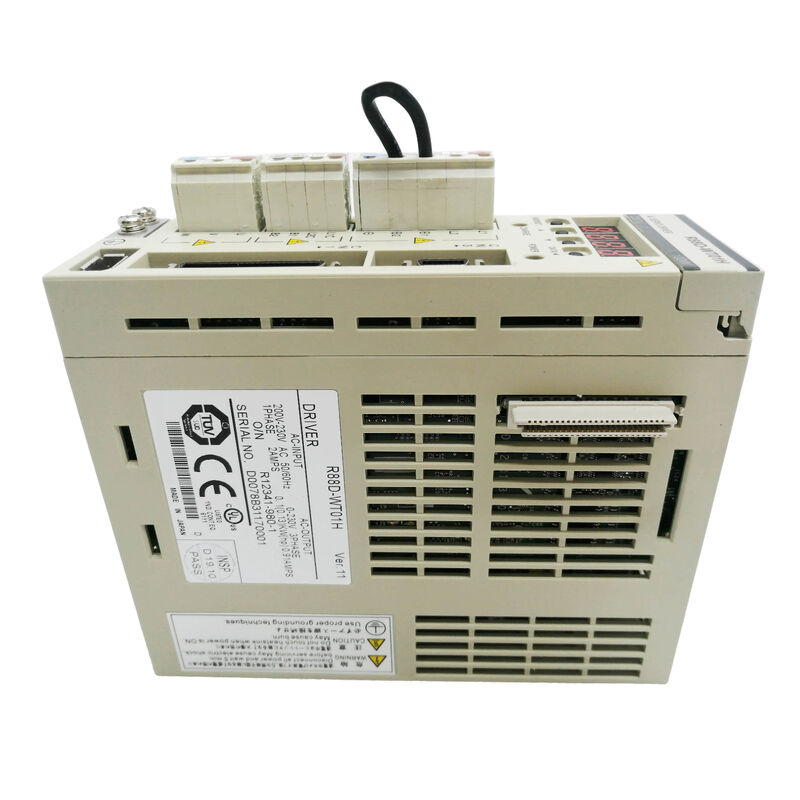
OMRON R88D-WT01H OMNUC W-Series AC Servo Drive — 100W Single-Phase 200V Servo Driver
More Than a Speed Controller
Ask any automation engineer who has worked with OMRON's servo lineup over the years which platform set the benchmark, and the OMNUC W-Series consistently comes up. The R88D-WT01H sits at the entry point of that family — a 100W, single-phase 200V AC servo driver — but the word "entry" undersells what this drive actually does. It's a three-mode drive: position control, speed control, and torque control, all in the same hardware. The operating mode is a parameter setting, not a hardware variant. One drive, three fundamentally different control behaviors.
That design philosophy carried through everything OMRON built in the W-Series. The goal was a servo platform capable enough to handle precise positioning on a small packaging axis, accurate speed regulation on a feed roll, or torque-controlled tension management on a winding stage — without requiring different hardware for each application. The R88D-WT01H delivers that flexibility in a compact panel-mount enclosure weighing under one kilogram.
Decoding the Model Number: R88D-WT01H
Every character in OMRON's servo driver naming convention communicates specific hardware information:
| Position |
Code |
Meaning |
| Product Family |
R88D |
OMNUC Series AC Servo Driver |
| Series |
W |
OMNUC W-Series |
| Control Type |
T |
Three-mode (Position / Speed / Torque) |
| Power Class |
01 |
100W |
| Voltage Class |
H |
200V AC (single-phase) |
The T designation in the model number is the most functionally significant character for application selection. It confirms this drive supports all three control modes in a single unit, distinguishing it from earlier or simpler OMRON servo platforms that were fixed to one control mode at the hardware level.
The H suffix indicates the 200V voltage class. The direct 100V-class equivalent is the R88D-WT01HL — same power rating, different supply voltage. These are not interchangeable; the main circuit winding, internal bus voltage, and motor compatibility differ between H and L variants.
Full Technical Specifications
| Parameter |
Specification |
| Model |
R88D-WT01H |
| Cross-Reference |
R88DWT01H |
| Series |
OMRON OMNUC W-Series |
| Rated Output |
100 W |
| Main Circuit Power Supply |
Single-phase 200/230V AC, 170–253V, 50/60 Hz |
| Control Circuit Power Supply |
Single-phase 200/230V AC, 170–253V, 50/60 Hz |
| Continuous Output Current |
0.91 A (rms) |
| Momentary Max Output Current |
2.8 A (rms) |
| Inverter Method |
PWM (IGBT) |
| PWM Frequency |
11.7 kHz |
| Speed Control Range |
1:5,000 |
| Load Fluctuation Rate |
0.01% max (0–100% load at rated speed) |
| Voltage Fluctuation Rate |
0% at rated voltage ±10% |
| Enclosure Rating |
IP10 |
| Dimensions (W × H × D) |
55 × 160 × 130 mm |
| Weight |
0.8 kg (1.76 lb) |
| Battery Connector |
CN8 (for absolute encoder battery) |
| Analog Monitor Output |
CN5 |
| Serial Communication Port |
CN3 (RS-232C / RS-422A) |
| Control I/O |
CN1 |
| Encoder Input |
CN2 |
| Manufacturer Status |
Discontinued (spare parts market) |
Three Control Modes — One Drive
The capability that defines W-Series drives in the OMRON lineup is the simultaneous availability of all three servo control architectures within the same unit.
Position Control Mode accepts pulse-string commands from the controller — the drive closes the position loop around the encoder feedback and executes the commanded move. The pulse input accepts Pulse+Direction, CW/CCW, or 90° phase-difference formats. An electronic gear function scales the command pulse ratio, allowing the controller's output pulse rate to be matched to the required motor resolution without modifying the controller program. Maximum command pulse frequency supports high-speed positioning demands without becoming a system bottleneck.
Speed Control Mode accepts an analog voltage reference (typically ±10V DC) from the controller or from a potentiometer, and regulates motor speed proportional to that input. The 1:5,000 speed control range — meaning the drive can regulate speed accurately from 0.6 r/min up to 3,000 r/min — is a benchmark figure that reflects genuine closed-loop performance rather than a theoretical maximum. At the low end of that range, the motor turns smoothly and controllably, which matters for feed applications where crawl-speed accuracy directly affects product quality.
Torque Control Mode regulates motor output torque proportional to an analog command signal, with speed limited to a preset ceiling. This mode is used wherever force or tension must be controlled rather than position or velocity — web tension systems, clamping mechanisms, torque-limited screwdriving, and material handling where the load is the reference.
Switching between modes is a parameter change, not a hardware swap. A machine designer can prototype an axis in speed mode, then move to position mode for the final implementation, using the same drive throughout.
Compatible Servo Motors
The R88D-WT01H is matched to OMRON's 100W W-Series servo motors running at 3,000 r/min rated speed. Four configurations are available depending on motor body style and encoder type:
Cylindrical body (standard):
- R88M-W10030H — incremental encoder, 100W
- R88M-W10030T — absolute encoder, 100W
Flat (slim-profile) body:
- R88M-WP10030H — incremental encoder, compact body
- R88M-WP10030T — absolute encoder, compact body
The H suffix on the motor indicates an incremental encoder; the T suffix indicates a battery-backed absolute encoder. Both encoder types are fully supported by the R88D-WT01H — the drive has a dedicated CN8 battery connector for the absolute encoder's backup battery, and the firmware handles both encoder types through the same CN2 encoder input.
The performance characteristics shared by all four 100W motor variants: rated torque 0.318 N·m, rated speed 3,000 r/min, momentary maximum speed 4,500 r/min, momentary maximum torque 0.96 N·m.
The flat-style (WP) motors offer the same electrical performance as their cylindrical counterparts in a significantly shorter body length — useful in machines where the motor mounting cavity has limited axial depth.
Connector Layout and Front Panel
Understanding what each connector does saves time during wiring and troubleshooting. From the top of the drive downward:
The battery compartment and CN8 are located beneath the top cover. If an absolute encoder motor is connected, the backup battery mounts here. Without a charged battery, the absolute encoder cannot retain multi-turn position data across a power cycle — a battery alarm on startup usually traces back to this compartment.
CN5 is a two-pin analog monitor output. Real-time analog voltage signals proportional to motor speed and torque current appear here, readable with an oscilloscope or data recorder without connecting PC software. This is the fastest diagnostic path during commissioning — connect a scope to CN5 and you can immediately see motor speed and torque waveforms in response to commands.
CN3 is the serial communication port (RS-232C / RS-422A) for parameter unit or PC connection. The OMRON R88A-PR02W hand-held parameter unit connects here for field programming and monitoring without a laptop. PC-based setup uses OMRON's WmonWin monitoring software via RS-232C.
CN1 is the control I/O connector — this is where the PLC or motion controller wires in: command pulses (position mode), analog speed or torque reference (speed/torque mode), servo ON/OFF, alarm reset, forward/reverse limit inhibits, and output signals like in-position, zero-speed, and alarm status.
CN2 is the encoder feedback connector, carrying the motor encoder signals back to the drive's position/speed processing circuitry.
Absolute Encoder Operation: Position Retention Across Power Cycles
When a T-suffix motor (absolute encoder) is paired with the R88D-WT01H, the servo system can report multi-turn absolute position to the controller even after a complete power-down. The encoder stores its multi-turn count and within-turn position in internal non-volatile memory backed by the battery in CN8.
On power-up, the drive reads the stored position from the encoder immediately. The controller receives the current axis position without requiring a homing cycle — the machine knows where it is the moment power is applied. This is the practical difference that makes absolute encoders worth the extra cost in machines where homing cycles consume production time, or where a safe homing path is complicated by the machine's geometry or tooling.
Incremental encoder motors (H-suffix) require a reference-point return on each power cycle. The trade-off is lower cost and no battery maintenance requirement. For machines where homing is fast, cheap, and unobtrusive, incremental encoders remain a rational choice.
Network Connectivity Options
The base R88D-WT01H communicates through its RS-232C / RS-422A serial port. For installations requiring field network integration, the R88A-NCW152-DRT DeviceNet Option Unit adds DeviceNet slave functionality to W-Series drives. The option unit connects to the drive's serial port via an external DSI communications kit and enables the drive to participate in a DeviceNet network — parameter access, command transmission, and status monitoring all through the device network without separate point-to-point wiring to each drive.
This upgrade path was an important feature for machine builders using OMRON's CS1 and CJ1 PLC families with DeviceNet master units. A single DeviceNet cable run to the panel could reach multiple servo drives, simplifying wiring and enabling centralized diagnostics.
Sourcing and Replacement Considerations
The R88D-WT01H has been discontinued from OMRON's active production catalog. The OMNUC W-Series was succeeded by OMRON's G-Series and later the 1S-Series, which offer expanded network capabilities, higher encoder resolution, and EtherCAT connectivity. However, W-Series drives remain installed across a large base of active machines globally, and replacement units are regularly sourced through specialist industrial automation suppliers.
When purchasing a used or refurbished R88D-WT01H, confirm that the unit has been load-tested, not merely powered on. A drive can pass visual inspection and power-up without faults while still exhibiting degraded IGBT performance, compromised encoder signal processing, or capacitor aging that only appears under motor load. Verify that the absolute encoder battery compartment is intact if the drive will be used with T-suffix motors.
Frequently Asked Questions
Q1: What is the difference between R88D-WT01H and R88D-WT01HL, and are they interchangeable?
The functional architecture of these two drives is identical — both are 100W W-Series three-mode servo drivers. The single difference is the input voltage class: the R88D-WT01H operates from a single-phase 200/230V AC supply (170–253V), while the R88D-WT01HL operates from single-phase 100V AC. They are electrically incompatible and cannot be substituted for each other. The compatible motor sets also differ — H-class drives pair with 200V motors (R88M-W10030H/T), and HL-class drives pair with 100V motors from the same mechanical frame. If your installation panel runs 200V single-phase, only the H-suffix drive is correct. Fitting an HL-class drive to a 200V supply will damage the drive; fitting an H-class drive to a 100V supply will result in undervoltage faults and the drive will not operate.
Q2: Can the R88D-WT01H work in position control mode with any pulse-output PLC, or does it require an OMRON controller?
The R88D-WT01H accepts standard pulse-string position commands and is controller-agnostic in this mode. Any PLC, motion controller, or indexer capable of outputting differential or open-collector pulse signals in Pulse+Direction, CW/CCW, or 90° phase-difference format can command this drive. OMRON's own positioning units (CJ1W-NC, CS1W-NC series) interface naturally, but Mitsubishi, Keyence, Panasonic, and other manufacturers' pulse-output controllers work equally well provided the signal levels and output current ratings are within the drive's CN1 input specifications. For speed and torque control modes, the drive requires a ±10V DC analog reference, which is a standard output from virtually all analog-capable PLC modules and motion controllers.
Q3: The drive is showing a battery alarm. What does this mean and how urgent is it?
A battery alarm on the R88D-WT01H indicates that the backup battery voltage in the CN8 battery compartment has dropped below the threshold required to maintain absolute encoder position data. This alarm is only relevant when a T-suffix motor (absolute encoder) is connected; it has no effect on systems using incremental encoder (H-suffix) motors. The urgency depends on the battery voltage's current state: an early battery warning means the battery is weakening and should be replaced soon, but the encoder data is still intact. If the battery fully discharges, the multi-turn position count stored in the encoder may be lost — on the next power-up, the drive will request a reference-point return to reestablish the absolute position reference. Replace the battery before it fully discharges to avoid this. OMRON's specified replacement is the R88A-BAT01W battery unit.
Q4: What is the speed control range of 1:5,000 and why does it matter for my application?
A speed control range of 1:5,000 means the drive can accurately regulate motor speed from as low as 0.6 r/min up to 3,000 r/min while maintaining its specified load regulation performance. In practical terms, this figure tells you how slow the drive can run the motor with reliable speed stability. For most positioning applications, this range is far more than necessary. Where it becomes critical is in applications requiring very slow, stable rotation — controlled material feeding, film winding at near-zero speed during splices, or precise low-speed indexing where any speed variation produces a visible defect in the output. Drives with narrower control ranges (say 1:1,000) become unstable or hunt at the low end; the W-Series 1:5,000 range reflects the resolution and bandwidth of the drive's speed control loop, which was a competitive differentiator for OMRON when this platform was current.
Q5: The R88D-WT01H is discontinued. Is the OMRON G5-Series or 1S-Series a direct replacement?
Neither is a fully transparent drop-in replacement, but both can substitute with parameter and wiring work. The OMRON G5-Series (R88D-KN01H-ECT or non-ECT variant) is the closest successor in terms of application scope and motor pairing — OMRON also produced compatible G5-Series 100W motors that share the same frame dimensions as W-Series motors. However, the connector layouts, parameter numbering, and encoder cable types differ between the W-Series and G5-Series, so wiring changes are required. The 1S-Series (R88D-1SN01H-ECT) is OMRON's current platform with EtherCAT communications and higher-resolution encoders; it represents a larger step change in wiring and PLC programming requirements. For a pure maintenance replacement where the goal is restoring a failed drive in an existing machine without redesign, sourcing a tested R88D-WT01H from the surplus market and transferring the original parameter set is typically faster than a platform migration. If the machine is being updated or multiple axes need replacement simultaneously, the G5-Series offers the most practical upgrade path from the W-Series.
The OMRON R88D-WT01H is part of the OMNUC W-Series AC servo system (User's Manual Cat. No. I531). This model is discontinued from OMRON's current production lineup. Always verify encoder type (incremental vs. absolute) and voltage class compatibility before ordering a replacement. Wait a minimum of five minutes after disconnecting power before working on drive wiring or connectors to allow internal capacitors to discharge.



 Your message must be between 20-3,000 characters!