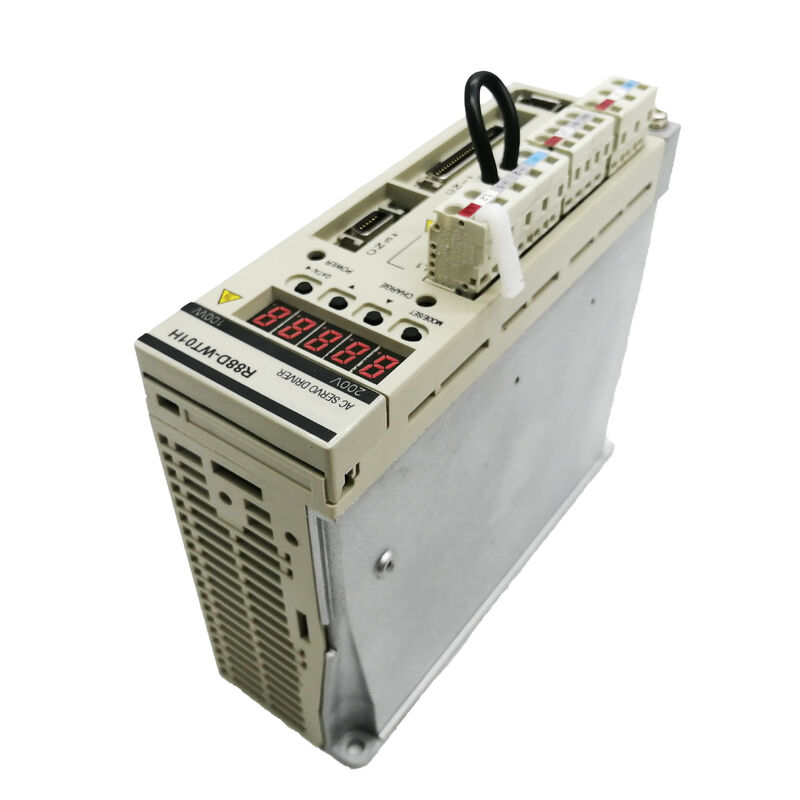
OMRON R88D-WTA3H — OMNUC W-Series 30W AC Servo Driver, Single-Phase 200V
The Smallest Drive in a Serious Servo Family
Thirty watts doesn't sound like much until you consider what the R88D-WTA3H actually brings to the table. This is the minimum-power entry point of OMRON's OMNUC W-Series — a servo platform that spans from this compact 30W unit all the way up to 15 kW, sharing the same three-mode control architecture, the same serial encoder interface, and the same programming environment across the entire range. Buying the smallest drive in this family doesn't mean accepting a stripped-down product. You get position control, speed control, and torque control in the same hardware, serial encoder compatibility with both incremental and absolute motors, and an RS-232C / RS-422A communication port — the full W-Series feature set, just scaled to a 30W load.
For machine builders working with small precision axes — label applicator carriages, compact dispensing heads, optical alignment stages, or miniature indexing mechanisms — the R88D-WTA3H hits the target precisely. Oversizing a servo drive wastes panel space and adds unnecessary cost; the WTA3H exists because some applications genuinely need 30W of servo performance and nothing more.
Technical Specifications
| Parameter |
Specification |
| Model |
R88D-WTA3H |
| Cross-Reference |
R88DWTA3H |
| Series |
OMRON OMNUC W-Series |
| Rated Output |
30 W |
| Main Circuit Power Supply |
Single-phase 200/230V AC, 50/60 Hz |
| Supply Voltage Range |
170–253V AC (−15% to +10%) |
| Control Circuit Power Supply |
Single-phase 200/230V AC, 50/60 Hz |
| Continuous Output Current |
0.44 A (rms) |
| Momentary Max Output Current |
1.3 A (rms) |
| Control Method |
PWM, IGBT-based |
| Motor Feedback |
Serial encoder — 13-bit incremental or 16-bit absolute |
| Control Modes |
Position / Speed / Torque (three-mode, T-type) |
| Speed Control Range |
1:5,000 |
| Operating Ambient Temperature |
0–55°C |
| Storage Temperature |
−20°C to +85°C |
| Humidity |
Under 90% RH (no condensation) |
| Dimensions (W × H × D) |
55 × 160 × 130 mm |
| Enclosure Rating |
IP10 |
| Communication Interface |
CN3: RS-232C / RS-422A |
| Control I/O |
CN1 |
| Encoder Input |
CN2 |
| Battery Connector |
CN8 (for absolute encoder backup) |
| Analog Monitor Output |
CN5 |
| Recommended Line Filter |
R88A-FIW104-E |
| Manufacturer Status |
Discontinued (spare parts market) |
Matched Motor: R88M-W03030H
The R88D-WTA3H is specifically matched to the R88M-W03030H series of 30W, 3,000 r/min cylindrical servo motors — the smallest members of the W-Series motor family.
At rated conditions, the R88M-W03030H delivers 0.0955 N·m of continuous torque, spinning at 3,000 r/min. Momentary peak speed reaches 4,500 r/min, and peak torque available during acceleration bursts is approximately three times the rated figure — consistent with the W-Series motor design across all power classes. The motor shaft runs sealed to IP67, meaning it can withstand direct washdown exposure in food-adjacent and wash-down manufacturing environments even while this smaller drive stays safely inside a sealed panel.
Two motor configurations are available for this drive:
- R88M-W03030H-□ — incremental encoder, 13-bit resolution
- R88M-W03030T-□ — absolute multi-turn encoder, 16-bit resolution
The T-suffix motor retains its absolute position across power cycles using the backup battery in the drive's CN8 connector. Choose the H-suffix incremental motor when homing on every startup is acceptable and cost reduction is a priority. Choose the T-suffix absolute motor when the machine cannot afford a homing cycle — or when the homing path is mechanically constrained by the application.
For installations where axial length is limited, OMRON's flat-body (slim-profile) 30W motors offer the same electrical performance in a shorter motor frame, and are fully compatible with this driver.
Three Control Modes, No Hardware Changes
What distinguishes the OMNUC W-Series from more basic servo platforms is the T-type three-mode architecture built into every drive across the family — including this 30W unit. Position, speed, and torque control are not separate product variants; they are operating modes selected by parameter. A single R88D-WTA3H can serve any of these three control roles in a machine.
Position control processes pulse-string commands from the host controller and closes the position loop internally using encoder feedback. The electronic gear function scales the command pulse input, so the controller doesn't need to output high-frequency pulse trains to achieve fine positioning resolution. Three pulse input formats are supported: Pulse + Direction, CW/CCW, and 90° phase-difference. This flexibility means the drive accepts commands directly from OMRON's own positioning units as well as third-party controllers with different output conventions.
Speed control regulates motor shaft speed proportional to an analog voltage reference, typically ±10V DC. The 1:5,000 speed control range is the same specification carried by larger W-Series drives — the 30W model doesn't accept reduced performance just because of its lower power rating. At the slow end of that range, the motor turns smoothly and controllably without hunting, which is what matters in tension-control and feed applications where low-speed stability determines output quality.
Torque control regulates motor output torque proportional to an analog input signal, with a configurable speed ceiling to prevent runaway on unloaded shafts. This mode is used wherever the machine needs to control force rather than motion — winding tension, clamping force, or controlled-force insertion operations.
Switching modes is a parameter change, documented in the standard W-Series user manual. A machine designer can configure the drive for development testing in speed mode, then switch to position mode for final commissioning, using the same hardware throughout.
Serial Encoder: Higher Resolution Than the Previous Generation
The W-Series motor-drive combination uses a serial encoder interface rather than traditional incremental A/B/Z quadrature signals. This is an important distinction from older servo platforms.
Incremental encoder motors in the W-Series (H-suffix motors) use a 13-bit serial encoder, delivering 8,192 counts per revolution of position feedback inside the drive's servo loop. Absolute encoder motors (T-suffix) use a 16-bit absolute serial encoder, providing 65,536 counts per revolution within a single turn, plus multi-turn tracking for absolute position across any number of revolutions.
The serial encoder link between motor and drive is also more noise-immune than parallel quadrature wiring. A single cable carries position data, velocity data, encoder status, and motor thermistor readings as a serial data stream. This reduces connector pin count, simplifies cable routing, and eliminates the differential signal degradation that long cable runs can cause on high-resolution incremental encoders. For a compact 30W application where the motor might be close to signal-generating equipment, this noise immunity is a practical benefit rather than a theoretical one.
Connector Layout and What Each Port Does
Understanding the drive's physical layout pays off during both installation and troubleshooting.
The CN8 battery compartment is under the top cover. If an absolute encoder motor (T-suffix) is used, the backup battery installs here. Without a charged battery, the absolute encoder cannot maintain its multi-turn position count during power-off. The drive will display a battery alarm on startup and request a reference-point return if this battery discharges completely.
CN5 provides analog monitor outputs — real-time voltage signals proportional to motor speed and current that can be observed on a standard oscilloscope. This is the fastest diagnostic connection during commissioning: without connecting any PC, a scope on CN5 immediately shows actual speed response and torque current as the axis moves. Overshoots, oscillations, and settling behavior are all directly visible.
CN3 is the serial communication port. The R88A-PR02W hand-held parameter unit connects here for field programming and fault diagnosis without needing a laptop. PC-based monitoring uses OMRON's WmonWin software over the same RS-232C connection, providing full parameter access, real-time monitoring, and data logging capability.
CN1 is the control I/O terminal — pulse command input, analog speed/torque reference, servo ON/OFF, alarm reset, forward and reverse limit inputs, and output signals including in-position, zero-speed, and alarm status.
CN2 is the encoder feedback input. The encoder cable runs directly from the motor's serial encoder to CN2; cable length affects system noise immunity and OMRON's specified standard and robot cables should be used for this connection.
Panel Installation: Shared Footprint, Clean Wiring
The R88D-WTA3H shares its 55 × 160 × 130 mm panel footprint with the WTA5H, WT01H, and WT02H models — all the W-Series 200V single-phase drives from 30W up to 200W occupy the same mounting dimensions. This matters for panel design: a machine that might need to scale from a 30W axis to a 100W axis in a later revision does not require a new panel cutout or cable bundle when the drive is upgraded.
Wall mounting uses two M4 screws. Front panel mounting (recessing the drive through a panel aperture with brackets) is also supported for installations where the drive's display and keypad need to be accessible from the panel face without opening a cabinet door.
EMC Compliance and Line Filtering
The R88A-FIW104-E footprint line filter is the recommended EMC filter for the R88D-WTA3H. Footprint-style filters mount on the panel DIN rail directly behind the drive, with the drive mounting flush against the filter's output terminals — this minimizes the unfiltered cable length between filter and drive, which is the primary factor in how well conducted EMC interference is actually suppressed.
The W-Series installation manual specifies wiring conditions for compliance with EMC directives. Following these conditions — specifically the grounding, cable routing, and filter installation requirements — enables the system to meet EN 55011 Class A Group 1 industrial emission limits. Without the line filter, conducted and radiated emissions from the drive's IGBT switching will exceed these limits.
Spare Parts Sourcing: What to Look for
The R88D-WTA3H has been discontinued from OMRON's active production lineup as the W-Series was superseded by the G-Series and 1S-Series platforms. Replacement units are available through the industrial automation surplus market. When sourcing a used or reconditioned unit, several practical checks apply.
Confirm the unit has been load-tested with an actual motor under commanded motion — not just powered up and fault-checked. A drive can appear healthy on a bench power-up while having IGBT degradation or capacitor aging that only manifests under motor load. Verify that the CN8 battery compartment is intact and has received a replacement battery if the drive has been in storage for an extended period. Check the firmware version if the drive will be imported into a multi-axis system where parameter compatibility across drives matters.
The W-Series user manual (OMRON Cat. No. I531) remains publicly available from OMRON's documentation archives and covers all alarm codes, parameter tables, and wiring diagrams for the R88D-WTA3H.
Frequently Asked Questions
Q1: What servo motor does the R88D-WTA3H pair with, and can I use a different 30W motor from another manufacturer?
The R88D-WTA3H is designed to work with OMRON's R88M-W03030H (incremental encoder) and R88M-W03030T (absolute encoder) 30W, 3,000 r/min servo motors from the W-Series family. These motors use a proprietary OMRON serial encoder interface — the signal transmitted over the CN2 cable is not a standard differential A/B/Z quadrature signal but a serial data protocol specific to the W-Series encoder. Third-party motors with standard quadrature encoders are not compatible with this drive's CN2 input. Substituting a non-OMRON motor would require verifying winding inductance compatibility, rewriting the drive's motor parameters, and accepting that OMRON's protection algorithms — which are calibrated to R88M-W series motor thermal and electrical characteristics — may not function correctly. In practice, pairing this drive with anything other than the matched R88M-W03030 motor is not recommended for production equipment.
Q2: Does the R88D-WTA3H require OMRON's own PLC or positioning unit, or will it work with third-party controllers?
No OMRON controller is required. In position control mode, the drive accepts pulse-string inputs — any controller, PLC, or motion card capable of outputting Pulse+Direction, CW/CCW, or quadrature-format pulses can command this drive. Controllers from Mitsubishi, Keyence, Panasonic, Delta, and others are routinely used with W-Series drives in this mode. In speed and torque control modes, the drive accepts a ±10V DC analog reference, which is a universal signal standard compatible with virtually all analog output PLC modules. The only OMRON-specific communication is over the RS-232C / RS-422A CN3 port for parameter access — and even that is accessible with standard terminal software if the communication protocol is configured correctly. For parameter setup in the field, the R88A-PR02W hand-held unit is the most practical tool regardless of which PLC brand controls the axis.
Q3: The R88D-WTA3H is showing an alarm. How do I identify the fault without connecting a PC?
The drive's front panel has a 7-segment LED display that shows two-character alarm codes directly. When a fault occurs, the display cycles through the alarm code and the word "AL" alternately so the code is readable without any tools or software. Common codes for this drive class include undervoltage (AL.10), overvoltage (AL.40), overcurrent (AL.30), overload (AL.71), encoder fault (AL.74), and position deviation overflow (AL.26). The OMRON W-Series User Manual (Cat. No. I531) contains the complete alarm table with probable causes and corrective actions for each code. After resolving the root cause, the alarm is cleared by activating the alarm reset input at the CN1 terminal strip — one pulse from the controller or a momentary contact from a pushbutton. Repeatedly clearing and restarting without addressing the cause will not resolve a hardware fault and may cause further damage.
Q4: Is the R88D-WTA3H compatible with absolute encoder motors, and what does that require in terms of hardware?
Yes — the drive fully supports both incremental (H-suffix) and absolute (T-suffix) W-Series motors. For absolute encoder operation, the R88A-BAT01W backup battery must be installed in the drive's CN8 battery compartment. This battery maintains the encoder's multi-turn position counter and within-turn position data when the machine power is off. On startup, the drive reads the stored position from the encoder immediately and reports the current axis position to the controller without any homing cycle. The only ongoing maintenance requirement is battery replacement when the battery voltage drops — the drive will display a battery warning alarm before the battery reaches critical levels, giving advance notice before position data is at risk. If the battery fully discharges and the encoder loses its position reference, a one-time reference-point return procedure reestablishes the absolute position and the system resumes normal absolute operation.
Q5: The R88D-WTA3H is discontinued. What is the most practical replacement option for an existing machine?
For a pure maintenance replacement — restoring a failed drive in an existing machine without redesigning the axis — the first choice is sourcing a tested R88D-WTA3H from the industrial surplus market and transferring the original parameter set from the machine's documentation. This keeps all wiring, cables, and PLC programming unchanged. If a W-Series unit is genuinely unavailable, the closest successor platform for migration is the OMRON G5-Series, specifically the R88D-KNA5H or R88D-KN01H range depending on rated output. G5-Series motors are physically similar to W-Series motors and OMRON produced compatible G5-Series 30W motors. However, the encoder cables, CN1 wiring, and parameter structure differ between generations, so a direct cable swap is not possible — wiring changes and parameter reentry are required. The newer 1S-Series (EtherCAT-based) represents a larger change in commissioning approach and PLC program structure and is more appropriate for new machine designs than for maintenance replacements of individual drives in existing W-Series installations.
The OMRON R88D-WTA3H is part of the OMNUC W-Series AC servo system (User's Manual Cat. No. I531). This model is discontinued from OMRON's current production catalog. Always verify motor model compatibility and voltage class before ordering a replacement. Wait a minimum of five minutes after disconnecting mains power before handling internal wiring or connectors.



 Your message must be between 20-3,000 characters!