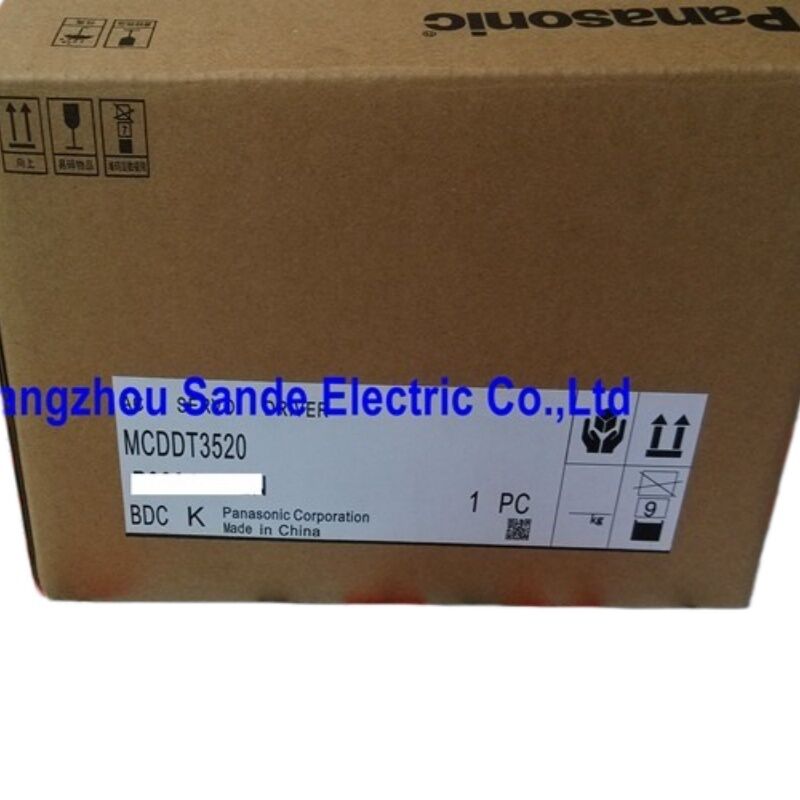
Panasonic MCDDT3520 — MINAS A4 Series 750W AC Servo Driver, C-Frame, Single/Three-Phase 200–240V
Built for Speed, Tuned for Precision
The machines that demand the most from a servo drive are the ones running fastest, stopping most abruptly, and repeating those cycles thousands of times a day. Panasonic designed the MINAS A4 series with exactly that environment in mind — and the MCDDT3520 sits at the 750W position in that lineup, carrying the full A4 architecture in the compact C-frame body.
What set the A4 apart from its predecessor generations was the adoption of a faster processing core. The platform achieved a velocity response frequency of 1 kHz, a figure that reflects how quickly the drive's control loop can react to disturbances and command changes. In high-speed pick-and-place machinery, rotary indexers, or multi-axis electronic cam systems, that response speed is the difference between a servo that tracks the commanded motion profile faithfully and one that accumulates lag errors under dynamic load. The MCDDT3520 delivers that same 1 kHz response bandwidth in the 750W class.
Technical Specifications
| Parameter |
Specification |
| Model |
MCDDT3520 |
| Series |
Panasonic MINAS A4 |
| Frame Size |
C-Frame |
| Rated Output |
750 W |
| Input Power Supply |
Single-phase or 3-phase, 200–240V AC, 50/60 Hz |
| Input Current (single-phase) |
6.0 A |
| Input Current (3-phase) |
3.3 A |
| Output |
3-phase, 0–126.9V, 0–333.3 Hz |
| Output Current |
4.0 A |
| Max Current Rating (Power Device) |
30 A |
| Current Detector Rating |
20 A |
| Control Modes |
Position / Speed / Torque / Full-closed control |
| Velocity Response Frequency |
1 kHz |
| Encoder Compatibility |
2,500 P/r incremental; 17-bit absolute/incremental |
| Communication Interfaces |
RS-232C / RS-485 |
| Ambient Operating Temperature |
0°C to 55°C |
| Storage Temperature |
−20°C to 80°C |
| Humidity |
Under 90% RH (no condensation) |
| Altitude |
Below 1,000 m |
| Weight |
1.42 kg |
| RoHS Compliance |
Confirmed (EU RoHS 2011/65/EU + 2015/863/EU) |
| Manufacturer Status |
Discontinued (spare parts market) |
Four Control Modes in One Drive
The MCDDT3520 is not a single-mode servo driver. Position, speed, torque, and full-closed control are all built into the same hardware — the operating mode is selected by parameter, which means one stocked spare covers multiple application types in a facility.
Position control is the most commonly used mode for machine axes: the host controller outputs a pulse train, the driver closes the position loop using encoder feedback, and the motor executes the commanded profile with the electronic gear function scaling the command ratio to the application's resolution requirement. Three pulse input formats are accepted — Pulse + Sign, CW/CCW, and quadrature — so the MCDDT3520 accepts commands from virtually any PLC or motion card without signal conversion hardware.
Speed control regulates shaft speed proportional to an analog voltage input, typically ±10V DC. The control loop operates at the A4 series' full bandwidth, which gives smooth, stable speed regulation even when the load torque varies within a cycle — important for grinding spindles, feed rolls, and tension-controlled winding applications where speed deviation is visible in the finished product.
Torque control regulates motor output torque proportional to an analog command signal, with a programmable speed limit ceiling. This mode serves clamping mechanisms, torque-limited insertion equipment, and winding systems where force management is the primary control objective.
Full-closed control is the A4 series' standout capability for precision machine tool applications. A secondary encoder — typically a linear scale or high-resolution rotary encoder — mounts on the load side of the mechanical drivetrain and feeds back the actual load position rather than the motor shaft position. The drive closes the position loop around this external feedback, eliminating the positioning error that arises from leadscrew pitch error, thermal expansion, and mechanical compliance between motor and load. For machine tools and semiconductor equipment where axis accuracy must be maintained over the full travel range, full-closed control is what makes the difference.
Encoder Support: Incremental and Absolute on the Same Drive
The MCDDT3520 supports both of Panasonic's A4-series encoder types, and the two populations of compatible motors are distinct in what they offer.
Motors fitted with the 2,500 P/r incremental encoder are the lower-cost option and the default configuration in the A4 series. The encoder outputs 2,500 line-count quadrature signals, which the drive internally interpolates for the position and velocity control calculations. On power-up, these motors require a reference-point return cycle to establish absolute position — a brief, predictable machine behavior that is designed into the startup sequence.
Motors with the 17-bit absolute encoder (131,072 counts per revolution) retain their full multi-turn absolute position across power cycles, using a backup battery connected to the drive. The parameter Pr0B switches the drive's encoder handling between incremental and absolute modes. Critically, the 17-bit absolute encoder can also operate in incremental mode without any battery — this is useful when multi-turn absolute position retention is not required but the higher encoder resolution is still desired. The drive's default ships set for incremental operation (Pr0B = 1); switching to absolute mode requires setting Pr0B to 0 and installing the backup battery.
Auto-Gain Tuning and Damping Control
Manual servo loop tuning on high-inertia or mechanically flexible machines is time-consuming work. The MINAS A4 series addresses this through automated gain tuning — the drive observes the motor's actual response to motion commands during an auto-tuning sequence and calculates proportional, integral, and derivative gains appropriate to the mechanical load characteristics. For machines with consistent, predictable loads, auto-tuning typically produces a well-behaved servo response on the first attempt, shortening commissioning time significantly.
The A4 series also includes damping control — a feature aimed at low-rigidity mechanical systems where residual vibration occurs at the end of a positioning move. Machine structures with long unsupported spans, flexible couplings, or gear compliance tend to ring at their resonant frequency after the motor stops. Damping control applies a filtered compensation to the velocity command to suppress this ringing without the instability that comes from simply increasing derivative gain. The result is cleaner position settling, better positional repeatability, and less mechanical stress on the drivetrain.
Compatible Motors
The MCDDT3520 covers the 750W rated output class across several motor series in Panasonic's A4 family. The motor series and their application characteristics are:
MSMD — Low inertia, 3,000 r/min rated speed. The standard choice for general motion control applications where fast acceleration and compact motor size are priorities. The 750W MSMD motors pair directly with the MCDDT3520 and are the most common combination in packaging, assembly, and material handling equipment.
MSMA — Low inertia, higher rated output range. For applications requiring higher torque at rated speed in the same power class.
MFMA — Middle inertia, 3,000 r/min. Better inertia matching for loads with significant rotating mass, reducing the tendency for resonance and overshooting in systems where the load inertia substantially exceeds the motor rotor inertia.
MGMA — Middle inertia, 2,000 r/min. For applications where lower base speed and higher torque at that speed are more appropriate than the standard 3,000 r/min class.
MHMA — High inertia, 3,000 r/min. Designed for applications such as large-diameter rollers and rotary tables where the dominant inertia is in the load.
Each motor is available in incremental encoder or absolute encoder configuration, with options for brake and different shaft styles. The combination of driver and motor must be verified against Panasonic's A4 series compatibility table before ordering — the drive's rated output must match the motor's rated output class, and the encoder type must match the drive's configuration parameter.
PANATERM Software and Front Panel Setup
Commissioning the MCDDT3520 does not require a laptop if the job is straightforward. The drive's front panel includes a 5-digit LED display and navigation keys for parameter access, JOG (trial run) operation, rotational speed monitoring, and alarm history review. For standard applications where auto-gain tuning handles the loop gain setup, this is often sufficient for complete commissioning.
For more complex setups, parameter backup, or fleet management of multiple drives, PANATERM — Panasonic's Windows-based servo setup software — connects to the drive via the RS-232C CN X3 port. PANATERM provides full parameter read/write access, real-time oscilloscope-style monitoring of speed and torque waveforms, alarm log retrieval, and a parameter copy function for transferring settings between drives. The RS-485 multi-drop capability on the same connector allows a single PC to reach multiple drives on a shared bus.
The optional console (hand-held parameter unit) connects directly to the front panel connector and provides the same parameter access, JOG run, and copy functions as the front panel — but from outside a closed control cabinet, which matters during machine setup when the cabinet door needs to stay closed.
Panel Installation: C-Frame Dimensions and Clearances
The MCDDT3520's C-frame body uses base mount (rear mount) as the standard orientation — the drive mounts to the back panel of a control cabinet through a set of M4 fasteners. The protective earth terminal is M4, with a specified tightening torque of 0.39 to 0.59 N·m.
Clearance requirements around the drive: 100 mm minimum above and below for airflow, and 10 mm minimum on each side. These figures apply to adjacent equipment within the same cabinet — adequate airflow around the C-frame body is the primary thermal management mechanism, and insufficient spacing leads to ambient temperature rise that shortens drive service life and eventually triggers thermal protection faults.
For installations where base mounting is impractical, an optional mounting bracket converts the drive to front panel mount orientation.
Operating altitude is limited to below 1,000 m without derating. Above this altitude, reduced air density decreases convective cooling efficiency, and the manufacturer's guidance should be followed for higher-altitude installations.
Sourcing and Maintenance Notes
Panasonic officially discontinued the MCDDT3520, with end-of-life documentation dating to September 2016. Replacement units are sourced through the industrial automation surplus and refurbishment market. When evaluating a used or refurbished MCDDT3520, confirm that the unit has been tested under actual motor load — bench power-up without a connected motor does not exercise the IGBT output stage or the current control loop that are most subject to failure in a working drive.
Check whether the drive's parameter set has been documented. A replacement drive that arrives with factory default parameters will need to be reconfigured to match the original motor's inertia class, encoder type, and machine-specific tuning. If the original machine documentation is not available, auto-gain tuning can re-establish the loop gains, but application-specific parameters such as electronic gear ratio, acceleration/deceleration time constants, and I/O logic must be re-entered manually.
Frequently Asked Questions
Q1: What servo motors is the MCDDT3520 compatible with, and how do I confirm the correct pairing?
The MCDDT3520 is matched to Panasonic A4-series 750W servo motors across several motor families: MSMD, MSMA, MFMA, MGMA, and MHMA at the 750W rated output level. The compatibility depends on three factors: rated output (must be 750W), voltage specification (200V class for this driver), and encoder type (either 2,500 P/r incremental or 17-bit absolute/incremental). The motor model number encodes all three — check the motor's nameplate or catalog designation against Panasonic's A4 series combination table in the instruction manual. A common example is the MSMD082S1T, a 750W low-inertia motor with 17-bit encoder. Using this drive with a motor outside its rated combination — different power class or different voltage class — will result in incorrect gain scaling, possible protection faults, and potential motor damage.
Q2: The machine uses full-closed control. What external encoder specifications does the MCDDT3520 support for the secondary feedback device?
The full-closed control function on the MCDDT3520 accepts feedback from a linear scale or external rotary encoder connected to the CN X5 control connector's external scale input. The input accepts differential line-driver signals in A/B/Z quadrature format, compatible with standard linear scale outputs from major encoder manufacturers. The electronic gear parameters for the full-closed loop must be configured to match the scale resolution and the machine's mechanical ratio — specifically, the parameter settings that define how many scale counts correspond to one motor revolution equivalent. This configuration is done during commissioning and depends on the specific scale used. If the full-closed loop oscillates during setup, the likely cause is incorrect gear ratio parameters or a loop gain that is too high for the combined stiffness of the mechanical system and scale mounting.
Q3: What does the velocity response frequency of 1 kHz mean in practice, and why does it matter?
The 1 kHz velocity response frequency describes the bandwidth of the drive's speed control loop — how quickly it can respond to a velocity disturbance or command change. A higher bandwidth means the loop can detect and correct speed deviations faster, which improves tracking accuracy on dynamic profiles and reduces position error during acceleration and deceleration. At 1 kHz, the A4 series was competitive with high-end servo platforms of its generation and substantially ahead of earlier Panasonic servo families. In practice, this matters most for high-cycle machines — those running many short moves per second — and for equipment where load torque varies rapidly within a cycle, such as cam-follower mechanisms or variable-pitch screw conveyors. For slow-moving, low-cycle applications, 1 kHz bandwidth is more capability than needed; for high-speed pick-and-place or electronic cam applications, it is the specification that enables the machine's throughput target.
Q4: How does the 17-bit absolute encoder differ from the 2,500 P/r incremental encoder in daily machine operation?
The core operational difference is what happens at machine startup. With a 2,500 P/r incremental encoder motor, the drive has no position information after power-off — the machine must perform a reference-point return (homing) cycle every time it starts up. With a 17-bit absolute encoder motor and a charged backup battery in the drive, the full multi-turn absolute position is retained through power-off. The machine knows exactly where every axis is the moment power is applied, and normal operation can begin without any homing movement. For machines where homing is fast and unobtrusive, incremental encoders are the lower-cost choice. For machines where homing takes significant time (long-stroke axes), requires the machine to be in a specific safe state, or interferes with production startup sequences, the absolute encoder eliminates the constraint entirely. The 17-bit resolution — 131,072 counts per revolution — also provides finer interpolation within the drive's control loop regardless of whether the absolute position retention feature is used.
Q5: The MCDDT3520 is discontinued. Is there a recommended Panasonic replacement, and what is involved in the changeover?
Panasonic's direct successor to the MINAS A4 series in the same power class is the MINAS A5 series (specifically the MADKT5540 / MCDKT3520 C-frame range for 750W) and, more recently, the MINAS A6 series. The A5 and A6 series offer improved auto-tuning algorithms, higher encoder resolution options, expanded communication interfaces including EtherCAT and MECHATROLINK, and updated safety function support. However, they are not pin-for-pin wiring replacements for the MCDDT3520 — the control I/O connector pinout, parameter numbering, and some communication protocols differ between A4 and A5/A6. A changeover requires reviewing the wiring diagrams for both generations, re-mapping I/O connections, and re-entering all parameters in the new drive's parameter structure. For facilities managing a fleet of A4-based machines, the most common maintenance approach is sourcing tested surplus MCDDT3520 units for immediate replacements while planning platform migration as part of a broader machine update schedule.
The Panasonic MCDDT3520 is part of the MINAS A4 AC Servo Motor and Driver series. This model is discontinued from Panasonic's current production lineup. Always verify motor compatibility using the A4 series combination tables before installation. Allow a minimum of five minutes after disconnecting main power before working on drive wiring to allow internal bus capacitors to discharge safely.


 Your message must be between 20-3,000 characters!