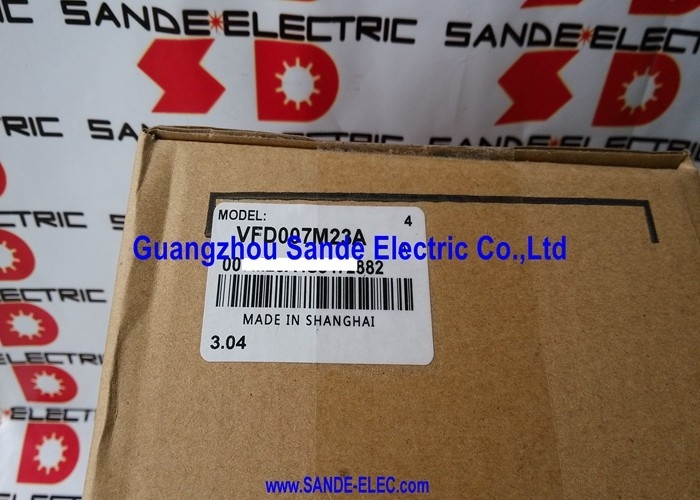
Delta VFD007M23A | VFD-M Series Sensorless Vector Micro AC Drive — 0.75 kW / 1 HP / 3-Phase 230V / 0.1–400 Hz / MODBUS
Compact and Capable — VFD-M for Small Motor Applications
The Delta VFD007M23A is the 0.75 kW member of the VFD-M series — Delta's compact "micro" AC drive designed for small to medium horsepower AC motor control. Three-phase 230V input, three-phase output, 0.1 to 400 Hz range, V/f and sensorless vector control, and built-in MODBUS communication: these are not features commonly found together at this power class. The VFD-M earned its position in small machine automation by packing professional drive capability into a compact footprint.
Sensorless vector control is the operating mode that separates the VFD-M from basic V/f-only drives at this price point. A sensorless vector drive builds an internal mathematical model of the connected motor — estimating flux and torque components in real time, without a physical speed encoder on the motor shaft. Under variable load conditions, it adjusts its output to maintain torque more accurately than V/f control. For milling spindles, conveyor drives, woodworking equipment, and small pump or fan applications where load varies during the cycle, sensorless vector provides better speed regulation.
The carrier frequency goes up to 15 kHz — the switching frequency of the IGBT output stage. Higher carrier frequencies produce quieter motor operation (less audible switching noise) and smoother current waveforms, at the cost of slightly higher drive heat dissipation. At 15 kHz, the VFD007M23A operates with low motor acoustic noise, which matters in workshop or precision manufacturing environments.
Key Specifications
| Parameter |
Value |
| Part Number |
VFD007M23A |
| Rated Power |
0.75 kW (1 HP) |
| Input |
3-phase 230V AC, 6.3A |
| Output |
3-phase 0–230V AC, 5.0A |
| Frequency Range |
0.1–400 Hz |
| Control |
V/f + Sensorless Vector |
| Carrier Frequency |
Up to 15 kHz |
| Communication |
MODBUS RTU up to 38,400 bps |
| Digital Inputs |
6 × multi-function (M0–M5) |
| Replacement |
VFD4A8MS23ANSAA |
| Status |
Discontinued |
Built-In PID and MODBUS — Automation Without Additional Hardware
Two features worth highlighting for small machine integration:
Built-in PID: The VFD007M23A has a native PID (Proportional-Integral-Derivative) feedback control loop. Connect a process feedback signal (pressure transmitter, flow meter, level sensor) to the drive's analogue input, set the setpoint, and the drive adjusts motor speed to maintain the process at the target — no external PLC required for closed-loop process control.
Built-in MODBUS: RS-485 MODBUS RTU at up to 38,400 bps allows the drive to be operated and monitored from a PLC, SCADA system, or HMI over a serial network. Speed setpoint, run/stop command, direction, and drive status parameters are all accessible via MODBUS registers — eliminating the need for dedicated analogue speed reference wiring in MODBUS-connected systems.
FAQ
Q1: What is the difference between V/f and sensorless vector control, and when should each be used?
V/f (voltage/frequency) control maintains a fixed ratio between output voltage and frequency across the speed range. It is simple and stable but speed droops under load. Sensorless vector control continuously estimates motor flux and torque and adjusts the output current vector to compensate for load — maintaining speed more accurately without a physical encoder. Use V/f for fans and pumps where some speed variation under load is acceptable. Use sensorless vector for milling spindles, conveyors, and processes where speed accuracy under variable load is important.
Q2: What is the replacement for the discontinued VFD007M23A?
Delta's confirmed replacement is the VFD4A8MS23ANSAA. Before substituting, confirm the VFD4A8MS23ANSAA's input voltage, output current rating, and physical dimensions match the installed application and panel space. The replacement belongs to Delta's MS series, which incorporates updated control features; verify that any communication settings and parameter structure are compatible with the installed control system.
Q3: Can the VFD007M23A run a single-phase 230V motor on a three-phase supply?
No. The VFD output is three-phase — it drives standard three-phase induction motors. Single-phase motors require a different output configuration and are not compatible with this drive's three-phase output. The VFD007M23A converts three-phase 230V AC input to a three-phase variable frequency output for three-phase motors only.
Q4: How is the MODBUS communication wired to the VFD007M23A?
The MODBUS RS-485 connection uses the drive's RS-485 serial terminal (typically labelled SG+, SG−, and GND on the control terminal strip). Connect to the PLC or master device's RS-485 port using a shielded twisted pair cable. Set the drive's MODBUS node address, baud rate (up to 38,400 bps), and data format through the drive's parameter settings. Terminate the RS-485 network at both ends with 120Ω termination resistors.
Q5: What auto torque boost and slip compensation mean in practice?
Auto torque boost automatically increases the output voltage at low frequencies to compensate for stator resistance voltage drop — maintaining motor torque at low speeds without manual tuning. Slip compensation adjusts the output frequency to counteract the natural speed reduction (slip) that occurs as motor load increases — keeping the motor shaft speed closer to the commanded frequency under load. Both improve motor performance without manual parameter tuning for standard induction motors.


 Your message must be between 20-3,000 characters!