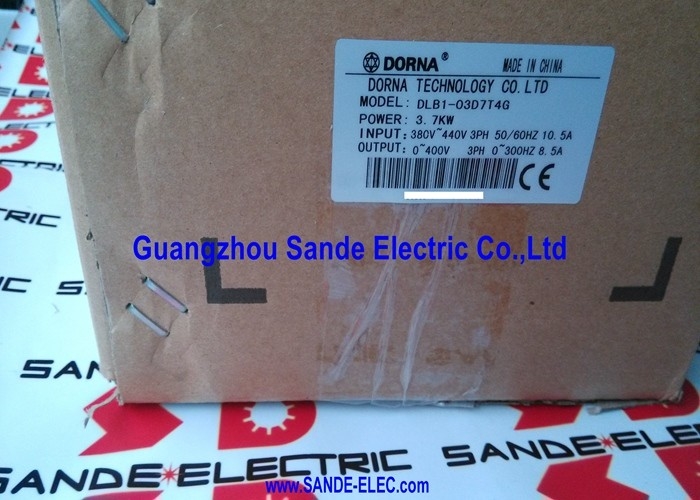
DLB1-03D7T4G | Dorna VFD Inverter — 3.7kW / 380V 3-Phase / 10.5A Input / 8.5A Output / General Purpose AC Drive
Dorna DLB1 Series — General-Purpose Variable Frequency Drive
The DLB1-03D7T4G is Dorna's DLB1 series 3.7kW general-purpose variable frequency drive. The DLB1 is designed for straightforward AC motor speed control across a wide range of standard industrial applications — conveyor systems, fans, pumps, compressors, and machine tool auxiliary drives.
At 3.7kW from a standard three-phase 380V industrial supply, the DLB1-03D7T4G controls induction motors in the mid-range of industrial motor power — a practical size for conveyor drives, air handling fans, centrifugal pump speed control, and production machine auxiliary drives.
Key Specifications
| Parameter |
Value |
| Output Power |
3.7kW |
| Input Voltage |
3-phase, AC 380V |
| Input Frequency |
50/60Hz |
| Rated Input Current |
10.5A |
| Rated Output Current |
8.5A |
| Drive Type |
General purpose VFD |
| Manufacturer |
Dorna Electronics |
General Purpose — Wide Application Range
The DLB1-03D7T4G is a general-purpose VFD — not application-specific. "General purpose" means the drive is designed and configured for the broadest range of standard AC motor applications:
V/Hz control: Provides basic variable speed control suitable for fan, pump, and conveyor applications where dynamic speed accuracy is not required.
Sensorless vector control (if equipped): Where available in the DLB1 firmware, vector control improves low-speed torque and speed accuracy — extending the drive's applicability to applications requiring better motor performance at speeds below 15Hz.
Application Scenarios
Conveyor drive: A production conveyor requires variable-speed control of its 3.7kW drive motor. DLB1-03D7T4G provides smooth speed ramp up and down, protecting the conveyor from mechanical shock during start and stop cycles — without the high starting current of a direct-on-line motor start.
Cooling fan speed control: An industrial cooling fan driven by a 3.7kW motor requires variable speed to match cooling capacity to heat load. DLB1-03D7T4G reduces fan speed during low-load periods — reducing noise and saving energy compared to fixed-speed operation.
FAQ
Q1: What type of AC motor is compatible with DLB1-03D7T4G?
DLB1-03D7T4G drives standard three-phase AC induction motors rated at 3.7kW and 380V. The motor must match the drive's rated output voltage (380V three-phase) and current (8.5A maximum). Motors with nameplate current above 8.5A should not be connected. Ensure the motor's rated voltage matches the drive's output voltage class.
Q2: Does DLB1-03D7T4G have a built-in braking resistor connection?
General-purpose VFDs in the DLB1 class typically provide a braking resistor connection terminal but do not include the braking resistor itself. An external braking resistor connected to the DC bus resistor terminals enables dynamic braking — allowing the drive to decelerate loads quickly by dissipating regenerated energy in the resistor rather than allowing the DC bus voltage to rise. Confirm from the DLB1 installation manual whether a braking resistor terminal is available and the minimum resistance specification for 3.7kW.
Q3: What output frequency range does DLB1-03D7T4G support?
The DLB1 series drives in this class typically support output frequency ranges from 0Hz (motor standstill) to 400Hz or 650Hz maximum — well beyond the 50/60Hz base frequency. Above 50Hz, the motor speed exceeds its nameplate rated speed (the drive operates in the "field weakening" region) — useful for driving high-speed spindles or fans where above-rated speed is required. Confirm the specific maximum output frequency from the DLB1-03D7T4G product documentation.
Q4: What protection functions does DLB1-03D7T4G provide for the connected motor?
Dorna DLB1 drives incorporate standard VFD protection functions: overcurrent protection (detecting motor or wiring faults at above-rated current), overvoltage and undervoltage protection (shutting down if the supply voltage is outside acceptable limits), electronic motor overload protection (detecting sustained overcurrent that indicates motor overload — adjustable for the specific motor's rated current), and output phase loss detection. These protections reduce the need for separate overload relays and current protection devices on the motor circuit.


 Your message must be between 20-3,000 characters!