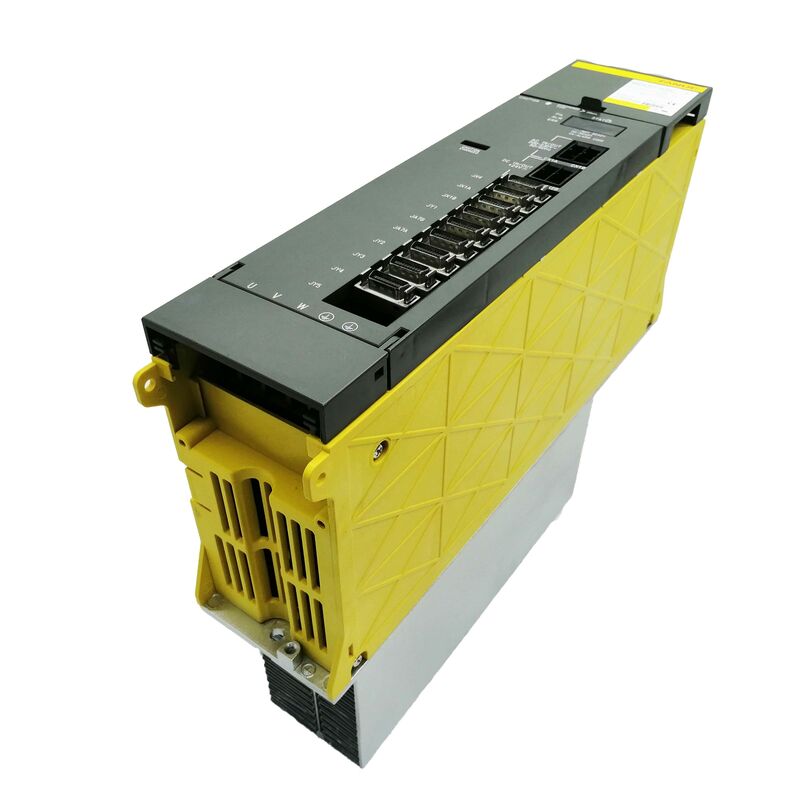
Fanuc A06B-6081-H106 | Alpha Power Supply Module PSMR-5.5 — 200–230V AC 3-Phase, 35A Input, 283–325V DC Bus, Resistor Discharge Type
Overview
The Fanuc A06B-6081-H106 is the PSMR-5.5, and the most important thing to understand about it before specifying or replacing it is embedded in the "R" in its designation: this is a resistor discharge type power supply, not an active regeneration type.
Every other alpha power supply module described in the A06B-6087 and A06B-6077 PSM families returns motor deceleration energy to the three-phase AC supply through an active front-end inverter stage. The A06B-6081-H106 does not.
It produces the same 283–325V DC bus output and takes the same 200–230V AC input, but the mechanism for handling the regenerative energy from decelerating motors is entirely different — and this difference has direct implications for what additional hardware the system requires.
In a PSMR system, when a servo or spindle motor decelerates, the kinetic energy converted to electrical energy by the motor flows back toward the DC bus. The DC bus voltage rises as this energy accumulates.
The PSMR module does not have an active circuit to return this energy to the AC supply; instead, it relies on an external regenerative discharge unit — a separately mounted resistor assembly with its own switching control — to absorb the energy and dissipate it as heat. Without this external discharge unit connected and functional, the DC bus will overshoot its voltage ceiling during deceleration events and trip the overvoltage protection (AL07), stopping the machine.
This is the fundamental trade-off of the PSMR architecture: simpler and less expensive than an active regeneration PSM at the initial supply stage, because the active front-end inverter circuit is omitted, but requiring the separate discharge unit whose cost partially offsets the saving, and which generates cabinet heat that an active PSM would have returned to the grid.
The PSMR makes engineering sense in applications where deceleration events are infrequent, the load inertia is low, or the regenerated energy per cycle is small — compact machines with small motors and low-cycle positioning, where the active regeneration hardware cost would be difficult to justify.
The PSMR-5.5 serves the low end of the alpha drive power range.
At 5.5kW, it is appropriate for machines with minimal servo axis loading — a single small SVM module and no spindle amplifier on the same bus, or configurations where the total simultaneous power demand is well within 5.5kW.
Key Specifications
| Parameter |
Value |
| Module Designation |
PSMR-5.5 |
| Rated Input Voltage |
200–230V AC, 3-phase |
| Rated Input Current |
35A at 200V |
| Input Frequency |
50/60Hz |
| Rated DC Bus Output |
283–325V DC |
| Wiring Board |
A16B-2202-0541 |
| Control Card |
A20B-2001-0890 |
| Regeneration Type |
Resistor discharge (external unit required) |
| CNC |
Series 0-D, 15, 16, 18, 21 |
PSMR vs PSM: Two Different Approaches to the Same Problem
The alpha drive system's power supply selection always involves a fundamental choice: PSM (active regeneration) or PSMR (resistor discharge)? The A06B-6081-H106 PSMR-5.5 represents one side of this choice.
Understanding the difference is not optional when maintaining or replacing these modules — fitting a PSMR in place of a PSM, or a PSM in place of a PSMR, has consequences for the system's ability to handle deceleration energy.
Active PSM (A06B-6077/6087 series): The front-end IGBT stage actively inverts deceleration energy back to the AC supply. No external discharge unit required. Higher module cost.
Returns energy to the grid — net energy consumption is lower on high-cycle machines. Cabinet runs cooler during heavy deceleration cycles.
PSMR (A06B-6081 series): No active inverter stage. External regenerative discharge unit required and must be sized and installed correctly.
Lower module cost. Deceleration energy dissipated as heat in the external resistor.
Appropriate for low-cycle or low-inertia applications where regenerated power per event is small.
The PSMR series includes the PSMR-3 (A06B-6081-H103) and the PSMR-5.5 (A06B-6081-H106).
The "3" and "5.5" designations reflect the same power class philosophy as the PSM family: the PSMR-3 serves even lighter loads, and the PSMR-5.5 is the larger of the two.
External Regenerative Discharge Unit — What It Is and Why It Matters
The external regenerative discharge unit is not optional on a PSMR system — it is a required system component. Without it, the PSMR-5.5 cannot handle any deceleration energy from connected motors, and the first axis deceleration event after the discharge unit is omitted or fails will produce an AL07 (overvoltage) trip.
The discharge unit consists of a high-power resistor (or resistor array) and a switching circuit that connects the resistor across the DC bus when the bus voltage rises above a threshold.
When the bus voltage climbs due to motor regeneration, the switching circuit fires and the resistor absorbs the energy, dissipating it as heat. The switching circuit disconnects the resistor when the bus voltage returns to normal, preventing continuous drain on the bus supply.
The discharge unit must be physically mounted in a location where its substantial heat output can be safely dissipated — typically outside the main electrical cabinet, on the machine's exterior structure, or in a separately ventilated enclosure.
Fanuc's alpha series documentation specifies the correct discharge unit model for use with the PSMR-5.5 and its mounting and wiring requirements.
A resistor thermal switch is included in standard discharge units and provides an alarm output if the resistor overheats — Fanuc's alpha startup documentation (B-65165E) specifies how this thermal switch signal must be connected into the machine's safety circuit.
Alarm Reference and Control Card
The A06B-6081-H106's control card (A20B-2001-0890) and wiring board (A16B-2202-0541) are specific to the A06B-6081 PSMR series. The alarm structure follows the same alphanumeric pattern as the PSM family:
AL01 — Overcurrent in the main power module. Inspect the three-phase supply, input fuses, and downstream bus connections.
AL02 — Cooling fan stopped. Replace the affected fan promptly to restore thermal margin.
AL03 — Heatsink over-temperature. Check the cooling airflow path; on the PSMR-5.5, confirm cabinet ventilation is functional.
AL04 — DC link voltage drop. May indicate excessive load or a fault in the pre-charge circuit.
AL05 — Pre-charge incomplete. The DC bus did not reach operating voltage in the expected time — inspect the pre-charge resistor/contactor.
AL06 — Input supply abnormal. Three-phase supply quality problem; check voltage balance and fusing.
AL07 — DC bus overvoltage. On a PSMR, this almost always indicates a problem with the external discharge unit — the resistor circuit failed to activate, the discharge unit is not connected, or its capacity is insufficient for the connected motor inertia.
AL07 on a PSMR is the alarm that uniquely points to the discharge unit, not the PSM itself. Before diagnosing the A06B-6081-H106 as faulty on an AL07 alarm, verify the external discharge unit's switching circuit is operational and its thermal switch has not tripped.
FAQ
Q1: Can the A06B-6081-H106 PSMR-5.5 be replaced by a PSM module (e.g., A06B-6077-H106 PSM-5.5) without other system changes?
Not directly. The A06B-6087 PSM modules include the active regeneration front-end stage that eliminates the need for an external discharge unit.
If the PSMR is replaced by the corresponding PSM type, the external discharge unit becomes unnecessary and should be disconnected — a PSM with an active discharge unit still connected is not a supported configuration.
Additionally, the internal board specifications differ between PSMR and PSM, so the wiring board and control card are not the same.
The DC bus voltage and output specification are compatible, so the replacement PSM will drive the same downstream SVM and SPM modules correctly.
Q2: What external discharge unit is required for the PSMR-5.5, and how should it be sized?
Fanuc specifies the appropriate discharge unit for the PSMR-5.5 in the alpha series selection guide (B-65162).
The sizing depends on the maximum regenerated power the connected motors produce during deceleration, which is calculated from the motor inertia, the speed change during each deceleration, and the deceleration time.
Fanuc's selection procedure involves calculating the average regenerated power over the duty cycle and selecting a discharge unit whose thermal rating exceeds this average, with a margin for the peak discharge events.
The discharge unit model number and specifications are documented alongside the PSMR module in B-65162.
Q3: In a system where the discharge unit has failed, can the machine be run at all?
No. A PSMR system without a functional discharge unit cannot safely decelerate any motor at a speed that generates significant regenerated energy. Every motor stop will drive the DC bus voltage upward until AL07 trips and the CNC performs an emergency stop.
The machine will not sustain normal operation cycles without the discharge unit functional.
If the discharge unit has failed, it must be repaired or replaced before normal machine operation can resume.
As a temporary measure, manually reducing all axis deceleration rates to extend deceleration time reduces the instantaneous regenerated power per event — but this is a diagnostic workaround, not an operational solution.
Q4: The boards inside the PSMR-5.5 (A16B-2202-0541 and A20B-2001-0890) appear in some listings as the same numbers as boards in other alpha modules. Are these actually interchangeable?
Board numbers can appear across multiple modules in the alpha family while serving different functions or having different firmware.
The A16B-2202-0541 and A20B-2001-0890 are specific to the PSMR series and should not be assumed interchangeable with identically numbered boards in PSM modules without verification.
The most reliable approach is to source PSMR-5.5 replacement modules (A06B-6081-H106) as complete units from the exchange market, which avoids the need to assess individual board compatibility.
Board-level repair should be performed only by specialists with access to Fanuc's component-level documentation.
Q5: What is the difference between the PSMR-3 (A06B-6081-H103) and the PSMR-5.5 (A06B-6081-H106), and when should each be selected?
The PSMR-3 and PSMR-5.5 differ in power class: the PSMR-3 serves lighter loads (3kW class), and the PSMR-5.5 serves the next tier at 5.5kW. Selection follows the same principle as choosing between any two PSM power classes — sum the continuous power demand of all connected SVM and SPM modules, apply a simultaneous operation factor, and select the PSMR whose rating exceeds the result.
If the calculation falls between 3kW and 5.5kW, the PSMR-5.5 is the correct choice.
The physical dimensions of the two units are similar (both in the A06B-6081 series, 60mm wide format), but the wiring and control board specifications differ and are not interchangeable between the H103 and H106.


 Your message must be between 20-3,000 characters!