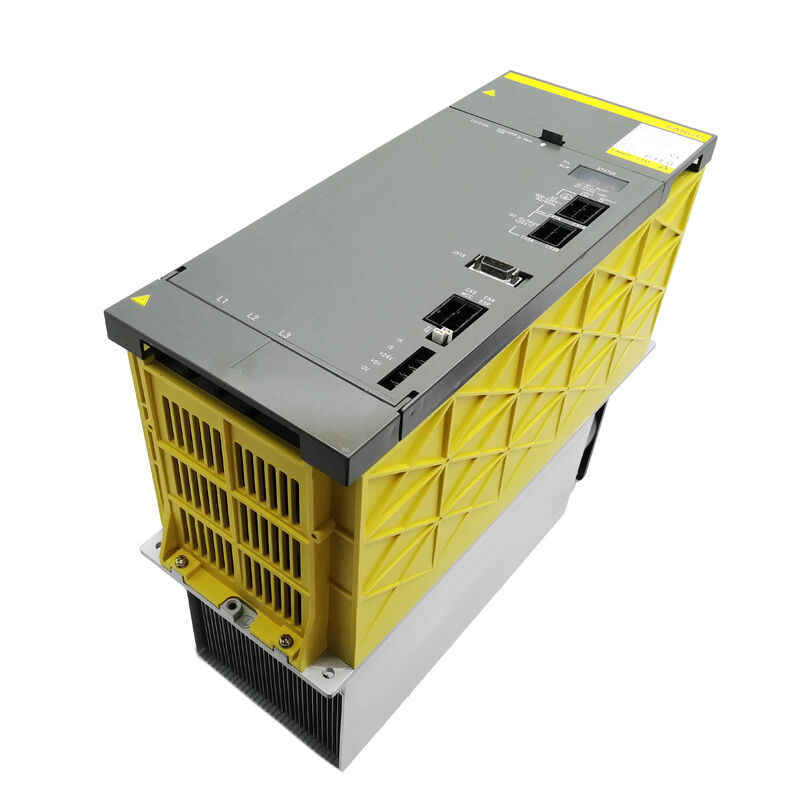
Fanuc A06B-6087-H155 | Alpha Power Supply Module PSM-55 — 65kW, 200–230V AC 3-Phase, 234A Input, 283–325V DC Bus, Active Regeneration, External Forced Cooling Required
Overview
The Fanuc A06B-6087-H155 is the PSM-55 — the highest-rated power supply module in the A06B-6087 alpha series, and the official successor to the PSM-45. At 65kW continuous output and 234A of rated input current at 200V, the PSM-55 serves the largest and most heavily loaded configurations in the alpha drive system: large-format machining centres with high-power spindle motors in the 22kW+ class, multi-axis systems where the combined servo and spindle current demand approaches or exceeds what the PSM-45's 55kW capacity can sustain at rated load, and heavy-duty turning centres processing large workpieces with aggressive cutting cycles.
The PSM-55 arrived in the A06B-6087 lineup as the replacement for the PSM-45 in August 1999.
The transition addressed a practical need at the top of the alpha power class: machines that had grown beyond the PSM-45's 55kW rating as spindle power requirements and multi-axis configurations became more demanding.
The PSM-55 delivers the same physical chassis form factor and the same active regeneration architecture as the PSM-45, while extending the continuous power ceiling by 10kW and raising the input current rating from 185A to 234A.
The active front-end regeneration is a defining characteristic at this power level. With a 22kW or 26kW spindle motor decelerating from full speed, the kinetic energy released is substantial — on a machine with frequent tool changes or repeated positioning cycles, this energy occurs dozens of times per shift.
The PSM-55 returns this deceleration energy to the three-phase AC supply rather than burning it in resistors, which is both an energy management advantage and a thermal management benefit.
At 65kW capacity, the heat that would be generated by resistor discharge during high-cycle operation is significant; the active front end eliminates it from the cabinet thermal budget entirely.
Like the PSM-45 it succeeds, the PSM-55 requires external forced air cooling.
This is not a peripheral installation consideration — it is a fundamental requirement for the module to reach its rated 65kW output. Without the external forced air supply directed at the module's heatsink, the junction temperatures of the IGBT transistor modules will exceed safe limits under production load, and AL03 (heatsink over-temperature) shutdowns are the predictable result.
Machines originally specified with the PSM-55 were designed with this external cooling arrangement as part of the electrical cabinet layout.
Key Specifications
| Parameter |
Value |
| Module Designation |
PSM-55 |
| Rated Input Voltage |
200–230V AC, 3-phase |
| Rated Input Current |
234A at 200V |
| Input Frequency |
50/60Hz |
| Rated DC Bus Output |
283–325V DC |
| Rated Output Power |
65kW |
| Wiring Board |
A20B-1007-0650 |
| Control Card |
A16B-2202-042x |
| Regeneration |
Active (energy returned to AC supply) |
| External Cooling |
Required (forced air) |
| CNC |
Series 0-D, 15, 16i, 18i, 21i and variants |
| Successor To |
PSM-45 (A06B-6087-H145) |
PSM-55 vs PSM-45: What Changed
The PSM-55 improves on the PSM-45 in a specific and practical way: 10kW more continuous power and 49A more input current, accommodating the machine configurations that the PSM-45 was beginning to underserve by the late 1990s.
The board specification changed — the PSM-55 uses wiring board A20B-1007-0650 rather than the PSM-45's A20B-2001-067x — but the physical chassis format, the DC bus connection scheme, and the external forced cooling requirement remain the same.
A machine originally fitted with a PSM-45 can receive a PSM-55 replacement in the same mounting position; the wiring and bus connections are compatible, and the additional power headroom is simply available when the machine needs it.
The PSM-55 uses the same control card family (A16B-2202-042x) as the PSM-45 and the rest of the A06B-6087 series, which means the alarm codes, CNC startup procedures, and diagnostic approaches documented in manual B-65162 apply unchanged to the PSM-55.
234A Input — Facility Electrical Planning
A 234A rated input at 200V demands careful attention to the facility supply circuit design.
The circuit breaker protecting the PSM-55 feed must be rated for sustained 234A operation with a trip curve that accommodates the startup inrush transient without nuisance tripping — a 300A thermal-magnetic breaker with a D or K tripping characteristic is typically appropriate, but the exact selection depends on the supply cable length and impedance. Cable cross-section for 234A continuous at the facility ambient temperature and conduit fill conditions must be calculated to the relevant electrical standards — undersized cables create a real fire and equipment risk at this current level.
The AC reactor recommended for the PSM-55 (A81L-0001-0123 or the appropriate reactor for this current class) serves to limit both the startup inrush transient and the harmonic current that the rectifier front end would otherwise inject into the facility supply.
At 234A, the harmonic current contribution without an AC reactor can be significant enough to create interference problems for other equipment on the same supply bus.
External Forced Cooling — Installation Detail
The external forced cooling for the PSM-55 must be arranged to deliver cooler ambient air directly to the module's heatsink face — not recirculated cabinet air.
A machine in production generates heat from multiple components within the cabinet; air temperatures inside the cabinet rise substantially above ambient during a production shift. If this recirculated hot air is directed onto the PSM-55 heatsink, the cooling effect is dramatically reduced and the heatsink temperature margin above the AL03 threshold narrows.
The practical implementation is a duct arrangement from the cabinet exterior that brings fresh ambient air to the PSM-55 heatsink intake, with the hot exhaust air from the heatsink exiting through a separate duct to the exterior of the cabinet.
This arrangement appears in the electrical cabinet designs of machines originally specified with PSM-45 and PSM-55 modules — it is not improvised; it is engineered as part of the machine's original thermal design.
FAQ
Q1: Is the PSM-55 a direct drop-in replacement for the PSM-45, or does it require electrical cabinet modifications?
The PSM-55 is physically and electrically compatible with the cabinet mounting arrangement designed for the PSM-45 — the same chassis format, mounting holes, and DC bus connection points apply. No mechanical modifications to the cabinet are required.
The electrical supply circuit must be verified to support the PSM-55's 234A rated input versus the PSM-45's 185A — if the original supply was sized only to the PSM-45's current, the circuit protection and cabling may need upgrading.
If the external forced cooling duct arrangement was designed around the PSM-45, verify it delivers adequate airflow for the PSM-55's slightly higher thermal output at 65kW.
Q2: The PSM-55 uses wiring board A20B-1007-0650, the same as the PSM-45 listing. Are these boards interchangeable between the two modules?
The A20B-1007-0650 appears in the specification for both the PSM-45 and PSM-55, reflecting that Fanuc used a common board design across these power classes with the transistor module specification and thermal components differentiating the power rating.
In practice, board-level interchangeability between PSM-45 and PSM-55 depends on the specific revision of the board and whether Fanuc's component specification on the board accommodates both current levels.
For a confirmed interchange determination, consult Fanuc's component-level documentation or a qualified Fanuc drive repair specialist rather than assuming compatibility based on shared board numbers.
Q3: What alarm typically precedes AL03 (heatsink over-temperature) on the PSM-55, and how should it be managed?
On a properly cooled PSM-55, AL03 should never occur during normal production.
It indicates the heatsink temperature has reached the protection threshold — a condition caused by inadequate external forced cooling, blocked duct arrangements, a failed internal fan, or ambient temperatures exceeding the module's rated operating range.
Before investigating the module itself, inspect the external cooling duct path for blockage or damage, confirm the external forced air supply is running, and check the internal fan(s) are operational.
AL02 (cooling fan stopped) will precede AL03 if the internal fan fails — treat AL02 as an urgent maintenance event requiring fan replacement before production is resumed.
Q4: How does the PSM-55 handle brief overloads during multi-axis simultaneous acceleration?
The PSM-55's 65kW rating is the continuous output — the rating sustainable indefinitely at the stated conditions.
Transient loads beyond 65kW can be accommodated for short durations by the module's IGBT transistors and DC bus capacitor bank, which supply the peak demand while the rectifier front end continues delivering its steady-state output.
The duration of this transient overload capability depends on the starting thermal state of the transistors and the magnitude of the overload.
The machine's servo amplifier modules have their own current limits that cap the peak demand imposed on the PSM bus — in practice, the PSM rarely sees current levels that the downstream amplifiers' own protection circuits wouldn't first limit.
Q5: The PSM-55 is active regeneration — is an external regenerative resistor or discharge unit required like the PSMR series?
No. The active regeneration front end in the PSM-55 handles all deceleration energy internally by returning it to the three-phase AC supply. No external discharge resistor, braking resistor, or regenerative discharge unit is required or should be connected.
This is the fundamental distinction between the PSM series (A06B-6077 and A06B-6087) and the PSMR series (A06B-6081) — the PSMR uses a resistor discharge unit to absorb regenerated energy, while the PSM uses an active inverter front end to return it to the supply.
Connecting an external discharge resistor to a PSM-55's DC bus would have no constructive effect and could interfere with the module's operation.


 Your message must be between 20-3,000 characters!