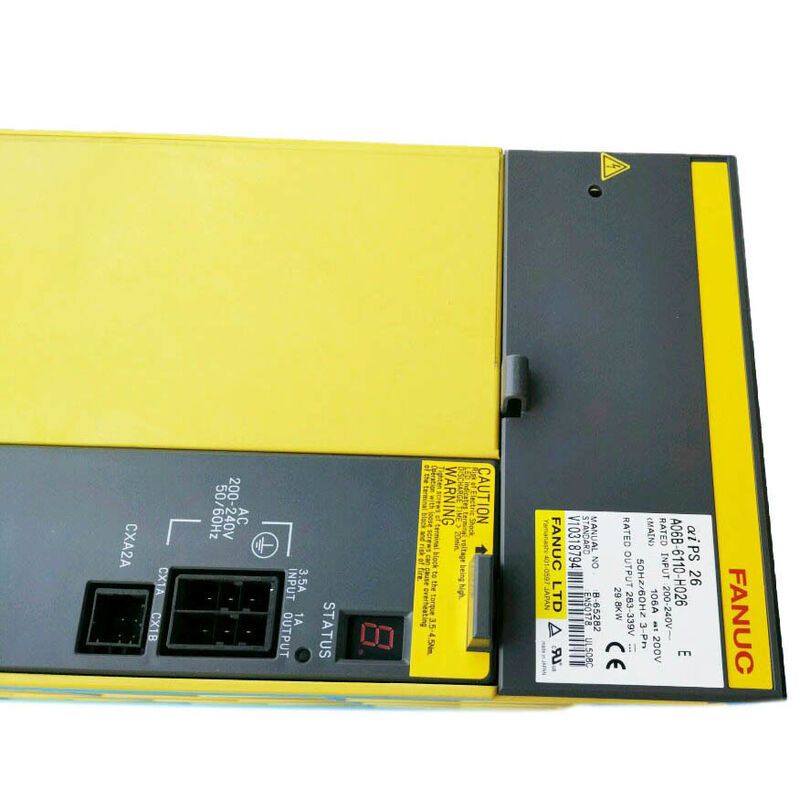
Fanuc A06B-6110-H026 | Alpha i PSM-26i — Service Life, Fan Replacement, Alarm Diagnosis, and the H026-to-H140 Transition
Overview
The Fanuc A06B-6110-H026 is the PSM-26i — the 29.8kW alpha i power supply module that has spent the better part of two decades in production service on 16i/18i and 0i-equipped machining centres worldwide.
The module entered service as part of Fanuc's first-generation alpha i drive system, delivered reliable performance through the machine lifetimes of thousands of installations, and is now routinely encountered by maintenance engineers dealing with equipment that has been running continuously since the mid-2000s.
At that age, the operational question is not whether the PSM-26i is correctly specified for the machine — it was, when the machine was built.
The question is where the module sits in its service life, which components are approaching end of useful life, and how to plan intelligently around an eventual failure.
This article approaches the PSM-26i from that angle: maintenance planning, alarm interpretation, and the decision between repair, exchange, and upgrade to the second-generation A06B-6140-H026.
Key Specifications
| Parameter |
Value |
| Input Voltage |
200–240V AC, 3-phase |
| Rated Input Current |
106A at 200V |
| Input Frequency |
50Hz |
| DC Bus Output |
283–325V DC |
| Rated Output Power |
29.8kW |
| Power Factor |
>0.98 |
| Efficiency |
~92% |
| Internal Fan |
A90L-0001-0441#39 |
| External Heatsink Fan |
A90L-0001-0509 |
| PCBs |
Control PCB + Power card |
| Successor |
A06B-6140-H026 |
| CNC |
16i-B, 18i-B, 21i-B, 0i-A/B |
The Fan Population — Two Units, Two Replacement Priorities
The PSM-26i carries two fans with different thermal roles and slightly different failure consequences.
A90L-0001-0441#39 (internal fan) circulates air inside the module housing across the control PCB and associated electronics. Its failure is announced by AL-2.
The bearing in this fan runs continuously whenever the machine is powered — on a machine running two or three shifts, that is seventeen to twenty-four hours daily for the machine's entire service life. Bearing wear is cumulative.
A fan that has been running since 2005 on a three-shift machine has accumulated over 100,000 hours of bearing rotation. Fan bearings at that service level are statistically overdue for replacement regardless of whether AL-2 has appeared yet.
A90L-0001-0509 (external heatsink fan) moves air through the external heatsink fins where the power transistors dissipate heat. Its failure is announced by AL-A.
This fan's failure has faster consequences than the internal fan because it directly limits the transistor thermal path — without it, the junction temperature of the power IGBTs climbs under load, and AL-3 (heatsink over-temperature) follows within minutes at rated power.
Both fans are stocked spare parts, available separately, and replaceable without exchanging the module.
On any PSM-26i in a machine that has been running since the H026's production era (mid-2000s to late 2000s) without documented fan replacement, both fans qualify as candidates for proactive replacement during a scheduled maintenance stop.
Alarm AL-1 on the PSM-26i — Not a Generic Overcurrent
AL-1 on the PSM-26i means the main power module (IPM) has detected a fault condition. The IPM's internal protection triggers on several conditions: transistor junction overcurrent, driver fault, or thermal overstress at the transistor level. Before diagnosing AL-1 as a failed IPM, work through the environmental and load-side causes:
Has the machine recently been moved, vibrated, or suffered a supply quality event?
Loose connections at the input terminals or bus bar can create transient current events that reach the IPM without the module itself being at fault. Are all downstream SVM and SPM modules in good condition?
A failing amplifier transistor drawing excessive current from the bus will present as AL-1 on the PSM-26i. Disconnecting SVM/SPM modules from the bus one at a time while observing whether AL-1 clears isolates a load-side fault.
If AL-1 persists with the bus completely unloaded and the supply confirmed good, the IPM on the power card has likely failed or been damaged, and the module requires exchange or card repair.
AL-5 — Pre-Charge Timeout on an Aging PSM-26i
AL-5 on the PSM-26i indicates the DC bus capacitors did not reach the operating voltage threshold within the expected pre-charge time after power-on.
On a newer module, AL-5 is uncommon. On a module with fifteen or more years of service, it becomes a realistic maintenance event for two reasons.
First, the pre-charge resistor — a current-limiting component that controls inrush into the bus capacitors at startup — can drift in resistance value with age and thermal cycling.
If its resistance has increased significantly from nominal, the pre-charge rate slows and may fail to reach threshold before the timer expires.
Second, the bus filter capacitors themselves accumulate equivalent series resistance (ESR) over years of operation at elevated temperature.
Elevated ESR affects the capacitors' charge acceptance rate and can extend pre-charge time beyond the threshold.
Consistent AL-5 at every power-on in an aging PSM-26i is a signal that the module's pre-charge circuit components require attention — either specialist bench evaluation or whole-unit exchange with a refurbished module that has had its capacitors and pre-charge components inspected or replaced as part of the refurbishment.
The H026-to-H140 Upgrade — When to Move, When to Stay
The A06B-6140-H026 is the second-generation equivalent: same 29.8kW, same 106A at 200V, same 283–339V DC bus, same downstream amplifier compatibility. It is a direct replacement — no parameter changes, no rewiring, no CNC configuration updates. The internal design differences are in component selection and board architecture, updated to address known wear patterns in the A06B-6110 series.
The practical question is timing.
If a PSM-26i has never been serviced, is approaching twenty years of service, and has not had its fans replaced, an AL-2 or AL-A alarm is a reasonable expectation in the near term.
A planned decision to replace the module with the A06B-6140-H026 during the next scheduled maintenance window, before an unplanned failure, has a different downtime and cost profile than an emergency exchange triggered by an unexpected production stop.
For machines where the PSM-26i is still performing reliably and is within reasonable distance from its most recent fan service, continuing with the H026 and planning exchange on the next confirmed fault is equally valid.
The decision is a planning exercise around the machine's production criticality and the cost differential between planned and unplanned downtime.
FAQ
Q1: Both the A06B-6110-H026 and the A06B-6140-H026 are available from the aftermarket. How does a buyer determine which to source as a replacement?
Either module will function correctly as a replacement — they are electrically and mechanically equivalent in the machine. The A06B-6140-H026 is the current-generation design and represents the latest board revision for this power class.
For a machine expected to run another five to ten years, the A06B-6140-H026 is arguably the forward-looking choice. For cost-sensitive situations where a tested, warranted A06B-6110-H026 exchange is available at lower cost, it remains fully valid. The choice is not one of function but of service life expectancy and economics.
Q2: The leakage detection circuit in the PSM-26i generates an alarm before a complete ground fault develops. At what point should leakage detection warnings be acted on?
Any confirmed leakage detection alarm warrants investigation rather than acknowledgment and continuation. The circuit detects current flowing to PE that should not be present — a path that indicates insulation degradation in the motor windings or output cable, not a PSM internal fault.
The progressive nature of insulation failure means a motor that generates a minor leakage alarm today may develop a complete winding-to-ground fault within weeks or months. Insulation resistance testing (Megger testing) of the connected motor and output cables at the time of a leakage alarm identifies which motor or cable is the source.
Acting at the leakage detection stage — before complete winding failure — avoids the higher repair cost and longer downtime of a tripped circuit associated with a full ground fault.
Q3: After the PSM-26i is powered on, how long does the pre-charge sequence take before the DC bus is available?
On a correctly functioning PSM-26i, the pre-charge sequence typically completes in approximately three to five seconds after power is applied to the module.
The front-panel LED or display transitions from the pre-charge state to the normal operating indication when the bus voltage reaches its operating range.
If the sequence completes successfully within this window, AL-5 does not appear.
If a particular power-on takes noticeably longer than expected before the normal indication appears — even without AL-5 triggering — the pre-charge circuit components are worth monitoring, as borderline performance often precedes an eventual AL-5 fault.
Q4: Can the A06B-6110-H026 be operated with only one of its two fans functioning?
Operating with either fan stopped is not a supported condition and should not be treated as a temporary workaround. Both fans are required for the module to maintain safe component temperatures at rated output.
The module will continue to operate after AL-2 or AL-A appears — the alarm does not immediately shut the module down in all configurations — but thermal margins are reduced and the timeline to AL-3 (heatsink over-temperature shutdown) or control board damage depends entirely on ambient conditions and actual load.
Fan replacement is the correct response to either alarm.
Q5: Is it normal for the PSM-26i to generate any audible noise during operation, and when does noise indicate a problem?
A correctly operating PSM-26i produces a consistent, moderate-frequency airflow noise from its two fans, and may produce a faint switching noise from the active front-end IGBT stage.
A sudden change in fan tone — a lower pitch, a roughness or intermittent vibration — is an early warning of bearing wear and should be treated as a precursor to an AL-2 or AL-A event.
A new, higher-pitched whine or buzzing from the module body that was not present previously can indicate a mechanical resonance from a loose component, a capacitor in distress, or an abnormal electrical condition in the bus circuitry.
Any unusual new noise in the PSM-26i warrants investigation rather than dismissal.


 Your message must be between 20-3,000 characters!