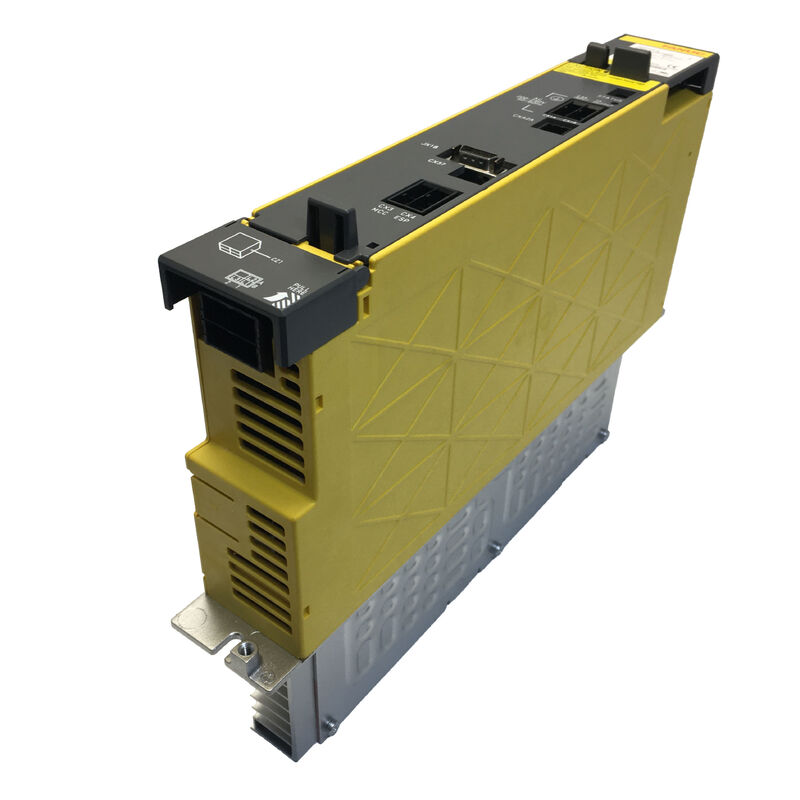
Fanuc A06B-6110-H037 | Alpha i Power Supply Module PSM-37i (aiPS-37) — 43kW, 200–240V, 153A, Drive System Load Sizing, Power Board A16B-2203-0632, 16i/18i/0i CNC
Overview
The Fanuc A06B-6110-H037 is the PSM-37i — the 43kW member of the A06B-6110 first-generation alpha i power supply family, sitting between the PSM-26i (29.8kW) and the PSM-55i (65kW) in the 200V line.
At 153A rated input at 200V, the PSM-37i serves mid-to-large machine tool configurations where a PSM-26i falls short but the full capacity of a PSM-55i would be excess for the connected amplifier load.
Its 150mm housing, power board A16B-2203-0632, and 43kW capacity define a module that was specified for machines built from the early to mid-2000s through the end of the first-generation alpha i era — machines that in 2025 carry fifteen-plus years of production history behind them.
This article focuses on the PSM-37i from the machine configuration and load calculation perspective: how the 43kW is actually used in practice, what machine types and amplifier configurations belong in the PSM-37i's natural range, and how the 153A input current figures into the facility electrical circuit planning that any machine installation or relocation requires.
Key Specifications
| Parameter |
Value |
| Input Voltage |
200–240V AC, 3-phase |
| Rated Input Current |
153A at 200V |
| Input Frequency |
50/60Hz |
| DC Bus Output |
283–339V DC |
| Rated Output Power |
43kW |
| Power Board |
A16B-2203-0632 |
| Dimensions |
~380mm × 150mm × 272mm |
| Weight |
~10.7 kg |
| Regeneration |
Active |
| CNC |
16i, 18i, 21i, 0i-A/B/C |
| Amplifiers |
A06B-6114 SVM, A06B-6120/6121 SPM |
| Replaced By |
A06B-6140-H037 |
Where 43kW Sits in the Alpha i Drive System
Every machine equipped with an alpha i drive system has a PSM chosen to supply the total simultaneous power drawn by all SVM and SPM modules on the shared DC bus. The selection method in Fanuc's alpha i configuration documentation asks the designer to sum the output power ratings of all connected amplifiers, apply a simultaneity factor (typically 0.7 to 0.8), and choose the PSM whose continuous rating exceeds the result.
In practical machine categories, the PSM-37i covers the space between two groups. The PSM-26i at 29.8kW serves machining centres with spindle power in the 7.5kW–11kW range and two to four medium-frame servo axes — a combined load that, with simultaneity factors applied, falls comfortably below 29.8kW.
The PSM-55i at 65kW serves the largest machining centres and five-axis machines where spindle motors above 22kW combine with multiple high-torque servo axes.
The PSM-37i territory — 43kW — lands in the middle: machining centres with 15kW–18kW spindle motors, or machines where a smaller spindle is combined with a larger number of servo axes with higher individual rated currents (gantry-type machines, multi-pallet horizontal machining centres, turning centres with driven tooling and C-axis).
These are common machine types in the automotive, aerospace, and precision engineering sectors that define the bulk of Fanuc's installed base, which is why the PSM-37i became one of the more widely used modules in the alpha i family during its production years.
The 153A Input — Facility Electrical Requirements
At 200V input, the PSM-37i draws 153A at rated output. This is not a number to underestimate in facility planning. Three-phase 153A at 200V represents approximately 53kVA of apparent power. The circuit feeding this module must be adequately protected and cabled.
Circuit protection: A 200A circuit breaker with a Class D or K trip characteristic is typically appropriate for the 153A continuous load and the startup inrush transient.
The exact breaker size and trip curve depend on the cable impedance and the specific breaker range; the Fanuc alpha series installation manual (B-65162) and the facility's electrical standards govern the final selection.
Cable sizing: 153A continuous at the installation's ambient temperature, conduit fill, and cable routing geometry determines the required conductor cross-section per IEC or NEC standards.
Undersized cables present a fire hazard and a voltage drop problem — excessive supply cable impedance under 153A load will produce measurable voltage sag at the PSM-37i terminals, which can cause AL-6 (input supply abnormal) or contribute to DC bus voltage variations.
AC reactor: The Fanuc alpha i series documentation specifies an AC line reactor appropriate for the PSM-37i's input current class. At 153A, the harmonic current content without a reactor can be significant.
The reactor reduces harmonics, limits startup inrush, and protects the module's input rectifier from supply transients.
For machine installations in facilities with other sensitive equipment on the same distribution bus, the reactor is particularly important.
Power Board A16B-2203-0632 and Service Implications
The power board A16B-2203-0632 inside the PSM-37i handles the main circuit functions: IGBT switching stage, DC bus capacitor bank, pre-charge circuit, and bus protection. This board is not available as a separate spare part through standard aftermarket channels.
When a board-level failure is diagnosed in the PSM-37i, the service path is either whole-unit exchange or specialist component-level board repair by a company with the necessary documentation and component inventory.
The board's age on a machine from the 2004–2008 production era is now fifteen to twenty years.
The electrolytic capacitors on this board — the DC bus filter capacitors, the pre-charge circuit capacitors, and the control power supply capacitors — have finite service lives that depend on operating temperature and hours.
Capacitors operating near the upper edge of their rated temperature (which in a cabinet without adequate ventilation is realistic) age faster than those operated conservatively. Visual inspection for capacitor bulging or electrolyte residue on the board surface is a maintenance action worth performing whenever the module is out of service for any other reason.
PSM-37i in Tandem and Multi-PSM Configurations
The A06B-6110-H037 supports tandem operation — two PSM-37i modules sharing a common DC bus to provide a combined 86kW of bus capacity.
This configuration is used in large machining centres where the combined amplifier load exceeds what a single PSM-37i can supply, but the machine builder has chosen to distribute the power supply across two modules rather than a single higher-power unit.
In tandem, both modules connect to the same three-phase supply (via the same or separate circuit breakers), share the DC bus bar, and both contribute their active regeneration front ends to return deceleration energy.
The combined 306A input current (153A from each module) requires the facility supply and circuit protection to be designed for this aggregate demand.
FAQ
Q1: A machine has an SPM module driving a 15kW spindle motor and three SVM modules each connected to a 3kW servo motor. Is the PSM-37i the correct power supply, or would the PSM-26i suffice?
Calculate the simultaneous bus demand: 15kW spindle at 80% load = 12kW; three servo axes at 50% average load each = 3 × 1.5kW = 4.5kW.
Total: approximately 16.5kW at typical machining loads.
This fits comfortably within the PSM-26i's 29.8kW capacity with substantial headroom. However, if the machine's motion program includes sequences where all four axes accelerate simultaneously at high feed rates while the spindle is at full load, the instantaneous peak demand could temporarily exceed 29.8kW.
Perform a peak demand analysis for the worst-case simultaneous acceleration scenario before finalising on the PSM-26i. If the peak demand calculation shows sustained loads approaching or exceeding 28kW, the PSM-37i is the safer selection.
Q2: The PSM-37i has been replaced by the A06B-6140-H037. In a breakdown situation, can the A06B-6140-H037 be fitted without preparing the machine at all?
Yes. The A06B-6140-H037 is electrically and mechanically compatible with the A06B-6110-H037 installation. Same 153A input, same 283–339V DC bus output, same mounting format, same amplifier compatibility.
The replacement requires no parameter changes to the CNC, no wiring modifications, and no adjustments to the downstream SVM or SPM modules.
After installing the A06B-6140-H037, power on the machine, confirm normal PSM status and DC bus voltage within specification, then verify normal axis operation before returning to production.
Q3: Why does the PSM-37i show the output voltage range as 283–339V when the input product label on some units reads 283–325V?
The 283–325V range appears on earlier-specification documentation and some product labels dating from the first-generation alpha i introduction period.
The 283–339V range reflects the actual operating bus voltage window that the PSM-37i's regulation circuit maintains across the full input voltage range of 200–240V.
The higher upper limit (339V vs 325V) provides more regulation headroom as input voltage varies toward the 240V end of the permitted range.
The connected alpha i amplifiers are specified for the 283–339V range; the wider window is operationally correct.
Q4: On a machine with a PSM-37i running at approximately 70% of rated load, how should thermal management be assessed?
At 70% load (approximately 30kW), the PSM-37i produces less heat than at rated 43kW, but the cooling requirement does not scale linearly with output — standby losses and transistor switching losses exist at all load levels.
The heatsink fan and internal fan must be operational regardless of load level. If the cabinet ambient temperature is high (above 40°C), the reduced thermal margin at partial load can still cause AL-3 events if fan performance has degraded.
Thermal assessment should include measuring the ambient temperature inside the cabinet near the PSM-37i at peak production load, confirming that the heatsink fan is moving adequate airflow, and checking the heatsink fins for any accumulation that restricts airflow.
Q5: Is there any difference in the manual reference B-65322 content between the PSM-37i and the PSM-26i? Can the same manual be used for both?
Manual B-65322 covers the Fanuc alpha i series servo amplifier system, which encompasses the A06B-6110 aiPS family including both the PSM-26i (H026) and PSM-37i (H037). The same manual applies to both.
PSM-specific differences — current ratings, power capacity, cooling requirements, input circuit protection specifications — are tabulated in the manual's specification sections by model designation.
For any procedure that references specific current or power values, confirm you are reading the PSM-37i row rather than the PSM-26i row, as the electrical ratings differ significantly at 153A versus 106A input.


 Your message must be between 20-3,000 characters!