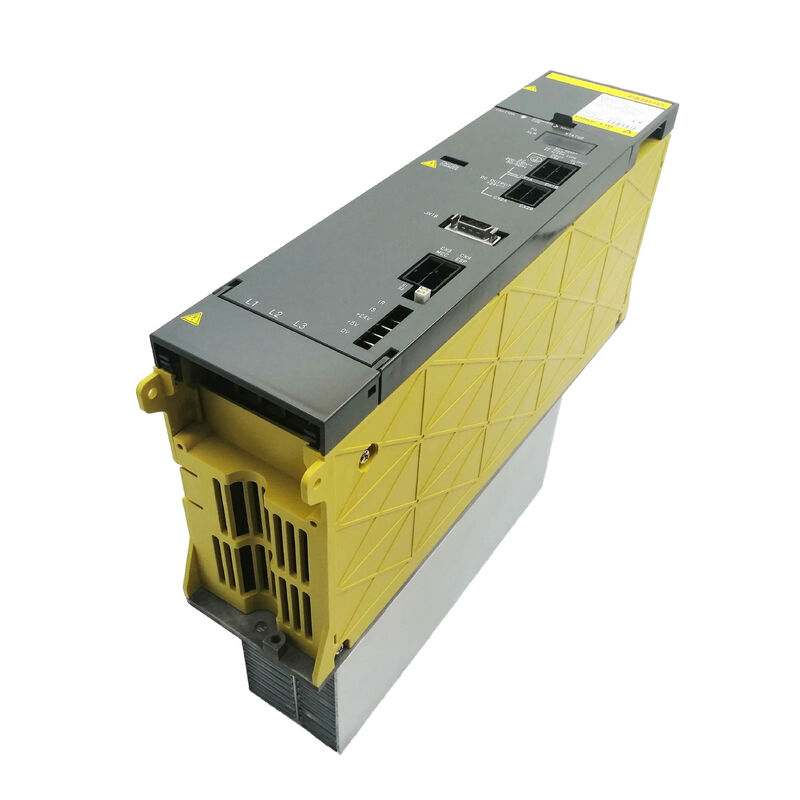
Fanuc A06B-6077-H111 | Alpha Power Supply Module PSM-11 — Servo Power Converter, 13.2kW, 200–230V AC 3-Phase, 49A, 283–325V DC Bus
Overview
The Fanuc A06B-6077-H111 carries the designation "servo power converter" in Fanuc's product classification — and that term captures the module's engineering role precisely. Sitting between the facility's three-phase AC supply and the servo and spindle amplifiers that drive machine axes, the PSM-11 performs the power conversion that makes motion control possible: rectifying and regulating alternating current into the steady 283–325V direct current bus voltage that every alpha series SVM and SPM module on the machine draws from.
In Fanuc's alpha drive hierarchy, the PSM-11 belongs to the A06B-6077 product group — the smaller of the two alpha power supply families, positioned below the A06B-6087 series that covers the PSM-15 through PSM-55.
This family distinction is not cosmetic; the A06B-6077 modules were engineered specifically for compact and small machine tool configurations where the combined drive system power demand fits within 13.2kW.
A machine with a small spindle motor (3.7kW or 5.5kW class) and two or three compact servo axes running the Series 0-D or 16/18/21 CNC is a natural PSM-11 application.
The 13.2kW capacity covers this configuration with adequate margin, and the compact module format (~2.26kg) fits the smaller electrical cabinets that characterise this machine class.
The PSM-11 includes active power regeneration — the same energy-return mechanism as the larger A06B-6087 PSM modules.
When axes decelerate, the motor braking energy is converted back to AC power and fed into the three-phase supply, rather than being burned in a resistor.
For small machines with frequent positioning cycles, this regeneration means cooler cabinets and lower energy draw from the facility supply across a production shift.
The alternative — the PSMR type in the A06B-6081 series — requires a separate external discharge resistor unit; the PSM-11 eliminates that need entirely.
One specification that distinguishes the PSM-11 from other modules in the alpha family is its external forced cooling requirement.
Fanuc's official alpha system documentation explicitly groups the PSM-11 alongside the much larger PSM-45 as modules requiring external forced air.
For a 13.2kW, ~2.26kg module, this might seem unexpected — it reflects the PSM-11's compact housing design, which does not accommodate the self-sufficient heatsink and fan arrangement of the 150mm-wide A06B-6087 modules.
The installation must provide directed airflow across the PSM-11's heatsink surfaces; relying solely on natural cabinet convection at full load will lead to AL03 heatsink over-temperature shutdowns.
Key Specifications
| Parameter |
Value |
| Series |
Alpha A06B-6077 |
| Input Voltage |
200–230V AC, 3-phase |
| Rated Input Current |
49A at 200V |
| Input Frequency |
50/60Hz |
| DC Bus Output |
283–325V DC |
| Output Power |
13.2kW |
| Wiring Board |
A16B-2202-0461 |
| Control Card |
A16B-2202-0420 |
| Internal Fan |
A90L-0001-0422 |
| Regeneration |
Active |
| External Cooling |
Required |
| Weight |
~2.26 kg |
| CNC |
0-C, 0-D, 16, 18, 21, 0i-A |
Servo Power Converter — Understanding the Role in the Alpha Drive Chain
In the alpha drive system's architecture, power flows from the facility supply → PSM → DC bus → SVM/SPM amplifiers → motors. The PSM-11's role in this chain is the AC-to-DC conversion stage.
It does not control motor velocity or position — that is the responsibility of the SVM and SPM modules downstream. What the PSM-11 does is maintain the DC bus at the regulated voltage that all downstream modules depend on, supplying the instantaneous current those modules need when acceleration or cutting loads spike above the average.
The quality of the DC bus regulation directly affects downstream amplifier performance.
Bus voltage swings beyond the 283–325V window — either sags from insufficient supply current or overshoots from regeneration energy arriving faster than it can be returned — produce drive alarms that stop the machine.
The PSM-11's control circuit continuously monitors the bus voltage and adjusts the rectifier's duty cycle to hold the bus within specification, providing the stable supply rail that servo loop quality demands.
The 49A rated AC input at 200V corresponds to approximately 13kW of real power input — closely matching the 13.2kW rated DC output after accounting for conversion losses. This tight relationship between input and output defines the module's thermal efficiency; most of the input power genuinely reaches the DC bus, with a small fraction becoming heat in the switching components.
A06B-6077 vs A06B-6087 — Two Alpha Families, One Bus Concept
The A06B-6077 (PSM-5.5 and PSM-11) and A06B-6087 (PSM-15 through PSM-55) families both produce the same 283–325V DC bus output and use the same active regeneration principle. The differences are in power level, physical format, and compatible board specifications.
A PSM-11 cannot directly replace a PSM-15 in the same cabinet slot — the physical housing dimensions and DC bus connection arrangement differ.
Each family has its own internal boards (the A06B-6077 uses A16B-2202-0461/A16B-2202-0420; the A06B-6087 PSM-15 uses A20B-1006-0470/A16B-2202-042x) and these are not interchangeable.
However, the downstream SVM and SPM amplifier modules are compatible with DC bus power from either family — an SVM module drawing current from a PSM-11 bus and an SVM module drawing from a PSM-26 bus both see the same regulated 283–325V and operate identically from the amplifier's perspective.
Leakage Detection and Alarm Reference
The PSM-11 includes a leakage detection circuit that monitors for ground fault conditions in the connected motor output wiring. This provides early warning of winding insulation degradation before a complete failure develops. Key alarm codes on the PSM-11's front panel display:
AL01 — Overcurrent in the main power module (IPM fault on PSM-11 class — note this differs from PSM-15 and above where AL01 means AC input overcurrent).
AL02 — Control circuit fan stopped. Replace the internal fan (A90L-0001-0422) before continued operation.
AL04 — DC link voltage drop. Check the downstream amplifier modules and bus connections.
AL05 — DC bus pre-charge incomplete. Inspect the pre-charge circuit within the module.
FAQ
Q1: If the PSM-11 requires external forced cooling, what is the minimum airflow arrangement needed in the machine's cabinet?
Fanuc's alpha series installation manual (B-65162) specifies the required airflow for each PSM type. For the PSM-11, the essential requirement is that cool external air — not recirculated cabinet air — is directed across the module's heatsink surfaces.
A dedicated small axial fan mounted to direct external air across the heatsink face, or a cabinet design with a forced airflow path from the cabinet exterior through the PSM-11's heatsink zone, satisfies this requirement.
The airflow volume needed is determined by the heatsink's thermal resistance and the heat generation at 49A input — the B-65162 manual specifies the exact fan type and minimum airflow rate.
Q2: Can the A06B-6077-H111 power alpha i series amplifiers (A06B-6114 SVM) rather than the original alpha SVM modules?
No. The alpha generation PSM (A06B-6077 and A06B-6087) and the alpha i generation aiPS (A06B-6110 and A06B-6140) are architecturally separate.
The DC bus voltage is similar, but the control power distribution, bus bar hardware, and communication architecture between the PSM and downstream amplifiers are specific to each generation.
Alpha i (A06B-6114) SVM modules require an alpha i aiPS (A06B-6110/6140 series) power supply.
Connecting an A06B-6114 SVM to a PSM-11 bus is not a supported configuration.
Q3: What is the consequence of omitting the external forced air cooling on the PSM-11 during machine operation?
Without external forced air cooling, the PSM-11 heatsink temperature will rise during sustained operation. The rate of rise depends on the ambient cabinet temperature and the actual load level.
Under full 13.2kW output in a cabinet without dedicated PSM-11 cooling, AL03 (heatsink over-temperature) will eventually occur. The module shuts down to protect the IPM transistor.
At reduced loads, the heatsink may remain below the AL03 threshold for longer, but the thermal margin is reduced and any ambient temperature increase can tip it over — an unreliable situation for production. External cooling is required, not optional.
Q4: The PSM-11 is listed as compatible with Series 0-C and 0-D controls. Does it also support 0i and 16i/18i controls?
Yes. The A06B-6077-H111 is compatible with the 0i-A control family (which uses the alpha drive system) as well as Series 16 (A/B), 18 (A/B), and 21 (A/B) controls.
The 0-C and 0-D compatibility reflects the earliest digital servo controls in Fanuc's lineup that used the alpha drive architecture.
The PSM-11 continues to serve as the power supply for compact alpha drive systems across all these control generations.
Q5: After fitting a replacement A06B-6077-H111, what checks confirm the module is working correctly?
Power on the machine and observe the PSM-11's front panel indicator — normal operation should show a steady status indication within a few seconds of power application, after the DC bus pre-charge completes. Confirm no alarm appears on the PSM display or on the CNC's servo alarm screen.
Verify the DC bus voltage appears on the SVM module status displays as expected. If all status indicators are normal, run each axis at slow manual jog to confirm servo loop operation before returning the machine to automatic cycle.
Document the pre-replacement alarm code and confirm it does not recur.


 Your message must be between 20-3,000 characters!