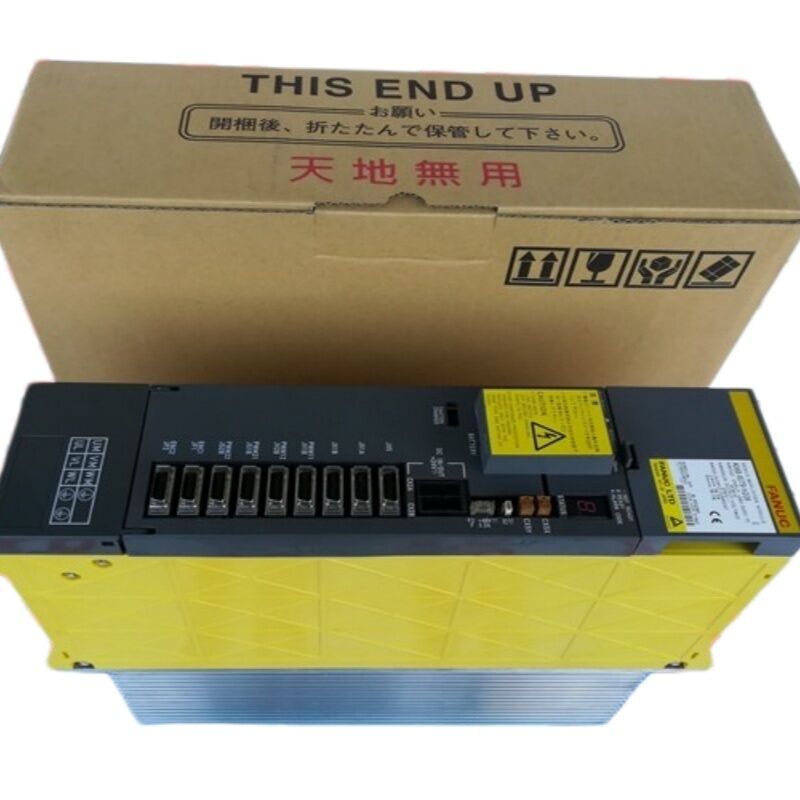
FANUC A06B-6079-H208 Alpha Servo Amplifier Module
Product Overview
The A06B-6079-H208 is a 2-axis FANUC Alpha servo amplifier in the SVM2-80/80 class. In available product and manual references, it appears as a dual-axis module with 18.7 A rated output current on both the L and M axes, 230 V maximum output, and a 9.5 kW rated input.
Its frame belongs to the larger two-axis Alpha amplifier group, which is why it is commonly chosen for machine axes that need more drive capacity while still keeping two servo channels inside one amplifier body.
What makes this model useful in real service work is not simply that it is dual-axis. Its value is in keeping a machine’s original motion structure intact.
When a system was built around a matched 80/80 two-axis amplifier, replacing it with the same class helps preserve axis balance, cabinet layout, and the drive-side relationship already established in the machine.
In practice, that usually means fewer surprises during startup and less need for improvised adaptation.
This is an engineering inference grounded in the module’s documented SVM2-80/80 classification and dual-axis current structure.
Technical Data
| Parameter |
Value |
| Part Number |
A06B-6079-H208 |
| Manufacturer |
FANUC |
| Product Type |
Servo Amplifier |
| Series |
Alpha |
| Model |
SVM2-80/80 |
| Axis Configuration |
2 Axis |
| Rated Input |
9.5 kW |
| Maximum Output |
230 V |
| Rated Output Current |
18.7 A (L axis / M axis) |
| Manual Number |
B-65162 |
| Height |
13.5 in |
| Length |
14 in |
| Width |
3.5 in |
| Country of Origin |
Japan |
Application Value
The A06B-6079-H208 fits best in CNC feed-axis systems, multi-axis machine tools, transfer equipment, and motion platforms where two higher-capacity servo channels need to work from one integrated amplifier.
Because both channels are in the same 80-class output range, the module is especially useful where the machine depends on two similarly demanding axes rather than one light axis and one heavier one.
That makes it a natural choice for installed systems that were originally engineered around a balanced two-axis amplifier instead of separate single-axis drives.
This application view follows from the model’s documented SVM2-80/80 structure and current ratings.
Its physical format also adds value. Available dimensional listings and Alpha manual references place this model in a cabinet-friendly amplifier class, and reseller descriptions also note an external-heatsink style configuration.
In practical panel terms, that matters because replacement success depends not only on electrical matching, but also on airflow, mounting fit, and service clearance.
A correct amplifier that does not suit the original cabinet geometry can create avoidable installation problems.
This is an engineering inference based on the model’s published dimensions and Alpha amplifier family format.
Replacement and Maintenance Perspective
For maintenance teams, the strongest reason to choose the A06B-6079-H208 is exact continuity.
This is not the sort of amplifier that should be selected by rough similarity.
The number of axes, the current class on both channels, the cabinet size, and the Alpha-system context all matter.
In real machine support, the right two-axis amplifier usually saves more time than a “close enough” alternative because it preserves the original electrical logic and reduces recommissioning risk.
This is an engineering inference based on the model’s documented dual-axis 80/80 configuration and size class.
FAQ
Q1: What type of amplifier is A06B-6079-H208?
It is a 2-axis Alpha servo amplifier in the SVM2-80/80 class, built to run two servo channels of the same output class from one module.
Q2: Why is the 80/80 structure important?
Because both axes share the same drive class, which is useful in machines where two servo channels carry similar load demands.
In service work, that balanced structure is often the key reason this exact model is required.
This is an engineering inference from the published current ratings and model designation.
Q3: What kinds of applications suit this model best?
It suits multi-axis CNC and automation systems where two higher-capacity feed axes are grouped into one amplifier body.
That makes it especially useful in machines designed around integrated dual-axis drive architecture.
This is an engineering inference based on the module’s two-axis 80/80 format.
Q4: Why do cabinet dimensions matter with this amplifier?
Because servo amplifiers are installed as part of a thermal and mechanical system, not just an electrical one. Matching the original frame size helps preserve airflow, mounting fit, and service clearance.
This is an engineering inference supported by the published dimensions and Alpha amplifier family layout.
Q5: What should a buyer verify before ordering?
Check the installed part number, axis count, current class, cabinet space, and the surrounding Alpha drive configuration.
Those checks usually matter far more than appearance alone.



 Your message must be between 20-3,000 characters!