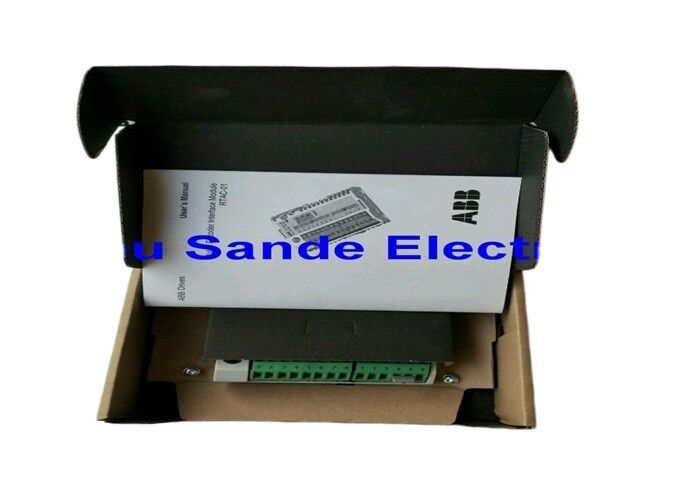
ABB RTAC-01 Pulse Encoder Interface Module
For ACS800 & DCS800 Drives | 15V / 24V DC | Differential & Single-Ended | Channels A/B/Z | Max 200 kHz | IP20 | 1.5 kV Isolation | SLOT 1 / SLOT 2 | Part No. 3AFE64610805
When Speed Feedback Accuracy Actually Matters
Open-loop AC drive control is adequate for many applications. Fans, pumps, simple conveyor systems — these do not need to know exactly how fast the motor shaft is turning. But the moment a process demands tight speed regulation under varying loads, position-controlled motion, or coordinated multi-drive synchronization, open-loop operation runs out of capability fast.
Closing the loop requires feedback. Real, shaft-level feedback. The ABB RTAC-01 is the option module that delivers it for ABB ACS800 and DCS800 drive platforms — a compact interface card that translates the raw pulse output of a standard incremental encoder into the speed and position data the drive's control firmware needs to execute true closed-loop vector control.
Fitting directly into the drive's RMIO board slot or onto an external AIMA-01 I/O Module Adapter on a DIN rail, the RTAC-01 bridges the gap between a physical encoder on the motor shaft and the control intelligence inside the drive — with provisions for both differential and single-ended encoder types, selectable supply voltage, and electrical isolation that protects the drive's sensitive logic circuitry from field-side disturbances.
Technical Specifications
| Parameter |
Value |
| Part Number |
RTAC-01 (3AFE64610805) |
| Manufacturer |
ABB |
| Function |
Pulse encoder interface module |
| Compatible Drives |
ACS800 (Application Program ASXR7000 or later), DCS800 |
| Encoder Input Channels |
A, B, Z (A+/A−, B+/B−, Z+/Z−) |
| Signal Interface Types |
Differential (push-pull), Single-ended (push-pull), Open collector, Open emitter |
| Supply Voltage to Encoder |
15 VDC (default) or 24 VDC — jumper selectable |
| Maximum Output Power |
5W |
| Maximum Input Frequency |
200 kHz |
| Speed Feedback Resolution |
0.00305% (15-bit) |
| Speed Feedback Accuracy |
50 ppm |
| Power Consumption from Drive |
55 mA (of available 250 mA) |
| Isolation |
1.5 kV AC (logic/power to earth, 1 min test) |
| Max Cable Length — Differential push-pull |
300 m |
| Max Cable Length — Single-ended push-pull |
200 m |
| Max Cable Length — Open collector/emitter |
100 m |
| Mounting |
SLOT 1 or SLOT 2 on RMIO board; or AIMA-01 adapter |
| 38-pin Connector |
Auto-connects signal and power on insertion |
| Node ID Range (AIMA-01 mode) |
16–31 (selector S1, positions 0–F; default: 0 = node ID 16) |
| Diagnostic LEDs |
CHA (green), CHB (green), WD/INIT (yellow) |
| Module Dimensions |
95 mm × 34 mm × 20 mm |
| Degree of Protection |
IP20 |
| Operating Temperature |
0°C to +40°C |
Inside the Module: What It Does and How
The RTAC-01's core function is translating a standard incremental encoder's quadrature pulse stream into the feedback the ACS800's motor control firmware uses. Physically, the module has two terminal blocks on its face: X1 for encoder power connections (with the voltage selection jumper for 15V or 24V output) and X2 for the encoder signal connections — the differential pairs for A, B, and Z channels.
On insertion into Slot 1 or Slot 2 of the ACS800's RMIO board, a 38-pin connector automatically makes all signal and power connections to the drive. Two screws secure the module mechanically while simultaneously providing the I/O cable shield earthing point and interconnecting the GND signals between the RTAC-01 and the RMIO board. This combined mechanical and electrical connection arrangement is a practical design detail: correct screw installation is documented in the ABB manual as essential for both EMC compliance and proper module operation.
The encoder signal channels are electrically isolated from the drive's logic circuits, power supply, and earth ground, tested at 1.5 kV AC for one minute. This isolation is what allows the RTAC-01 to be installed in industrial environments where the motor shaft — and the encoder attached to it — may experience electrical disturbances that would otherwise reach the drive's RMIO board directly.
Encoder Types Supported and Cable Length Implications
Four physical encoder output types are accommodated:
Differential push-pull is the highest-performance configuration, supporting cable runs up to 300 metres. The differential pair (A+/A−, B+/B−, Z+/Z−) provides common-mode noise rejection that makes long cable runs viable in electrically noisy environments — the norm in industrial drive applications where encoder cables share cable trays with motor power conductors.
Single-ended push-pull supports up to 200 metres. Only the positive signal from each channel is used; the negative input is left unconnected or handled through the module's internal configuration.
Open collector and open emitter encoders are supported up to 100 metres, with appropriate pull-up resistor configurations required at the module side. For open emitter (sourcing) outputs, the ABB manual specifies pull-down resistor values of 1.0–1.5 kΩ at 0.5W for 15V operation and 1.8–2.2 kΩ at 0.5W for 24V operation.
The 200 kHz maximum input frequency is the ceiling for all encoder types. For a given encoder's pulses per revolution, this translates directly to a maximum supported motor speed — a 1024 ppr encoder hits the 200 kHz limit at approximately 11,700 RPM, which comfortably covers most industrial motor applications.
Power Supply Considerations for the Encoder
The RTAC-01 draws 55 mA from the ACS800's internal 250 mA power supply for its own operation. When the drive's internal supply is also used to power the encoder through the module (via the V OUT terminal on X1), the combined current consumption of the RTAC-01 and the encoder must not exceed the drive's available 250 mA budget.
ABB's manual and product documentation are clear on this constraint: when the drive's internal power supply powers the encoder, additional option modules may not be installed. This is a practical system integration consideration for multi-option configurations — if the application requires both the RTAC-01 and other powered option modules (such as the RDIO-01 digital I/O extension), the encoder supply current budget must be calculated before committing to the configuration.
The solution for power-constrained configurations is an external encoder power supply. When an external supply is used, the voltage selection jumper on the X1 terminal block must be removed to disconnect the drive's internal supply from the V OUT terminal.
The Three Diagnostic LEDs: What They Tell You
The RTAC-01 carries three diagnostic LEDs that provide immediate visual status without requiring a connection to the drive's parameter display:
CHA (green) — Active when the encoder is producing A-channel pulses. A flashing pattern confirms the encoder is turning and the signal is being received. A permanently dark LED during motor rotation suggests signal loss on the A channel — check the encoder connection and cable integrity.
CHB (green) — Same function for the B channel. Both CHA and CHB illuminated and active during rotation confirms valid quadrature signal reception.
WD/INIT (yellow) — Shows the module's operational status. The ABB manual states this LED is lit when the drive is configuring the module (during power-on initialization). Persistent illumination after the initialization period may indicate a communication issue between the module and the drive's RMIO board.
These LEDs are the first diagnostic stop when troubleshooting speed feedback issues on an ACS800 installation. If CHA or CHB shows no activity despite the motor running, the fault isolation is straightforward: encoder hardware, encoder cable, or RTAC-01 module — in that order.
Programming Through Drive Parameters
The RTAC-01 has no standalone configuration interface — it is programmed entirely through ACS800 drive parameters, specifically Parameter Groups 50 and 51 (feedback configuration) and Group 98 (option module configuration). These parameters set the encoder pulse count per revolution, direction logic, and tell the drive which slot contains the module and how the feedback data should be applied to the motor control algorithm.
The WD/INIT LED behavior during power-up is the visual indicator that this parameter exchange is taking place: the drive reads the module's identity through the 38-pin connector, confirms compatibility, and loads the appropriate configuration. No rotary switches, no DIP switches, no standalone commissioning tool — all configuration is handled through the drive's standard parameter environment, which means encoder feedback is set up within the same workflow as all other drive commissioning tasks.
When the module is mounted on an external AIMA-01 I/O Module Adapter rather than directly on the RMIO board, the node ID selector (S1) must be set to a unique address in the range 16–31. The default position 0 corresponds to node ID 16. This node address is what allows the drive to distinguish the RTAC-01 from other modules on the same adapter.
Frequently Asked Questions
Q1: Can the RTAC-01 be used with encoders that have a supply voltage requirement other than 15V or 24V?
The module supplies either 15V DC (default, jumper between terminals 4-5 on X1) or 24V DC (jumper between terminals 5-6 on X1) to the encoder through its V OUT terminal. Encoders requiring other supply voltages — 5V TTL encoders being the most common example — must be powered from an external supply, with the jumper removed from the module's X1 terminal to disconnect the internal supply from V OUT. Note that the RTAC-01 is specifically designed for 15V and 24V encoder signal levels; for 5V TTL encoders, ABB offers the RTAC-03 module, which is purpose-built for the TTL level interface. Connecting 5V TTL encoder signals to an RTAC-01 configured for 15V or 24V supply will not produce valid signal reception.
Q2: What is the maximum encoder cable length when using the RTAC-01 with a differential push-pull encoder?
ABB's RTAC-01 User's Manual specifies a maximum cable length of 300 metres for differential push-pull encoder connections. This represents the best-case cable run capability and applies only when using properly shielded twisted-pair cable, with the shield grounded at the module's SHLD terminal (earthing screws on the module). Longer runs with marginal shielding, or parallel routing near high-current motor cables, reduce effective noise margin even within the specified cable length. For demanding installations near variable frequency drives, cable segregation and proper shielding practice are the primary determinants of reliable encoder signal quality at long cable distances.
Q3: The WD/INIT LED stays lit after power-up and the drive shows a fault. What should be checked first?
The WD/INIT LED illuminates during the initialization sequence when the drive configures the module through the 38-pin connector. If it remains lit beyond the normal startup period, the drive-to-module communication has not completed successfully. The most common causes are mechanical: the module is not fully seated in the slot (the retaining clips have not locked), the two screws are not fully tightened (which affects both GND connections and EMC performance), or the module is inserted into the wrong slot (verify against the drive documentation for the ACS800 variant in use). If mechanical seating is confirmed, check that the ACS800's Application Program version is ASXR7000 or later, as earlier versions do not support the RTAC-01. Finally, verify drive parameters in Group 98 are configured to recognize the module in the correct slot.
Q4: Can the RTAC-01 be installed in an ACS800 that already has other option modules in both slots?
The RTAC-01 occupies one of the two option slots (SLOT 1 or SLOT 2) on the ACS800's RMIO board. If both slots are already occupied by other option modules, the RTAC-01 can alternatively be installed on an AIMA-01 I/O Module Adapter, which mounts on a DIN rail and connects to the drive via a separate cable. When using the AIMA-01, the node ID selector on the RTAC-01 must be set to a unique address. Additionally, the 250 mA power supply budget shared across all option modules must be checked: if the RTAC-01's 55 mA consumption, combined with the current requirements of the other installed options and the encoder itself, approaches the 250 mA limit, an external encoder supply is required.
Q5: Is the RTAC-01 compatible with both the ACS800 and DCS800 drive series?
Yes. The RTAC-01 is specified by ABB for use with both the ACS800 AC drive platform and the DCS800 DC drive platform. The ACS800 compatibility requires Application Program version ASXR7000 or later. For DCS800 installations, the applicable firmware version requirement should be verified against the DCS800 system documentation. The physical installation procedure — SLOT 1 or SLOT 2 on the RMIO board, 38-pin automatic connection, two screw securing and earthing — is the same for both drive families. Programming is performed through the respective drive's parameter groups, with the specific parameter numbers differing between the ACS800 and DCS800 firmware environments.



 Your message must be between 20-3,000 characters!