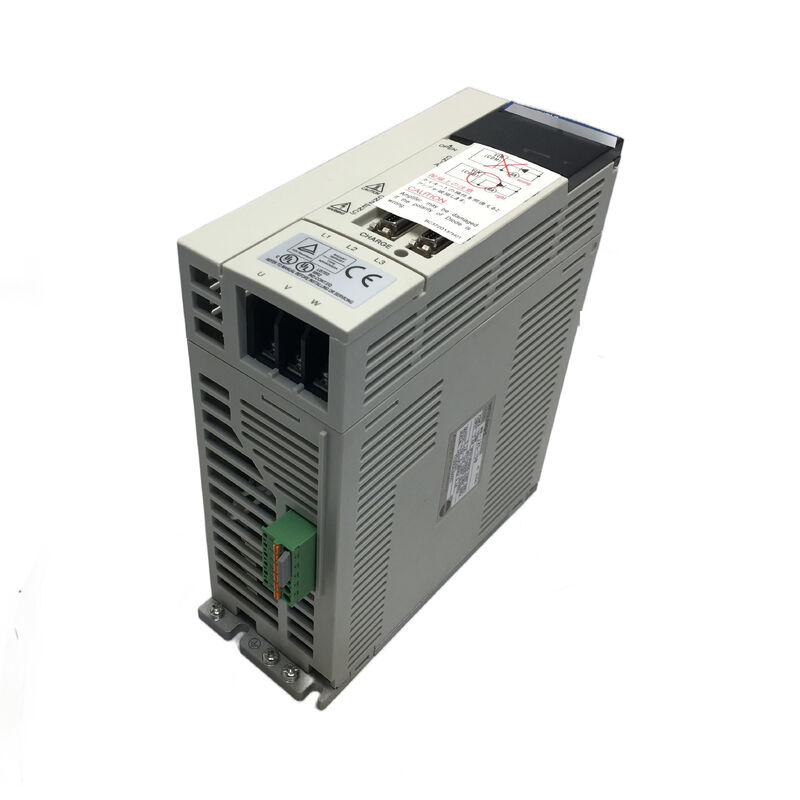
Mitsubishi MR-J2S-70A AC Servo Amplifier — 750W MELSERVO J2S Drive for Precise Motion Control
Running a servo system well starts with the amplifier. The motor gets the attention, but it's the drive that reads the position feedback, calculates the correction, and fires the output stage hundreds of times per second to keep the axis where it's supposed to be. The Mitsubishi MR-J2S-70A is the 750 W amplifier in the well-established MELSERVO J2S series — a general-purpose AC servo drive that handles position, speed, and torque control with the reliability that Mitsubishi's industrial servo platform is known for.
What MELSERVO J2S Brought to the Table
The J2S series represented Mitsubishi's significant step forward from the earlier J2 generation. The headline improvement was the servo motor encoder: J2S-paired motors use a 17-bit absolute encoder (131,072 pulses/rev), which delivers considerably finer resolution and position accuracy than the J2 series predecessor. For the amplifier side, this translates to a tighter, more stable control loop — the drive is working with more position data per revolution, so speed and position commands track more cleanly, especially at low speeds and during fine positioning.
The J2S also introduced real-time auto-tuning, which continuously monitors the machine dynamics and adjusts servo gain settings accordingly. On a machine where load characteristics change — a robot arm moving through different configurations, or a grinding wheel that changes mass as it wears — the auto-tuning function keeps the loop stable without manual intervention.
Technical Specifications
| Parameter |
Value |
| Part Number |
MR-J2S-70A |
| Manufacturer |
Mitsubishi Electric Corporation |
| Series |
MELSERVO J2S |
| Rated Output |
750 W |
| Input Power |
1-phase or 3-phase, 200–230 V AC, 50/60 Hz |
| Input Current (rated) |
3.8 A |
| Output Voltage |
3-phase, 170 V AC |
| Output Current (rated) |
5.1 A |
| Output Frequency Range |
0–360 Hz |
| Control Method |
Sine wave PWM / current control |
| Control Modes |
Position / Speed / Torque (switchable) |
| Max. Input Pulse Frequency |
500 kpps (differential receiver) / 200 kpps (open collector) |
| Analog Input Range |
±10 V DC (speed), ±8 V DC (torque) |
| Speed Control Ratio |
1:5000 (analog), 1:2000 (internal speed) |
| Communication |
RS-232C / RS-422 (MR Configurator compatible) |
| Operating Temperature |
0 °C to +55 °C |
| Storage Temperature |
−20 °C to +65 °C |
| Humidity |
Up to 90% RH (non-condensing) |
| Max. Altitude |
1,000 m above sea level |
| Weight |
approx. 3.99 lbs (1.8 kg) |
| Compatible Motor Series |
HC-SFS, HC-KFS, HC-MFS, HC-UFS |
Three Control Modes — One Drive
The MR-J2S-70A is not a dedicated position controller. It handles three distinct operating modes, and critically, it can switch between them on the fly based on digital input signals:
Position control mode — the drive follows a high-speed pulse train from the upstream controller. Each pulse represents a commanded position increment. With up to 500 kpps input pulse frequency from a differential receiver, the drive can follow rapid position commands while the 131,072 ppr encoder provides the feedback resolution to execute them accurately.
Speed control mode — an analog voltage input (0 to ±10 V DC) or one of seven internally programmed speeds defines the target speed. The drive then regulates motor velocity to match, with smooth acceleration and deceleration ramps settable via parameters.
Torque control mode — an analog voltage (0 to ±8 V DC) commands the output torque directly. The speed is limited to a programmable ceiling, and the drive delivers whatever current is needed to maintain the commanded torque up to that speed limit. This mode is used in tension control, press-fit, and clamping applications.
Sine Wave PWM Control — Why It Matters
The MR-J2S-70A uses sine wave PWM current control to drive the motor. The distinction from simpler trapezoidal or six-step commutation methods is significant in practice: sine wave excitation produces smoother torque output with less ripple, which means quieter operation, less mechanical vibration, and better servo performance at low speeds.
At low speeds — creep feeds on a grinding machine, fine positioning on an assembly fixture — the difference between sine wave and trapezoidal commutation is noticeable in vibration level and speed stability. For applications where surface finish or positional accuracy at low speed matters, the sine wave control architecture is part of why the J2S series earned its position as the reference platform for Mitsubishi servo applications during its production era.
The Absolute Position System
MELSERVO J2S documentation states that adding a battery to the servo amplifier converts the system to absolute position operation — no additional hardware required beyond the battery holder. With battery backup active:
- The encoder remembers its position through power cycles
- Machine restart does not require a reference return homing sequence
- After an alarm or emergency stop, the axis position is immediately known
Setting up a home position once during initial commissioning is all that's needed. From that point forward, the absolute system maintains the axis datum indefinitely. For machines with multiple axes and complex homing sequences, eliminating the reference return at every power-up is a tangible productivity gain.
Auto-Tuning — Practical Setup Advantage
Many servo amplifiers require manual gain tuning: the commissioning engineer sets proportional gain, integral gain, and derivative gain based on inertia estimates and measured response, then iterates until the system is stable and responsive. It works, but it takes time, expertise, and re-work when machine characteristics change.
The MR-J2S-70A's real-time auto-tuning handles this continuously. The drive estimates the machine's moment of inertia from the motor's torque and acceleration response, and adjusts the servo gains accordingly. New machines commission faster. Machines where load varies — a robot picking different workpieces, or a spindle with different tooling — stay properly tuned without periodic manual adjustment.
Typical Application Areas
The 750 W rating of the MR-J2S-70A slots it into the mid-range of the J2S amplifier family — capable enough for the majority of CNC axis drive and automation applications, compact enough to fit in a standard control cabinet. It is found driving:
CNC Machine Tool Axes — X, Y, Z feed drives on milling machines, lathes, and machining centers where sub-micron repeatability is demanded
Robotic Arms and SCARA Robots — joint drives where the combination of speed, torque, and absolute position retention covers the application requirements
Automated Assembly Equipment — precision insertion, screwdriving, and press-fit stations where torque control mode provides precise force management
Conveyor and Indexing Systems — speed-controlled web drives and position-controlled rotary index tables
Winding and Tension Systems — material winding applications where torque mode with speed limiting provides accurate tension across different roll diameters
FAQ
Q1: What servo motors are compatible with the MR-J2S-70A?
The MR-J2S-70A is rated at 750 W and pairs with Mitsubishi HC-SFS, HC-KFS, HC-MFS, and HC-UFS series servo motors in the 750 W / 200 V class. Specific compatible motor models include HC-SFS73, HC-KFS73, HC-MFS73, and HC-UFS72. Always confirm compatibility against Mitsubishi's motor-amplifier combination table for your exact motor model.
Q2: Can the MR-J2S-70A accept both single-phase and three-phase power?
Yes. The MR-J2S-70A accepts either single-phase or three-phase 200–230 V AC input at 50/60 Hz. For single-phase 230 V, connect to L1 and L2 and leave L3 open. This flexibility is useful in installations where only single-phase supply is available in the control cabinet.
Q3: Does the MR-J2S-70A support absolute position operation, and what does it require?
Yes — adding a battery to the servo amplifier enables absolute position operation using the 17-bit encoder in compatible J2S series servo motors. Once a home position is set during commissioning, the system retains axis position through power-off. No reference return homing cycle is needed at startup.
Q4: What software is used to configure and diagnose the MR-J2S-70A?
The MR-J2S-70A communicates via RS-232C or RS-422 with a PC running Mitsubishi's MR Configurator software. This allows parameter setting, test operation, gain adjustment, status monitoring, and alarm history review through a computer interface without needing to navigate drive parameters manually via front panel buttons.
Q5: Is the MR-J2S-70A still in production, and what is the current replacement?
The MR-J2S series has been officially discontinued by Mitsubishi Electric and is a mature legacy product. The current-generation replacement is the MR-J4 series, which offers higher resolution encoding, improved auto-tuning, and SSCNET III/H communication capability. However, MR-J2S amplifiers remain widely available through the industrial automation aftermarket for machine maintenance and repair purposes.



 Your message must be between 20-3,000 characters!