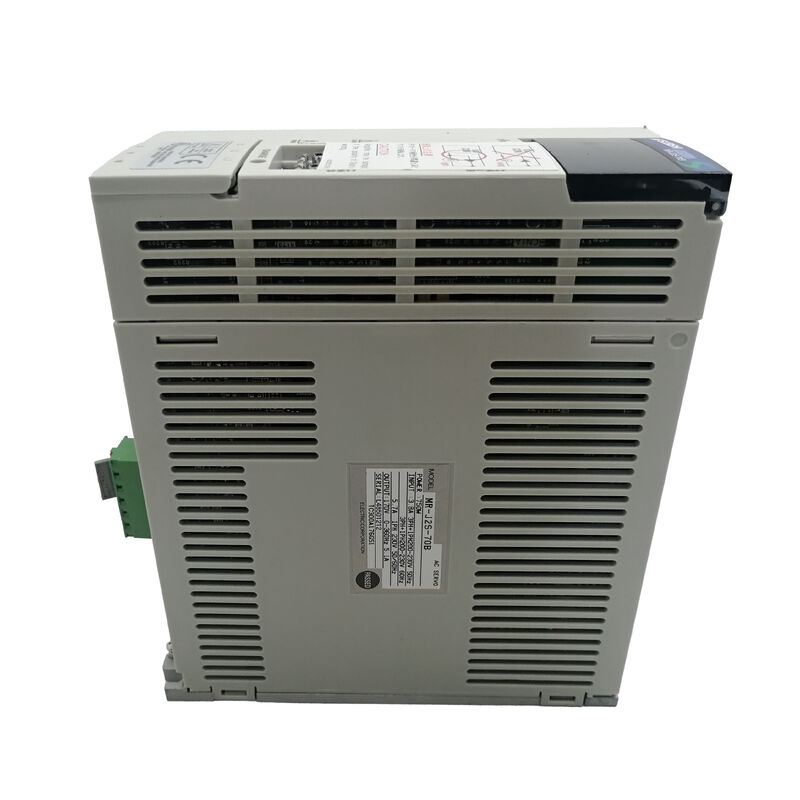
Mitsubishi MR-J2S-70B MELSERVO-J2S AC Servo Drive — 750W SSCNET III/H Amplifier
The Drive That Made SSCNET Motion Control Mainstream
Before EtherCAT and PROFINET dominated the motion control conversation, Mitsubishi's SSCNET high-speed serial bus was doing the same job — synchronizing multiple servo axes with deterministic communication, eliminating the rats-nest of pulse train wiring that multi-axis panel builds used to require.
The MR-J2S-70B is a 750W AC servo amplifier from the MELSERVO-J2-Super series, and the B in its part number is the designation that matters most: it's the SSCNET interface variant, designed to operate as part of a coordinated multi-axis system under a Mitsubishi motion controller.
This drive delivers 0.75 kW of rated output using sinusoidal PWM control with current control method — the combination that produces smooth motor torque, minimal cogging at low speeds, and the kind of axis response that CNC machining and high-cycle automation demand.
It accepts both single-phase and three-phase 200–230V AC input, includes a built-in dynamic brake for controlled axis stopping on servo-off, and uses natural cooling — no forced air, no cooling fan to maintain or fail.
Technical Specifications
| Parameter |
Value |
| Part Number |
MR-J2S-70B |
| Series |
MELSERVO-J2-Super (MR-J2S) |
| Sub-Range |
MR-J2 Series |
| Rated Output |
750W (0.75 kW) |
| Supply Voltage |
200–230V AC (200V class) |
| Input Phase |
Single-phase (2P) or 3-phase (3P) |
| Control Method |
Sinusoidal PWM / Current control |
| Communication Interface |
SSCNET III/H |
| Dynamic Brake |
Built-in |
| Cooling Method |
Natural cooling |
| Operating Temperature |
0 to +55°C |
| Compatible Motors |
HC-KFS, HC-MFS, HC-UFS series |
| Weight |
1.72 kg (3.79 lbs) |
| Status |
Discontinued by manufacturer |
Protection Functions: Overcurrent shut-off · Regeneration overvoltage shut-off · Overload shut-off (electronic thermal) · Servo motor overheat protection · Encoder fault protection · Regeneration fault protection · Undervoltage / sudden power outage protection · Overspeed protection · Excessive error protection
SSCNET III/H — What the B Interface Actually Delivers
The B suffix is what separates this drive from the MR-J2S-70A (pulse/analog interface) and positions it as a networked motion control component rather than a standalone drive. SSCNET III/H is Mitsubishi's high-speed serial servo network — it connects multiple servo amplifiers to a motion controller over a dedicated fiber-optic or serial cable, with synchronized communication that keeps all axes phase-locked to each other.
What this means in practice: interpolated multi-axis motion, electronic gearing, cam profile following, and coordinated feed axis control are all possible without the parameter-matching headaches that come with pulse train systems.
The motion controller handles trajectory planning; the SSCNET bus delivers the synchronized commands to each amplifier simultaneously; each amplifier handles the inner velocity and current loops locally.
The architecture is clean, and the MR-J2S-B series was the platform that brought it into widespread use on mid-range CNC machines and automated equipment.
Sinusoidal PWM and Natural Cooling
Sinusoidal PWM control generates a motor current waveform that closely approximates a true sine wave rather than the stepped approximation of older trapezoidal commutation.
For the motor, this means lower torque ripple, smoother rotation at low speeds, and less heat generated per revolution — which directly benefits surface finish in machining applications and reduces acoustic noise in equipment where that matters.
Natural cooling on the MR-J2S-70B means the drive dissipates heat through its heatsink fins to the surrounding air without an internal fan.
This removes one potential failure mode — fan failures are a common cause of drive thermal shutdowns — but it also means the drive needs adequate free air space around it in the cabinet.
Mitsubishi specifies minimum clearances above and below the unit; ignoring these in a packed cabinet is the most common reason drives in this series run hot.
Compatible Motor Series
The MR-J2S-70B is designed for use with Mitsubishi HC-KFS, HC-MFS, and HC-UFS series servo motors in the appropriate capacity range for a 750W amplifier.
These are the low-to-medium inertia, small-capacity motors that were the standard pairing for J2S drives on CNC machine tool feed axes and robotic workcells.
If you're sourcing this drive as a replacement, confirm the motor installed on the axis is from one of these series — the J2S amplifier stores motor parameter tables internally, and the motor type must match what the amplifier is configured to drive.
Sourcing Reality
The MR-J2S-70B has been discontinued by Mitsubishi Electric. Available supply comes from surplus inventory, refurbished exchange units, and repair services.
For machines where a SSCNET-based motion system is still in active production use, replacing like-for-like with a tested MR-J2S-70B is the path of least resistance — swapping to a different drive generation requires parameter migration, SSCNET compatibility assessment, and potentially motion controller firmware updates.
Frequently Asked Questions
Q1: What is the difference between the MR-J2S-70B and the MR-J2S-70A?
A: The only difference is the communication interface. The 70A uses a pulse train and analog input interface — standard for standalone positioning or velocity control from a PLC pulse output.
The 70B uses SSCNET — it communicates with a Mitsubishi motion controller over a high-speed serial bus and is designed for coordinated multi-axis motion control. The two are not interchangeable in an existing system.
Q2: What Mitsubishi motion controller is required to use the SSCNET B interface?
A: The MR-J2S-70B connects to Mitsubishi motion controllers that support the SSCNET protocol — typically the Q17nCPUN, QD77MS, or similar Q-series motion modules.
The specific compatible controller depends on your system configuration. SSCNET III/H on the J2S series is not the same as later SSCNET III/H versions — verify compatibility with your controller before mixing drive generations.
Q3: Can the MR-J2S-70B be replaced with a newer Mitsubishi drive generation?
A: Mitsubishi offers upgrade paths from J2S-B to J4-B using renewal tools (MR-J2S renewal kit), which allow the existing SSCNET wiring and motion controller to remain in place while the drive is modernized. This is a planned migration option rather than a direct swap — it requires additional hardware and parameter configuration work.
Q4: What happens to the axis if power is lost while the drive is running?
A: The built-in dynamic brake activates automatically on power loss or when the servo-off signal is received — it shorts the motor windings through a resistor to decelerate the axis.
The undervoltage and sudden power outage protection also triggers, logging the fault. For vertical axes or applications requiring guaranteed holding after power loss, an external mechanical brake on the motor is still recommended.
Q5: Is the MR-J2S-70B compatible with single-phase power?
A: Yes — the MR-J2S-70B accepts both single-phase 200–230V AC and three-phase 200–230V AC input. Single-phase operation is available for installations where three-phase supply is unavailable, but input current per phase is higher in single-phase mode.
Check the supply wiring and breaker sizing against the drive's single-phase input current specification before connecting.
The MR-J2S-70B is a discontinued industrial servo amplifier. Confirm SSCNET version compatibility, motor type, and motion controller interface before sourcing a replacement.



 Your message must be between 20-3,000 characters!