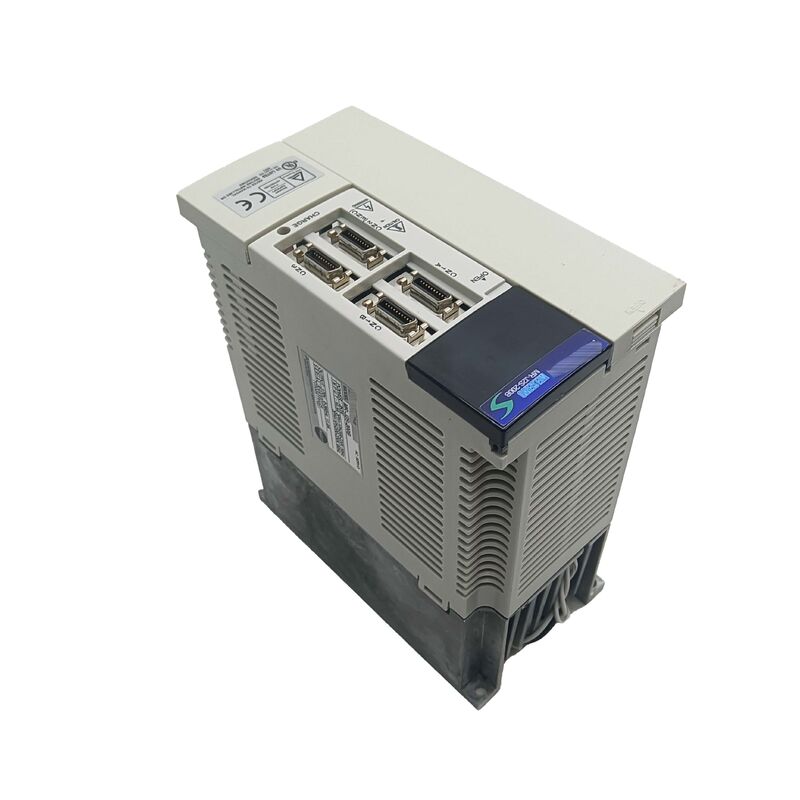
Mitsubishi MR-J2S-200B | MELSERVO J2S SSCNET Servo Amplifier — 2kW, 10.5A, 200–230VAC, Built-In Dynamic Brake, 550Hz Response, HC-SFS/HC-RFS Motors — Discontinued
Overview
The Mitsubishi MR-J2S-200B is the 2kW SSCNET variant of the MELSERVO J2S servo amplifier family — the "-B" suffix identifying it as a network-bus controlled drive rather than the pulse-train input "-A" variant.
Where the MR-J2S-200A takes position commands as a pulse train from a standalone controller or CNC, the MR-J2S-200B receives its motion commands digitally over SSCNET, the Servo System Control NETwork that connects Mitsubishi's Q-series and A-series motion controllers to their servo axes.
This architectural difference defines everything about how the B variant is integrated and used: it is a drive designed to be one node in a multi-axis motion network, not a standalone single-axis controller.
SSCNET communication allows the motion controller to synchronise multiple axes with precise timing coordination.
Each MR-J2S-200B on the network receives its velocity/torque references at the same moment — the serial network delivers commands simultaneously to all connected amplifiers at the network scan rate, enabling the tight inter-axis coupling that interpolated multi-axis motion requires.
For applications like multi-axis gantry systems, coordinated pick-and-place machines, or multi-head printing or cutting systems where axis synchronisation is the primary performance requirement, the SSCNET architecture is the natural solution, and the MR-J2S-200B is the 2kW axis amplifier for those designs.
The sinusoidal PWM / current control method produces the smooth, low-noise motor output that distinguishes modern servo drives from the earlier trapezoidal PWM drives. Sinusoidal commutation means the motor's phase currents follow a smooth sine waveform matched to the rotor's magnetic field angle — the result is very low torque ripple at any speed, which is particularly important in applications like precision material handling, where torque ripple would appear as velocity variation visible in the finished product.
The 550Hz speed loop bandwidth figure reflects how quickly the drive can respond to velocity disturbances — a 550Hz response means the drive can correct a velocity error ten times faster than a conventional industrial drive, which is what enables tight positioning in the face of real-world load disturbances.
Key Specifications
| Parameter |
Value |
| Rated Output |
2000W / 2kW |
| Rated Current |
10.5A |
| Input Voltage |
200–230V AC (170–253V tolerance) |
| Phase |
Single-phase (2P) or 3-phase (3P) |
| Input Frequency |
50/60Hz (±5%) |
| Control Method |
Sinusoidal PWM / current control |
| Network Interface |
SSCNET via CN1A/CN1B |
| Dynamic Brake |
Built-in |
| Cooling |
Forced ventilation |
| Speed Response |
550Hz or higher |
| IP Rating |
IP00 |
| Operating Temp |
0 to +55°C |
| Weight |
~2.0 kg |
| Compatible Motors |
HC-SFS152, HC-SFS202, HC-RFS153, HC-RFS103 |
SSCNET — The Network That Defines the B Series
SSCNET is Mitsubishi's proprietary servo network protocol, and the MR-J2S-200B's CN1A and CN1B connectors are the physical entry and exit points for this network chain.
The motion controller connects to the first amplifier's CN1A, and a cable runs from that amplifier's CN1B to the next amplifier's CN1A, creating a daisy chain that can extend across many axes.
Each amplifier's position in the chain determines its axis number as seen by the controller.
The key performance advantage of SSCNET is that all amplifiers on the network receive their velocity commands synchronously — the controller broadcasts to all axes simultaneously rather than addressing them sequentially.
This timing synchronisation is the foundation of smooth multi-axis interpolation. Without it, axis positions would drift apart in time even if individual axes tracked their commanded profiles perfectly, because small timing differences between axes accumulate into path errors.
With synchronous command delivery, the controller's interpolated path arrives at each axis at the same moment, and the resulting mechanical motion matches the commanded trajectory.
The SSCNET implementation in the MR-J2S series also carries encoder feedback data back to the controller over the same network, eliminating separate feedback wiring between the amplifiers and the motion controller.
The 17-bit absolute encoder signal from the HC-SF motor flows through the amplifier's feedback processing and onto the SSCNET network as digital position data, where the motion controller reads it for the closed-loop position calculation.
Built-In Dynamic Brake
The MR-J2S-200B's built-in dynamic brake circuit activates when the amplifier's servo-on signal (SON) is de-asserted or when a protective fault trips the drive.
The dynamic brake connects a resistor directly across the motor's phases, converting the motor's kinetic energy into heat in the resistor and bringing the motor to a stop more rapidly than unpowered coasting.
This is distinct from a holding brake (an electromagnetic mechanical brake that physically locks the shaft) — the dynamic brake is an electrical braking mechanism that provides controlled deceleration, not a parking lock.
In emergency stop scenarios, the dynamic brake ensures the motor decelerates within the drive's deceleration envelope rather than coasting freely, which protects connected machinery from overshoot and prevents personnel safety hazards from continued motion after the command to stop.
For vertical axes or axes with significant momentum, the dynamic brake shortens the stopping distance meaningfully compared to unbraked deceleration.
Protection Architecture
The MR-J2S-200B's protection system operates in two layers.
The first layer is electronic monitoring within the amplifier: overcurrent shutdown (using the current feedback to detect transistor overload before junction temperature becomes critical), regeneration overvoltage shutdown (preventing DC bus overvoltage during deceleration), and electronic thermal overload (tracking the integrated I²t product of the output current to detect sustained overload before winding damage occurs).
The second layer covers system-level conditions: encoder fault protection (detecting loss or corruption of the 17-bit position data from the motor), undervoltage and power outage detection, overspeed protection (monitoring motor speed against a configurable threshold), and excessive position error protection (detecting when the following error exceeds the allowed band — the classic "servo error overflow" condition that indicates a load jam, mechanical binding, or gain mismatch).
J2S-B vs J2S-A: Choosing the Right Variant
The MR-J2S-200A and MR-J2S-200B share the same rated output, motor compatibility, and control performance.
The difference is the command interface: the A variant accepts pulse train position commands and has CN1 general-purpose I/O for standalone operation, making it suitable for use with any controller that provides pulse output.
The B variant uses the SSCNET bus and is designed specifically for use with Mitsubishi SSCNET-capable motion controllers.
The B variant cannot accept pulse commands — it only operates in a SSCNET network context.
Before specifying a replacement amplifier, confirm the machine's command architecture: pulse-train input machines need the A variant; SSCNET-networked machines need the B variant.
FAQ
Q1: Can the MR-J2S-200B replace an MR-J2S-200A in a machine if the A variant is unavailable?
No. The -A and -B variants are not interchangeable. The -A accepts pulse-train position commands from a CNC or standalone controller via its CN1 I/O connector.
The -B only operates in an SSCNET bus environment and has no provision for pulse-train input.
If an -A is needed and unavailable, the replacement must be a -A variant or a cross-compatible alternative — fitting a -B into a pulse-train application will result in a non-functional drive.
Q2: What Mitsubishi motion controllers are compatible with the MR-J2S-200B's SSCNET interface?
The MR-J2S-200B's SSCNET interface is compatible with Mitsubishi A-series motion controllers (A171SH, A172SH, A173UH) and Q-series motion controllers (Q172, Q173), as well as positioning modules (A1SD75M, QD75M) that output SSCNET commands.
The SSCNET implementation in the MR-J2S series is the original SSCNET protocol — note that later generations use SSCNET III (optical fiber), which is not directly compatible with the MR-J2S copper SSCNET connectors without conversion hardware.
Q3: How does real-time autotuning work in the MR-J2S-200B?
The MR-J2S series real-time autotuning continuously estimates the load inertia attached to the motor shaft by analysing the relationship between the commanded acceleration current and the actual resulting velocity change.
As the estimated inertia is updated, the drive recalculates the proportional, integral, and derivative gain values for the speed and position loops to maintain optimal servo stiffness and damping.
This process happens during normal machine operation — no special tuning motion cycle is required.
The autotuning response level (gain setting) is configurable via parameter to balance responsiveness against vibration suppression, allowing adjustment for machines with varying mechanical compliance.
Q4: The MR-J2S-200B is discontinued — what is the recommended current-production replacement?
Mitsubishi's recommended upgrade path is the MR-J4-200B (MELSERVO J4 series), which maintains the SSCNET interface (now SSCNET III/H optical) and the 2kW power class. The J4 platform brings higher resolution encoders (22-bit on current motors), improved autotuning, and expanded safety function support.
Migrating from J2S to J4 requires replacing both the amplifier and the motor (J4 drives use the current HG-SR/HG-SN series motors, not the HC-SF series).
The SSCNET III/H protocol used by J4 is not backward-compatible with the original SSCNET copper interface, so the motion controller may also need a SSCNET III/H module upgrade.
Q5: What alarm code indicates an encoder fault on the MR-J2S-200B, and how should it be diagnosed?
AL.16 (encoder error) is the primary encoder fault code on the MR-J2S amplifier. It can appear at power-up or during operation.
At power-up, it usually means the encoder cable is not connected or is faulty — inspect the MR-JHSCBL encoder cable and both connectors (amplifier CN2 and motor encoder connector) before assuming encoder failure. During operation, AL.
16 appearing at specific positions suggests a local disc contamination or cable flex issue at a particular orientation.
AL.16 that appears only at high speed points to signal integrity problems at the cable length in use.
For diagnosis, temporarily substitute a known-good cable from another axis with the same motor type and verify whether the alarm follows the cable or stays with the motor/amplifier combination.



 Your message must be between 20-3,000 characters!