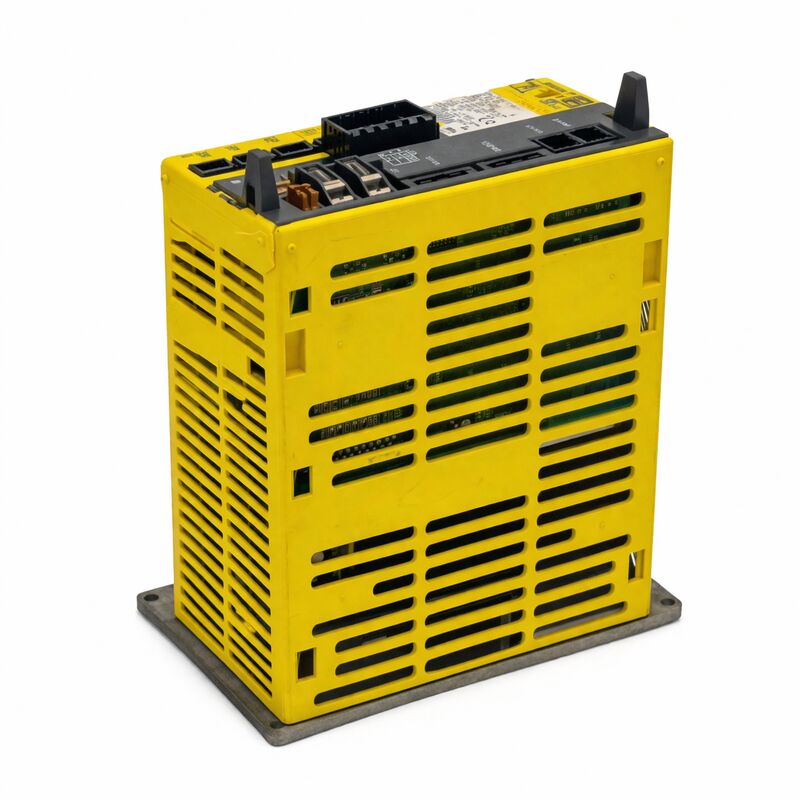
Fanuc A06B-6130-H002 | Beta i Servo Module BSVM1-20i — FSSB Fiber Optic Interface, 240VAC, 8A Input / 6.8A Output, Standalone Power Supply, 0i Series Compatible
Overview
The Fanuc A06B-6130-H002 is the FSSB fiber optic variant of Fanuc's Beta i BSVM1-20i servo module — the same BSVM1-20i module designation as the I/O Link A06B-6132-H002, but connecting to the CNC via FSSB (Fanuc Serial Servo Bus) using a fiber optic cable rather than the I/O Link serial bus.
This interface distinction defines the drive's role in the machine architecture: where the I/O Link variant integrates into the PMM auxiliary axis function, the FSSB A06B-6130-H002 connects directly to the CNC's servo bus as a standard controlled axis — participating in axis interpolation, synchronized motion, and the full range of CNC axis control functions alongside the primary alpha-series drives.
The fiber optic FSSB interface used in the A06B-6130-H002 is the same high-speed serial bus that connects alpha-series SVM modules to the CNC, operating at data rates fast enough to close the position loop at the CNC's interpolation cycle rate.
This gives the Beta i module, despite its more economical power class relative to the alpha-series, full integration into the CNC's motion control architecture.
The CNC treats the FSSB-connected Beta i axis as a controlled CNC axis with the same position feedback, velocity regulation, and alarm monitoring as any alpha-series axis.
A distinguishing design feature of the A06B-6130-H002 is its built-in standalone power supply.
Rather than sharing a common DC bus with other drive modules through a separate power supply module (as alpha-series SVM modules do), the Beta i module rectifies its own AC input locally and generates its own DC bus voltage.
This self-contained design allows the module to be located independently from the main servo drive stack — wherever AC mains power is available on the machine — connected to the CNC only by the fiber optic FSSB cable.
Key Specifications
| Parameter |
Value |
| Module Model |
BSVM1-20i |
| Interface |
FSSB (Fanuc Serial Servo Bus), fiber optic |
| Input Voltage |
240V AC |
| Input Current |
8 A |
| Output Current |
6.8 A |
| Internal Power |
Standalone built-in rectifier |
| Transistor Module |
50A rated |
| Wiring Board |
A20B-2101-0091 |
| Control Card |
A20B-2101-005x |
| Weight |
Approx. 2.76 lbs |
| Compatible Controls |
FANUC 0i-MC, 0i-MD |
FSSB Fiber Optic — Full CNC Axis Integration
Fanuc's FSSB fiber optic serial bus operates as a ring topology connecting the CNC to each drive module in sequence.
The CNC sends position commands and receives encoder feedback for all connected axes simultaneously, at cycle times fast enough for the control loop computations that produce smooth, accurate machining motion.
The A06B-6130-H002's FSSB connection places it on this bus as a full participant — the CNC assigns it an axis letter (A, B, C, or a numbered auxiliary axis), configures its servo parameters, and manages it within the same position loop architecture as the machine's primary X/Y/Z axes.
This full FSSB integration is the critical difference from the I/O Link variant.
An FSSB-connected Beta i axis can interpolate with other CNC axes — for example, a fourth rotary axis synchronized with a linear axis during a helical cutting operation — in ways that I/O Link PMM axes cannot.
For machine builders and users who need an auxiliary axis with true CNC interpolation capability rather than M-code-sequenced auxiliary motion, the FSSB Beta i module is the appropriate choice at a lower cost point than the full alpha-series hardware.
Standalone Power Supply — Location Flexibility
The A06B-6130-H002's built-in rectifier and DC bus capacitor bank convert the incoming 240V AC supply directly to the drive's internal DC bus without requiring a separate PSM (Power Supply Module) as the alpha-series SVM architecture does.
This is both a cost advantage (no PSM needed for a Beta i installation) and a layout advantage — the module can be installed at any location that has 240V AC available, connected to the CNC via a single fiber optic cable run.
In machine tool installations, this means a fourth-axis rotary table drive can be mounted in a compact satellite enclosure near the rotary table mechanism, with only the fiber optic cable running back to the main CNC cabinet.
The machine builder avoids running a heavy DC bus cable from the main cabinet to the remote axis location, which simplifies the machine's wiring design and reduces installation time.
The standalone supply also means the A06B-6130-H002 has its own fault isolation — a DC bus fault in the Beta i module does not affect the main drive stack's power supply and does not interrupt the primary machine axes.
FAQ
Q1: What is the fundamental difference between A06B-6130-H002 (FSSB) and A06B-6132-H002 (I/O Link)?
Both modules are physically the BSVM1-20i with identical power ratings — 8A input, 6.8A output, 240VAC.
The difference is entirely in the communication interface. The H002 in the 6130 series uses FSSB fiber optic, connecting as a full CNC axis that can participate in interpolated machining motions.
The H002 in the 6132 series uses I/O Link, operating as an auxiliary axis managed through the PMM function with M-code-driven position commands.
Choosing between them depends on whether the axis needs full CNC interpolation capability (choose FSSB) or simpler auxiliary positioning (choose I/O Link).
Q2: Which fiber optic cable connects the A06B-6130-H002 to the CNC?
The FSSB fiber optic cable uses Fanuc's standard plastic optical fiber interface — the same physical fiber type used to connect alpha-series SVM modules.
The cable is typically Fanuc part number A66L-6001-0023 or equivalent plastic optical fiber cable with the proprietary connector on each end.
The cable routes from the CNC's FSSB connector port (or the last drive in the ring chain) to the A06B-6130-H002's FSSB input connector. Maximum allowable cable length depends on the fiber specification — consult the Fanuc connection manual for the specific 0i series control in use.
Q3: Does the A06B-6130-H002 require parameter loading before it will operate, like the I/O Link BSVM1-20i?
Yes. Like all Beta i servo modules, the A06B-6130-H002 requires the motor-specific servo parameters to be loaded from the CNC before the axis will run.
The parameter loading procedure for the FSSB variant uses the CNC's standard servo parameter initialisation sequence — the same procedure used for alpha-series axes.
This means the replacement module will display servo alarm conditions and refuse motion commands until the correct motor parameters (motor model, encoder type, loop gains, etc.) are loaded and saved.
Q4: The alarm indication on the A06B-6130-H002 is a simple LED — how is the fault identified?
The BSVM1-20i uses a basic LED indicator rather than a numeric display. When an alarm occurs, the LED illuminates. The specific alarm code must be read from the CNC's alarm display or the CNC's servo diagnostic screens — the drive's LED alone does not identify the fault type.
On the 0i-MC/MD control, the servo alarm number appears on the operator panel display and is logged in the CNC's alarm history.
This is the authoritative fault source — use the alarm number from the CNC to look up the fault category and follow the corresponding diagnostic procedure.
Q5: Can the A06B-6130-H002 be repaired, or is exchange the only practical option?
Repair is technically possible but limited by component availability. The 50A transistor modules and internal fan are available as service parts; the battery (for absolute encoder backup) is a standard consumable.
However, the control card A20B-2101-005x and wiring board A20B-2101-0091 are not sold separately from the module — if these boards are damaged, the only practical path is module exchange.
Most service providers therefore offer the A06B-6130-H002 as an exchange service: the customer's failed module is evaluated, standard consumable components are replaced and tested, and the reconditioned module is returned or supplied from exchange stock with warranty.


 Your message must be between 20-3,000 characters!