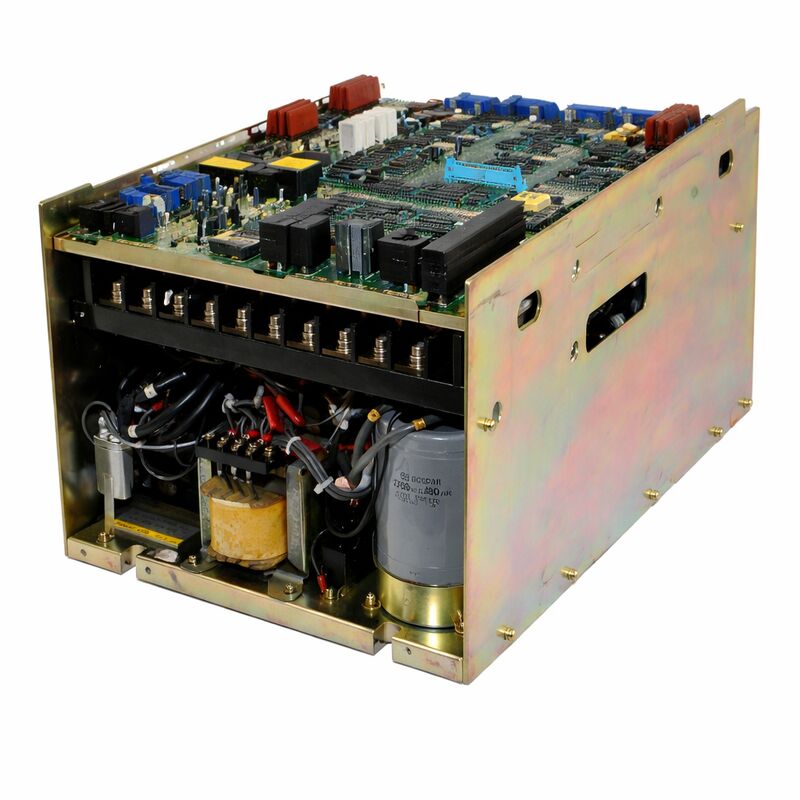
FANUC A06B-6055-H212 AC Spindle Drive Model 12/18P
Overview
The A06B-6055-H212 is a legacy FANUC AC spindle drive commonly identified in the market as model 12/18P, and it is regularly described as a digital spindle drive with external-fin or external-heatsink construction.
Commercial references also associate this model with medium-size CNC machines and older FANUC digital-control environments, which places it firmly in the category of installed-base service parts rather than a current-generation spindle platform.
What makes this model commercially relevant is not novelty, but continuity.
Older spindle amplifiers like the H212 are usually purchased because the machine already depends on the original spindle-drive architecture. In that context, a correct replacement matters more than a broad specification sheet.
Buyers are typically trying to restore spindle readiness, maintain stable machine behavior, and avoid the rework that comes with adapting a different drive family into an older CNC cabinet.
Application and Use Perspective
In practical shop-floor use, the A06B-6055-H212 fits machines where the spindle side of the system still relies on classic FANUC AC digital spindle-drive hardware.
Commercial sources commonly associate it with mills and lathes, which is consistent with the type of spindle-control role a model 12/18P drive would serve in older CNC machine tools.
That makes it especially relevant for retrofit maintenance, service stock, and exchange-based replacement programs rather than new machine builds.
This type of drive is usually most valuable in environments where downtime costs more than the effort of sourcing the exact legacy part.
If a machine has already been engineered around this spindle-drive family, keeping the same model class helps preserve the original cabinet layout, motor compatibility expectations, and spindle-side control logic.
From a maintenance standpoint, that usually means fewer surprises during restart and less risk of turning a simple replacement into a full system integration project.
This is an inference based on the model’s documented legacy spindle-drive role and the way it is sold into repair and exchange channels.
Why Buyers Still Look for This Model
The H212 remains attractive to technical buyers because it sits in a space many plants still occupy: older but productive machines that are not ready for full electrical modernization. For those users, the priority is usually reliable spindle recovery, not redesign.
A drive in this class is therefore less about headline features and more about preserving established machine behavior, keeping spare-parts strategy practical, and shortening the path back to production when a spindle amplifier fails.
This is an inference from the part’s legacy positioning and repair/exchange availability.
Technical Data
| Parameter |
Value |
| Part Number |
A06B-6055-H212 |
| Manufacturer |
FANUC |
| Product Type |
AC Spindle Drive / Spindle Amplifier |
| Drive Model |
12/18P |
| Construction |
Digital external-fin / external-heatsink type |
| Application |
CNC spindle control |
| Typical Fit |
Legacy machine tools, commonly mills and lathes |
| Product Position |
Legacy / service-replacement spindle drive |
FAQ
Q1: What kind of product is A06B-6055-H212?
It is a spindle drive, not a feed-axis servo amplifier. Market references consistently identify it as a FANUC AC spindle drive model 12/18P, which places it on the spindle-control side of the CNC system rather than the axis-control side.
That distinction matters because spindle drives are selected around spindle motor application, control generation, and cabinet integration, not just around generic amplifier appearance.
Q2: What types of machines is it commonly associated with?
Commercial references tie this model to medium-size CNC machines and commonly mention mills and lathes.
That does not mean every installation is identical, but it does tell a buyer the drive belongs to the real spindle-power section of conventional CNC machine tools rather than to light auxiliary equipment. In service work, that usually points to installed legacy systems where the correct spindle-drive family matters more than cosmetic similarity.
Q3: Why is the external-fin construction relevant?
Because spindle drives generate heat under real machining load, and the external-fin or external-heatsink design is part of how that thermal load is managed in the cabinet.
In practical maintenance terms, that means a replacement should be checked not only for part-number match, but also for mounting position, airflow condition, dust loading, and surrounding cabinet temperature.
A correct drive installed into a poor thermal environment will not give the kind of service life buyers expect.
This last point is an engineering inference based on the documented external-fin construction.
Q4: Is this a good candidate for exact replacement rather than substitution?
Yes, that is usually how parts in this class are treated. Because the H212 is a legacy spindle-drive model tied to older FANUC control environments, exact replacement tends to be safer than trying to adapt a different drive family.
That approach helps preserve spindle-side compatibility, cabinet fit, and startup behavior, especially on older CNCs that were not designed for flexible cross-family substitution.
This is an inference from the model’s documented installed-base use and exchange/repair positioning.
Q5: What should a technician verify before buying A06B-6055-H212?
The first step is to confirm the exact installed part number. After that, it is wise to check the machine’s spindle-drive family, control generation, cabinet space, cooling condition, and the health of the spindle motor and cabling.
On legacy spindle systems, these surrounding factors matter almost as much as the part itself.
Buyers who verify only the housing style and ignore the original application often create longer commissioning work later.
This is an engineering recommendation grounded in the model’s spindle-drive role and legacy service context.


 Your message must be between 20-3,000 characters!