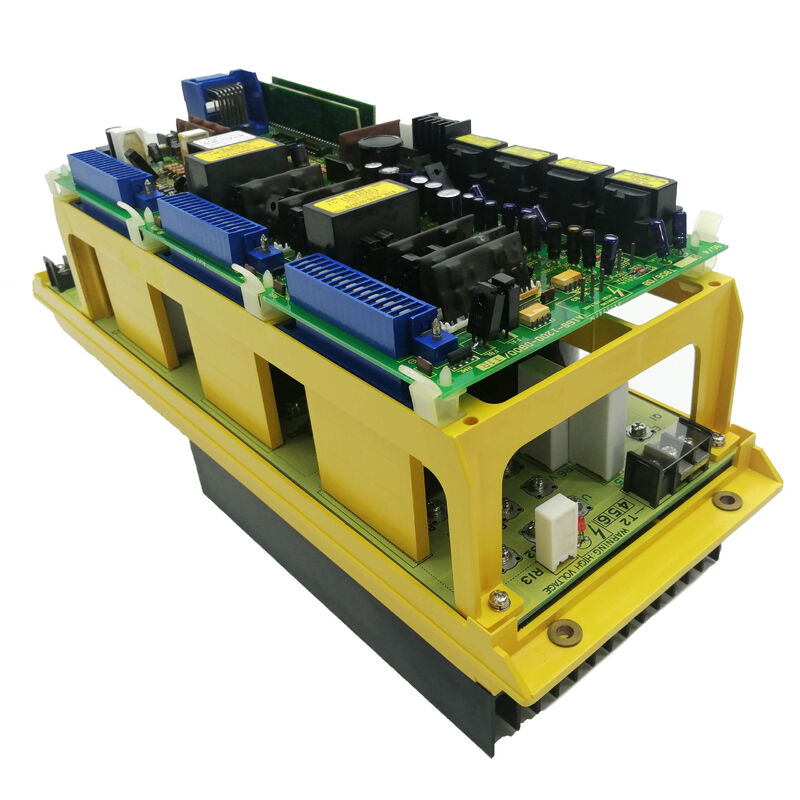
FANUC A06B-6058-H223 | S Series Dual-Axis AC Servo Amplifier — FANUC 0-B / 0-C / Series 15
Part Number: A06B-6058-H223
Manufacturer: FANUC Corporation (Japan)
Product Type: AC Servo Amplifier — Dual Axis
Series: S Series
Built for the Machines Still Running
The A06B-6058-H223 is the dual-axis digital servo amplifier from FANUC's S Series — the drive platform that powered CNC lathes, machining centres, and grinding machines through the late 1980s and into the 1990s. The machines these drives were fitted to were not built for a five-year replacement cycle. Many are mechanically sound and still in active production, which is why the A06B-6058-H223 remains a sought-after part rather than a forgotten one.
The digital interface between the 0-B/0-C/15 control and this amplifier represented a genuine advancement from the analogue-interface era. Position loop data flows digitally from the CNC; the drive handles velocity and current control internally. The dual-axis housing controls both the L-axis and N-axis simultaneously from a single module — practical on two-axis machines and two-axis sub-groups on larger machining centres, reducing cabinet component count and sharing the DC bus between axes.
The internal A16B-1200-0800 control board is a separately replaceable component. When a fault is confirmed in the control section rather than the power transistors, the board can be sourced and replaced independently — a more economical path than replacing the entire amplifier.
Sourcing Options
Three routes exist for replacing the A06B-6058-H223:
- Exchange: A tested refurbished unit ships immediately; your failed unit returns as the exchange core. Best for minimising machine downtime.
- Surplus: A used unit sourced from a decommissioned machine. Quality is supplier-dependent — ask specifically whether it was tested under dual-axis load with 0S or 5S motors.
- Repair and return: Your specific unit is diagnosed, repaired, and returned. Best when the machine's setup history matters or the unit has known-good power transistors.
The question that cuts through all three options: was the unit tested on a live FANUC system with actual 0S or 5S motors on both axes under cutting load? A drive that initialises without fault at bench is not the same as one that runs two production axes reliably.
Key Specifications
| Parameter |
Value |
| Part Number |
A06B-6058-H223 |
| Series |
S Series |
| CNC |
FANUC 0-B, 0-C, Series 15 |
| Axes |
Dual (L + N) |
| Motors |
Model 0S, 5S (both axes) |
| Control Board |
A16B-1200-0800 |
| Status |
Discontinued, aftermarket active |
FAQ
Q1: Which FANUC CNC controls are compatible with the A06B-6058-H223?
FANUC 0-B, 0-C, and Series 15. Earlier 0-A controls used analogue servo interfaces and are not compatible. Newer controls (16i, 18i, 0i) use a different serial servo bus (FSSB) and do not work with S Series amplifiers — no drop-in crossover exists.
Q2: What motors does this drive accept?
FANUC Model 0S and 5S AC servo motors on both axes. These are the red-cap motors standard on FANUC machines of this generation. The same motor type is interchangeable between L-axis and N-axis positions.
Q3: Can the A16B-1200-0800 control board be replaced without replacing the whole drive?
Yes. The control board is a discrete, replaceable component. When fault diagnosis confirms the control section — not the power transistors — is the failure point, replacing the A16B-1200-0800 separately is substantially more economical than a full drive replacement.
Q4: What typically causes the A06B-6058-H223 to fail?
Power transistor failure in the output stage is the most common hardware fault, typically triggered by a motor winding fault, cable short, or overcurrent event. Blown fuses are a secondary consequence — always replace fuses as part of a transistor repair, never in isolation. Control board faults show up as specific axis alarm codes at the CNC display before the machine stops.
Q5: Is there a modern FANUC drive that directly replaces the A06B-6058-H223?
No. The S Series architecture is tied to the 0-B/0-C/15 control generation. There is no modern drop-in replacement — a servo retrofit requires upgrading the CNC control as well. For machines where the control and mechanical systems are sound, sourcing a working A06B-6058-H223 remains the practical answer.


 Your message must be between 20-3,000 characters!