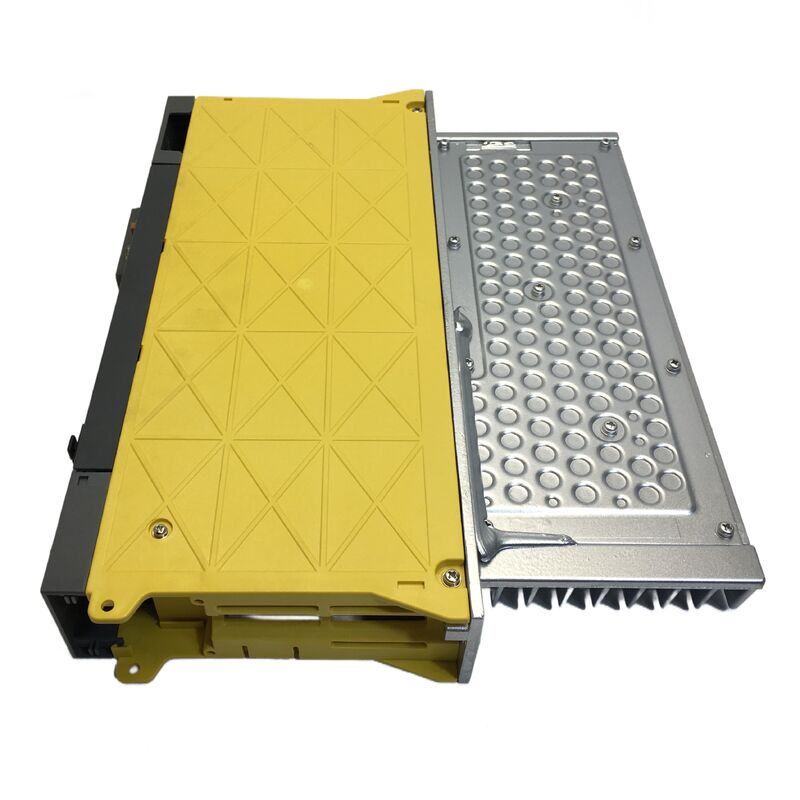
Fanuc A06B-6093-H114 | Beta Series Servo Amplifier Unit SVU1-80 — Single Axis, 15A Output, 220–240V AC Input, 45mm External Heatsink, FSSB Fiber Optic, Self-Powered
Overview
The Fanuc A06B-6093-H114 is the SVU1-80 — the highest-current single-axis unit in the Beta series A06B-6093 servo amplifier family, rated at 15.0A output with an 80-class internal transistor. It is 45mm wide and uses an external heatsink arrangement.
Everything about this module's architecture is different from the alpha series SVM modules it sometimes shares a cabinet with, and those differences matter when selecting, maintaining, or replacing it.
The most important architectural difference is power sourcing. Alpha SVM modules (A06B-6079, A06B-6096 series) draw their operating power from the shared PSM DC bus — they take their high-power input from the regulated 283–325V DC rail that the Power Supply Module generates and distributes.
The Beta SVU is self-powered: it connects directly to the facility's AC supply, has its own internal rectifier to generate its operating DC, and operates completely independently of any PSM module.
A cabinet with Beta SVU units alongside an alpha spindle amplifier has two separate power supply architectures coexisting; the SVU units draw from AC, the SPM draws from the PSM DC bus.
This architectural independence is part of what makes the Beta series a cost-effective solution for machine configurations where full alpha-class performance is not required on every axis.
A machine tool where one or two axes need only moderate servo performance for positioning tasks — a rotary table, an automatic tool changer drive, a pallet shuttle — can use Beta SVU modules on those axes without sizing the PSM for their current demand.
The PSM is sized only for the axes that draw from it (alpha SVM and SPM modules).
The Beta SVUs are budgeted separately against the AC supply circuit.
The SVU1-80's 15.0A rated output powers the Beta b22/2000 servo motor — Fanuc's Beta series motor at the 22-class torque rating.
At 15A continuous, this motor can sustain significant axis torque for sustained cutting passes and handles the acceleration demands of a production CNC axis without overheating or continuous current limiting.
Key Specifications
| Parameter |
Value |
| Module Designation |
SVU1-80 |
| Housing Width |
45mm |
| Input (1-phase) |
220–240V AC, 27A |
| Input (3-phase) |
200–240V AC, 17A |
| Max Output Voltage |
240V AC |
| Rated Output Current |
15.0A |
| Wiring Board |
A20B-3200-0132 |
| Control Board |
A20B-2100-0184 |
| Interface |
FSSB fiber optic |
| Compatible Motor |
Beta b22/2000 |
| CNC |
15i, 16i, 18i, 21i |
| Power Source |
Self-powered (AC input) |
Single-Phase and Three-Phase Input — Why Both Matter
The SVU1-80 accepts either single-phase or three-phase AC input. This flexibility is not a secondary feature; it is one of the reasons the Beta SVU family was designed for the applications it serves.
In machine tools, it is common for auxiliary axes or sub-axes to be powered from single-phase supply feeds within the electrical cabinet, while the main axes and spindle draw from the three-phase main circuit.
The SVU's single-phase capability means these auxiliary axes can be served by the same beta servo drive without requiring a three-phase sub-panel.
At single-phase 220–240V, the SVU1-80 draws 27A input. At three-phase 200–240V, the same rated 15A output draws 17A per phase. The input current difference is not surprising — single-phase power delivery at the same output requires higher line current.
Cabinet wiring for the SVU1-80 must be sized for whichever input configuration the installation uses; 27A single-phase wiring and fusing is different from 17A three-phase, and both exceed the module's 15A output rating, requiring appropriate circuit protection.
45mm External Heatsink — Physical Installation Requirements
The SVU1-80's 45mm wide housing is the compact form characteristic of the Beta SVU series. The external heatsink arrangement extends beyond the module's front face — in standard cabinet installation, the heatsink fins project through a rear panel cutout or are arranged along the module's side.
Adequate airflow across the heatsink fins must be ensured. Without sufficient cooling, the heatsink temperature rises toward the module's thermal protection threshold, producing temperature alarms and eventually a protective shutdown.
In tight cabinet layouts, the 45mm width is an asset, but the heatsink's airflow requirement must be factored into the thermal design of the cabinet section where the SVU1-80 is mounted.
Placing the SVU1-80 adjacent to other heat-generating components without considering the combined thermal contribution and available cabinet airflow is a common installation oversight that leads to premature thermal shutdowns during high-duty-cycle operation.
Internal Boards and Repair Considerations
The SVU1-80 contains two main boards: wiring board A20B-3200-0132 and control board A20B-2100-0184. Neither is available separately through standard distribution channels. When a board-level failure occurs, the resolution is whole-unit exchange or specialist component-level board repair.
The 4-LED diagnostic display on the front of the SVU1-80 provides alarm coding that identifies the fault class when the unit enters an alarm state.
The alarm codes for the Beta SVU series are documented in the Fanuc beta servo unit maintenance manual and differ from those used by the alpha SVM family.
When diagnosing a fault on the SVU1-80, use the beta SVU alarm reference, not the alpha SVM alarm table — the same LED pattern may indicate a different fault type between the two product families.
Beta SVU in the FSSB Chain
The A06B-6093-H114 uses FSSB communication — fiber optic — to connect to the CNC's servo card, placing it in the same FSSB chain as any alpha SVM modules in the system. From the CNC's perspective, the Beta SVU1-80 is an axis on the FSSB chain like any other; it receives position commands and returns velocity and position feedback through the same FSSB digital link that connects to alpha modules.
The power architecture difference (self-powered AC vs PSM DC bus) is transparent to the CNC.
The fiber optic FSSB cabling between the CNC and the Beta SVU must be kept clean and undamaged.
FSSB connectors that are contaminated with coolant mist or machining particulate can produce intermittent communication alarms that are difficult to distinguish from drive faults without isolating the cable and connector as the first diagnostic step.
FAQ
Q1: The SVU1-80 is self-powered from AC supply. Does this mean it can operate completely independently, without any other Fanuc drive module in the cabinet?
The SVU1-80's motor power circuit is independent of the PSM — it does not need the DC bus to drive the motor. However, the CNC controller that issues position commands to the SVU1-80 via FSSB must be powered and operational.
Additionally, if the machine's safety circuit requires the PSM or other modules to be healthy before the SVU1-80 servo enable signal is released, the SVU1-80 will not run axes even if its own power is present.
The self-powered concept means only that the SVU1-80 does not load the PSM's DC bus, not that it is a standalone unit.
Q2: Can the A06B-6093-H114 SVU1-80 replace the SVU1-40 (A06B-6093-H113) on a machine where the 40-class drive has failed?
The SVU1-80 has a higher output current rating (15A vs 12.5A for the SVU1-40) and a larger internal transistor. If the motor connected was originally a beta b12/2000 or similar 40-class motor, fitting the SVU1-80 drives the same motor but at higher available current than the motor was designed for.
The servo parameters (current limits, motor-specific parameters) must be set for the actual motor connected, not the maximum of the new amplifier. If the original SVU1-40 motor parameters are loaded and the SVU1-80's higher available current is correctly limited in the servo parameter set, the combination can work.
However, the correct solution is always to match the SVU to the motor class; the SVU1-40's motor-matched parameters avoid any ambiguity.
Q3: The product listing says this is labeled as both SVU-40 and SVU1-80. Why the different designations?
Some earlier product listings for the A06B-6093-H114 carry "SVU-40" designations from older Fanuc part numbering conventions, while the correct current Fanuc designation for the unit at 15A output is SVU1-80.
The suffix numbers in the SVU family designation (SVU1-4, SVU1-12, SVU1-20, SVU1-40, SVU1-80) correspond to current class codes, not directly to ampere values. SVU1-80 does not mean 80 amperes — it is an index in the series, with 15A actual output current.
The "40" in some legacy listings likely refers to the earlier naming scheme.
When ordering, use the part number A06B-6093-H114 to unambiguously specify this unit.
Q4: How does the SVU1-80 communicate with the CNC compared to older Beta SVU units with PWM interface?
The A06B-6093-H114 uses FSSB — the fiber optic serial bus introduced with the 16i/18i generation of CNC controls. Earlier Beta SVU units (with PWM or I/O link interface, different A06B-6093 sub-numbers) use a pulse train or electrical interface to communicate with older CNC series.
The FSSB SVU units are not interchangeable with PWM-interface SVU units on the same machine; the CNC card determines which interface type is required.
Machines with 15i, 16i, 18i, or 21i CNCs use FSSB; machines with older 0-series or 15 controls may use PWM interface Beta SVU units with different part numbers.
Q5: The SVU1-80's four LED display shows an alarm pattern at power-on. What is the correct first diagnostic step?
Record the exact LED pattern (which of the four LEDs are on, which are off, any flashing) and cross-reference it with the Fanuc beta servo unit alarm code table in the A06B-6093 maintenance manual.
Do not assume the LED pattern corresponds to the alpha SVM alarm table — the coding is different.
Once the alarm code is identified, the manual describes the fault condition and recommended diagnostic path.
Before investigating the SVU1-80 itself, check the FSSB cable connection and the motor power cable connections; FSSB communication errors and motor cable faults produce alarm codes that do not indicate internal drive failure.


 Your message must be between 20-3,000 characters!