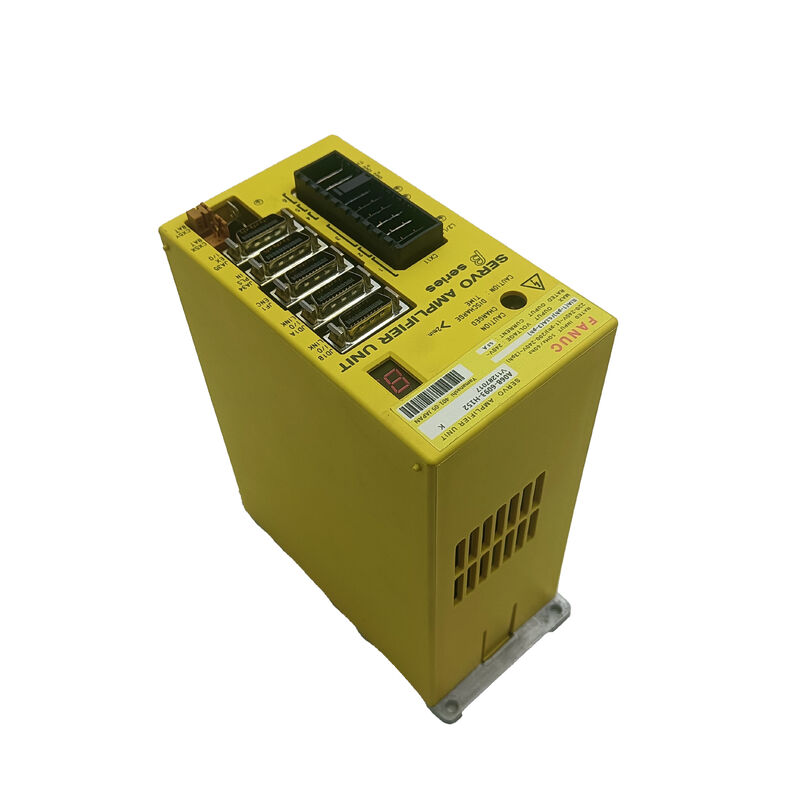
Fanuc A06B-6093-H152 | Beta Series SVU-20 Servo Drive Unit — I/O Link, Single-Axis, 200–240VAC, 5.9A Output, Air-Cooled, β Motor Series
Overview
The Fanuc A06B-6093-H152 is a Beta series SVU (Servo Amplifier Unit) for the SVU-20 size class, connecting to Fanuc CNC controls via the I/O Link interface.
It is a standalone servo drive — unlike the modular alpha-series amplifiers that share a common power supply bus, the Beta SVU incorporates its own built-in rectifier and power supply, drawing directly from the AC mains line.
This standalone architecture gives machine builders the flexibility to locate the drive wherever the machine's physical layout requires, independent of the main servo amplifier stack.
In Fanuc CNC machine tool design, the Beta SVU is the standard drive for auxiliary and peripheral axes: turret indexing on CNC lathes, automatic tool changer magazine drives, pallet shuttle motors, fourth-axis rotary tables on machining centres, and steady rest positioning.
These axes share common characteristics that the Beta SVU is designed for — they require accurate position control and torque output, but they operate at lower continuous power than the primary X/Y/Z/spindle axes, and they benefit from the Beta series' cost-effective, compact packaging.
The I/O Link interface distinguishes the H152 from the H112 variant within the A06B-6093 series, which uses FSSB (Fanuc Serial Servo Bus) connection instead.
The I/O Link-connected drive communicates through the PMM (Power Mate Manager) function in the CNC, allowing the auxiliary axis to be programmed with M-code sequences, position commands, and speed references within the main machining program without requiring a dedicated axis controller card in the CNC.
Key Specifications
| Parameter |
Value |
| Type |
Beta SVU-20, single-axis |
| Interface |
I/O Link (Type B) |
| Input Voltage |
200–240V AC |
| Input Current (1-phase) |
10.1 A |
| Input Current (3-phase) |
6.3 A |
| Output Current |
5.9 A rated |
| Output Voltage |
240V max |
| Cooling |
Air-cooled |
| Compatible Motors |
β3/3000, β6/2000, similar small Beta |
| Compatible Controls |
FANUC Series 15/16/18/20/21 |
Standalone Beta SVU — Built-In Power, Location Freedom
The SVU (Servo Amplifier Unit) design integrates everything needed for servo drive operation — the rectifier that converts AC mains to DC bus voltage, the IGBT inverter output stage, the brake control circuit, and the servo control electronics — into a single enclosure that connects directly to the AC supply.
This is fundamentally different from the alpha-series SVM (Servo Amplifier Module) design, which requires a separate PSM (Power Supply Module) to provide the shared DC bus that the SVM modules draw from.
For machine builders, the SVU's self-contained design means a Beta-axis drive can be positioned at any machine location with AC power available — near the turret, adjacent to the ATC magazine, or in a satellite control box away from the main electrical cabinet — and connected to the CNC via a single I/O Link cable rather than requiring the power and communication cabling of a full alpha-series installation at that location. This independence is the engineering reason the Beta SVU became the standard solution for distributed auxiliary axes.
Typical Applications — Turret, ATC, Fourth Axis
The A06B-6093-H152 with its 5.9A output current and I/O Link interface represents a specific capability level appropriate for the most common Beta SVU applications:
CNC lathe turret drives require accurate indexing to within tenths of a degree, moderate torque to overcome turret clamp friction, and fast response to index commands to minimise non-cutting time.
The Beta SVU provides the position loop bandwidth needed for clean, fast turret indexing.
Automatic tool changer magazine drives on machining centres require precise pocket positioning for tool pick-up/put-down, with reliable torque to handle the loaded magazine's inertia. The Beta SVU's built-in brake control circuit manages deceleration and holding for magazine-stopped positions.
Fourth-axis rotary tables use the Beta SVU when the table's payload and torque requirements fall within the Beta motor range.
For heavier tables requiring larger motors, the alpha-series SVM with FSSB connection is typically specified instead.
FAQ
Q1: What is the difference between the A06B-6093-H152 (I/O Link) and A06B-6093-H112 (FSSB) drives?
Both are Beta SVU-20 single-axis drives with identical power ratings. The H152 uses I/O Link interface (Type B), communicating through the PMM function in the CNC as an auxiliary axis.
The H112 uses FSSB (Fanuc Serial Servo Bus), connecting as a controlled axis on the main servo bus — this allows it to participate in multi-axis interpolation as a full CNC axis. Choose H152 for auxiliary axes controlled with M-code sequences; choose H112 for axes that need to interpolate with other CNC axes in machining programs.
Q2: Does the A06B-6093-H152 have an internal brake control circuit?
Yes. The Beta SVU series includes a built-in brake control output that manages the motor's holding brake — energising the brake release coil when the motor is powered and commanded to move, and releasing it (allowing the brake to engage) when the motor is brought to rest or when power is removed.
This built-in brake circuit simplifies wiring for turret and ATC applications where the motor's electromagnetic brake must be controlled in synchrony with the drive's enable/disable sequence.
Q3: What Beta motors are compatible with the A06B-6093-H152?
The SVU-20 class is sized for smaller Beta series motors including the β3/3000 (rated 0.3kW, 3000rpm) and β6/2000 (rated 0.6kW, 2000rpm) among others in the lower to mid-range Beta motor family.
The specific motor model must be configured in the drive's parameters — loading the correct parameter set tells the drive the motor's pole count, encoder type, rated current, and other motor-specific values. Using the wrong parameter set produces incorrect motor behaviour or overload alarms even if the motor current is within the drive's physical capacity.
Q4: Can the A06B-6093-H152 be connected to a single-phase supply in a 3-phase installation?
Yes. The SVU-20 is specified for both 1-phase (220–240V, 10.1A input) and 3-phase (200–240V, 6.3A input) AC supply.
The 3-phase connection is preferred in production environments because it balances the supply current across phases and reduces the single-phase current draw.
For installations where only single-phase power is available at the drive's mounting location, the single-phase connection operates the drive at the same output performance with a higher input current. Wire sizing for single-phase supply must account for the 10.1A input current.
Q5: Where is the A06B-6093-H152 typically mounted in the machine?
The SVU's standalone design allows flexible mounting. Common locations include inside the main electrical cabinet near the other servo drives, in a satellite cabinet near the machine's turret or ATC mechanism, or on a DIN rail within the machine's machine tool base structure.
Fanuc specifies that the SVU requires a minimum clearance above and below the unit for cooling airflow — the unit is air-cooled and relies on natural convection or forced airflow past the heatsink fins.
In ambient temperatures above 45°C, forced cooling is recommended to maintain the drive within its operating temperature limits.



 Your message must be between 20-3,000 characters!