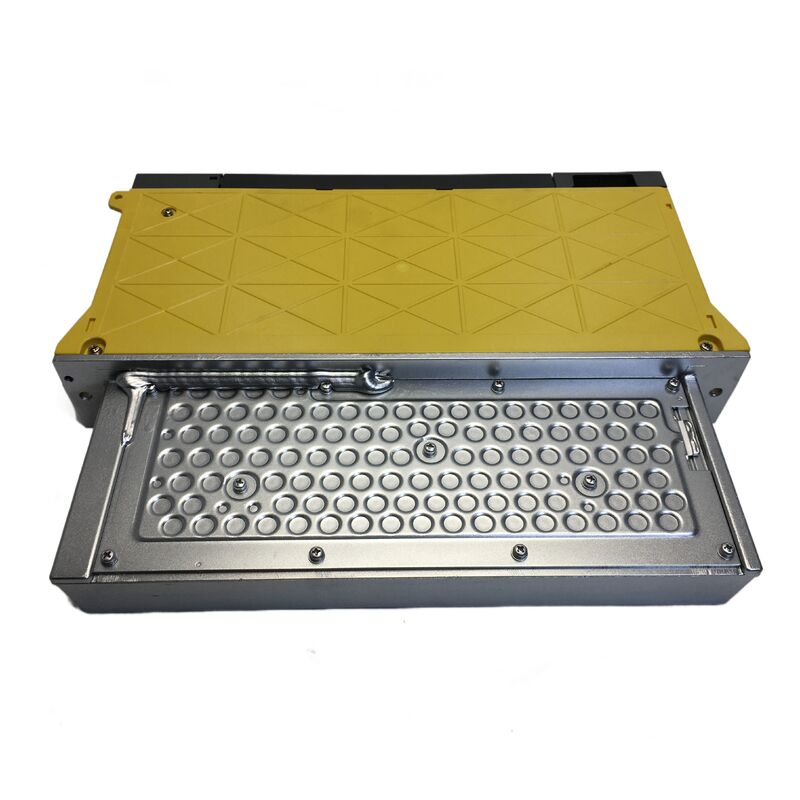
FANUC A06B-6096-H102 Alpha Servo Amplifier Module SVM1-20
Overview
The FANUC A06B-6096-H102 is an Alpha-series servo amplifier module designated SVM1-20 for the FSSB interface. In FANUC’s 200-V input series ordering section, it is listed as a standard 1-axis module with external dimensions of 380 × 60 × 172 mm, making it one of the more compact single-axis units in the family.
That compact format is one reason this model remains practical in field replacement work.
It is small enough for tightly arranged control cabinets, but still belongs to a clearly defined servo amplifier class in the official FANUC lineup. For buyers and maintenance technicians, that is the point that matters: it is a specific Alpha/FSSB amplifier, not a generic drive with a similar housing.
Key parameters
| Parameter |
Value |
| Part Number |
A06B-6096-H102 |
| Manufacturer |
FANUC |
| Product Type |
Servo Amplifier Module |
| Series |
Alpha |
| Model |
SVM1-20 |
| Axis Configuration |
1-Axis |
| Interface |
FSSB |
| Input Series |
200 V Input Series |
| External Dimensions |
380 × 60 × 172 mm |
| Rated Output Current |
5.9 Arms |
| Nominal Current Limit |
20 Ap |
| Example Applicable Motors |
αM2/3000, αM2.5/3000, αC3/2000, αC6/2000, αC12/2000, β3/3000, β6/2000 |
| Main Circuit Control Method |
Sine-wave PWM control with transistor (IGBT) bridge |
Technical Profile
In FANUC’s individual specification table, SVM1-20 is associated with applicable motor examples such as αM2/3000, αM2.5/3000, αC3/2000, αC6/2000, αC12/2000, β3/3000, and β6/2000. The same table assigns a rated output current of 5.9 Arms and a nominal current limit of 20 Ap to this model class.
FANUC’s common SVM specification also identifies the control method as sine-wave PWM control with transistor (IGBT) bridge.
That gives the H102 a straightforward technical position in the range. It is a single-axis 20-class servo amplifier intended for appropriately matched Alpha/FSSB applications, with enough official specification detail to make it useful for engineering review without overstating anything that the manual itself does not say.
Application and Replacement Context
The strongest use case for the A06B-6096-H102 is direct replacement in an installed FANUC system that already uses the same interface family and amplifier class.
When the objective is to restore machine operation cleanly, keeping the original model designation and interface type aligned is usually more valuable than trying to adapt a different module into the cabinet.
Because this is an officially identified SVM1-20 FSSB module, it is well suited to repair stock, rebuild projects, and service orders where accurate part-number matching is part of the risk control.
For technical buyers, the official current class and motor examples make the H102 easier to validate than a loosely described aftermarket equivalent.
FAQ
Q1: What is A06B-6096-H102 in FANUC’s official naming?
FANUC identifies this model as SVM1-20, a single-axis Alpha servo amplifier module with an FSSB interface in the 200-V input series. That naming matters because it defines both the amplifier class and the communication family it belongs to.
Q2: What current class does SVM1-20 belong to?
In FANUC’s individual specification table, SVM1-20 is shown with a rated output current of 5.9 Arms and a nominal current limit of 20 Ap. For machine service work, that clearly separates it from the larger 40-class and 80-class units in the same product family.
Q3: What motors are officially listed as applicable examples for this model?
The manual lists αM2/3000, αM2.5/3000, αC3/2000, αC6/2000, αC12/2000, β3/3000, and β6/2000 as example applicable motors under the SVM1-20 group.
That is useful for initial technical review, especially when a buyer needs to verify whether the amplifier sits in the right motor class before moving to machine-specific documentation.
Q4: Why is the exact ordering number important for H102?
Because FANUC’s ordering tables distinguish amplifier models by interface and by output class. A06B-6096-H102 is specifically the FSSB version of SVM1-20, so using the exact ordering number helps protect against interface mismatch and unnecessary troubleshooting during installation.
Q5: What should be checked before replacing this amplifier?
A service team should verify the installed ordering number, the system interface, the intended motor pairing, and the cabinet space available for the replacement.
FANUC also warns users to confirm that the motor and amplifier combination is appropriate and that valid parameters are specified, because mismatches can prevent normal operation and may damage the unit.


 Your message must be between 20-3,000 characters!