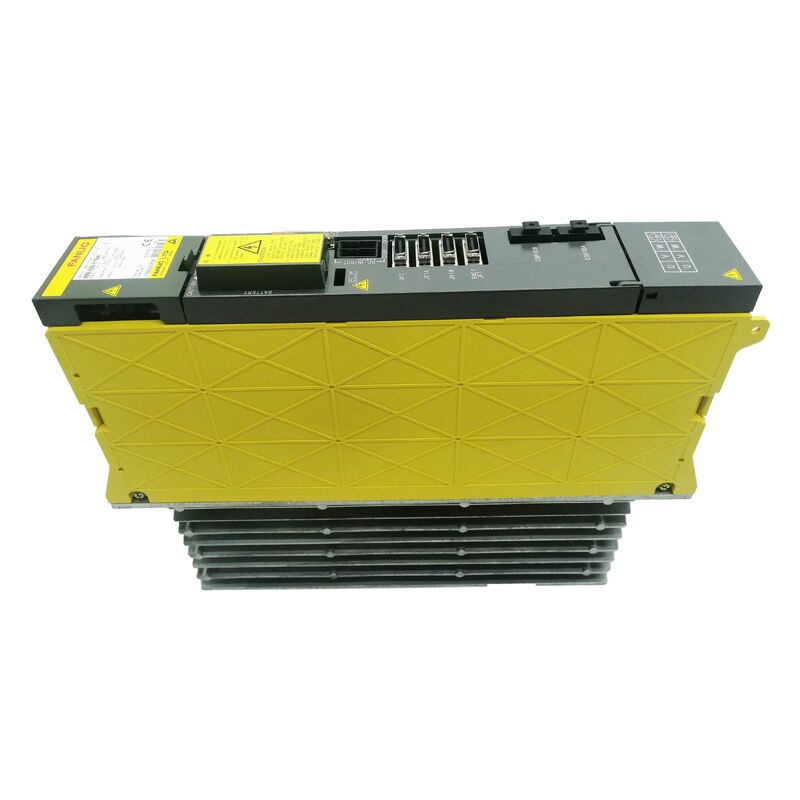
Fanuc A06B-6096-H208 | Alpha Servo Module SVM2-80/80 — 2-Axis, 18.7A Per Axis, 283–325V, 9.5kW, FSSB Interface, Two 150A Transistors, Compatible with Alpha 12/2000 and 22/2000 Motors
Overview
The Fanuc A06B-6096-H208 is the SVM2-80/80 — a two-axis alpha servo module that puts 18.7A of continuous rated output current on each of two independent axes, drawing its operating power from the PSM DC bus at 9.5kW total.
At 18.7A per axis, the SVM2-80/80 drives alpha motors in the 12/2000 and 22/2000 class — motors capable of 1.2kW to 2.2kW continuous rated output, commonly used for the principal axes (X, Y, Z) of mid-size machining centres, turning centres, and multi-axis special-purpose machines.
The two 150A transistor modules inside give the SVM2-80/80 substantial peak current capability. Each transistor serves one axis: 150A transistor for an 18.7A rated output gives the module an internal peak-to-continuous ratio that accommodates aggressive acceleration profiles without transistor protection trips.
The alpha 22/2000 servo motor, one of the typical motor pairings for this module, can demand 40–50A from the drive during a hard acceleration — the 150A transistor handles this transient with margin, while the rated 18.7A governs continuous thermal loading.
The FSSB (Fanuc Serial Servo Bus) fiber optic interface places the SVM2-80/80 in the 16i/18i generation drive architecture.
Where the equivalent A06B-6079-H208 would have used a Type A or Type B electrical serial interface to communicate with an older-generation CNC servo card, the A06B-6096-H208 connects via fiber optic cable to the CNC's FSSB card.
The motor output, internal transistors, and DC bus connection are identical between the two product lines; only the CNC communication path changes.
Key Specifications
| Parameter |
Value |
| Module Designation |
SVM2-80/80 |
| Axes |
2 (L, M) |
| DC Bus Input |
283–325V |
| Input Power |
9.5kW |
| Max Output Voltage |
230V |
| Rated Output Current |
18.7A (each axis) |
| Transistors |
Two × 150A |
| Wiring Board (v1) |
A16B-2203-0594 |
| Wiring Board (v2) |
A16B-2202-0774 |
| Control Cards |
A20B-2100-054x |
| Interface |
FSSB fiber optic |
| Motors |
Alpha 12/2000, 22/2000, 6/3000 |
| CNC |
16i, 18i, 21i |
Two Wiring Board Variants — Critical When Ordering
The A06B-6096-H208 is produced with two different wiring board specifications: A16B-2203-0594 and A16B-2202-0774.
These boards are not interchangeable with each other; they have different circuit configurations and connection geometries. Both boards appear in the SVM2-80/80 production run, and the distinction between them affects replacement sourcing.
For a machine-specific exchange purchase, the easiest approach is to photograph the wiring board part number on the original unit before it is removed from service, then confirm that the replacement unit carries the same board.
If the original unit has already been removed and the board number is unknown, a specialist with physical stock of both variants can guide identification from the machine's serial number and commissioning date.
Fitting the wrong wiring board variant will result in a module that produces alarms or fails to initialize correctly — not a consequence of a faulty unit, but of a specification mismatch.
This two-variant issue is a known characteristic of the SVM2-80/80 series and is worth flagging to any maintenance planner building a spare parts strategy for machines using this module.
Motor Pairings — What 18.7A Actually Drives
The 18.7A continuous rating is matched in the Fanuc motor selection guide to alpha motors in the 12/2000 and 22/2000 torque and speed class.
The alpha 12/2000 provides approximately 1.2kW rated output at 2000 rpm; the alpha 22/2000 provides approximately 2.2kW at the same rated speed.
These are the standard feed axis motors for mid-class machining centres — compact enough to fit in typical CNC lathe turret or machining centre column arrangements, yet powerful enough to sustain the cutting forces of production-grade machining on steel and aluminium workpieces.
The SVM2-80/80 is also listed as compatible with the alpha 6/3000 motor — the 6Nm class motor optimised for 3000 rpm operation.
This motor offers lower torque than the 22/2000 but higher speed, suited to applications where rapid traversal and positioning speed matter more than sustained cutting torque.
The same 18.7A rated output in the SVM2-80/80 is used because the alpha 6/3000's peak current demands during acceleration at 3000 rpm are comparable.
FSSB Chain Position and Cascading Axes
In a typical machining centre with X, Y, Z, and B or C axes, the FSSB chain might run: CNC → SVM2-80/80 (X, Y) → SVM1-80 or SVM2-40/40 (Z, B) → end of chain.
Each module connects to the next via a short fiber optic jumper cable at the FSSB connectors on the module's side or rear panel. The CNC recognises each axis by its position in the FSSB chain and the axis number assigned during system setup.
A replacement SVM2-80/80 must be positioned in the same chain location as the original; otherwise, the CNC servo parameter set assigns the wrong axis parameters to each channel.
The fiber optic cables in the FSSB chain are a maintenance consideration that deserves attention alongside the drive modules themselves.
Fiber optic connectors are sensitive to contamination — coolant, oil mist, and metallic particles from machining can coat the connectors and attenuate the optical signal below threshold, producing axis communication alarms that look identical to drive failures.
Inspecting and cleaning the FSSB connectors with appropriate optical cleaning tools before condemning a drive module saves unnecessary exchanges.
FAQ
Q1: The SVM2-80/80 has two axes rated at 18.7A each. Can these two axes operate simultaneously at full rated current, or does the 9.5kW bus power limit constrain simultaneous operation?
Both axes can operate simultaneously at their rated 18.7A output. The 9.5kW total bus power reflects the simultaneous rated output of both axes combined.
At 18.7A each into a 230V motor supply, each axis delivers approximately 4.3kW, totalling approximately 8.6kW — within the 9.5kW bus power rating with margin for losses and peak transients.
The module is designed for simultaneous dual-axis operation; this is its primary use case in two-axis machining configurations.
Q2: Can the A06B-6096-H208 be connected to the same DC bus as an A06B-6079-H208 in the same machine?
No. The A06B-6096 (FSSB) and A06B-6079 (Type A/B) SVM modules are not electrically compatible on the same DC bus. More practically, a machine has one CNC with one servo interface type — it either has FSSB capability (requiring A06B-6096) or Type A/B (requiring A06B-6079).
Mixing the two module types in the same drive rack is not a supported configuration.
Q3: One axis of the SVM2-80/80 shows an alarm but the other axis is functioning. Must the entire module be exchanged, or can only the affected axis be repaired?
If the fault is diagnosed to the 150A transistor module serving the failed axis, that transistor can be replaced separately — both transistors are replaceable parts.
If the fault is in the wiring board or control card, these are not separately available, and whole-unit exchange or specialist board repair is required.
Single-transistor replacement by a competent technician with the correct parts is a cost-effective repair when the fault is isolated to the output transistor.
Replacing a transistor without identifying the root cause (a motor winding fault that destroyed the transistor) risks immediate re-failure of the new component.
Q4: What battery inside the SVM2-80/80 requires periodic replacement, and what happens if it is not replaced?
The SVM2-80/80 contains a backup battery that maintains the absolute position data in the connected motors' pulse coders when machine power is off. Battery failure results in the loss of absolute position reference on power-up, requiring axis reference return (zero-return) before the axes can be used in automatic mode.
Battery replacement is a standard periodic maintenance item — the replacement battery is available as a Fanuc spare part.
The module displays a battery low alarm (SV000 or similar battery warning) before complete battery failure, providing advance notice that replacement is due.
Q5: How does an engineer verify that the A06B-6096-H208 replacement unit has the correct wiring board for the machine's original specification?
Before shipping the original unit for exchange, photograph the wiring board part number printed on the board itself — it is visible without disassembling the module through the module's inspection area or partial disassembly.
Note the number (A16B-2203-0594 or A16B-2202-0774) and include this information when contacting a replacement supplier.
Reputable exchange suppliers will confirm the wiring board variant of their available units before shipment.
If confirming the original board is not possible, provide the machine's serial number and CNC purchase date to a Fanuc specialist, who can cross-reference this to the likely production period and determine which board variant was standard at that time.


 Your message must be between 20-3,000 characters!