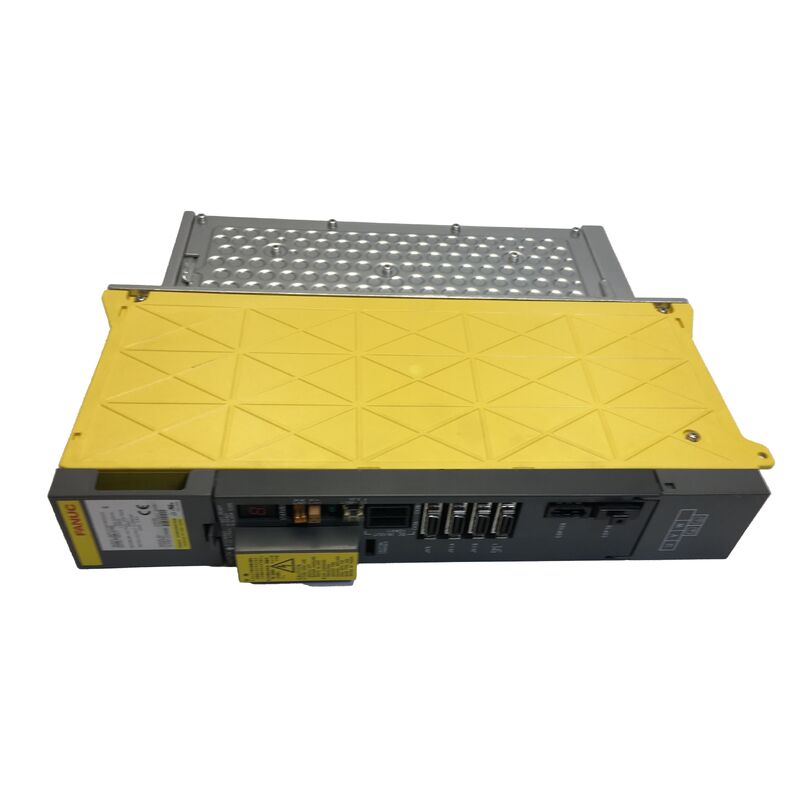
Fanuc A06B-6096-H304 | Alpha Servo Module SVM3-20/20/20 — 3-Axis, 5.9A Per Axis, 283–325V, 3.7kW, FSSB Interface, 90mm Housing, Three 50A Transistors
Overview
The Fanuc A06B-6096-H304 is the SVM3-20/20/20 — a three-axis alpha servo module that delivers equal 5.9A drive capability to three independent servo axes simultaneously, packaged in a single 90mm wide housing that draws its operating power from the shared PSM DC bus.
Three axes in one 90mm slot is the defining commercial value of this module: a machining centre with X, Y, and Z axes driven by small alpha motors can accommodate all three servo drives in the slot width that a single large SVM1 would occupy.
The "20/20/20" designation corresponds to three matched 20-class output current channels — 5.9A rated per axis, appropriate for the lighter end of the alpha motor range: the aC/2000, a0/2000, a1/2000, a2/2000, and a3/2000 servo motors that are common on compact machining centres and drilling centres.
These are the machine axes that need responsive, precise positioning rather than high torque at the cut — three-axis machining with small-bore spindles and relatively light workpieces.
Driving three such axes from a single SVM3-20/20/20 rather than three individual SVM1 modules reduces cabinet width and simplifies the DC bus wiring, at the cost of one module covering the complete three-axis servo system.
The A06B-6096-H304 is the FSSB-interface version of what would be a Type A/B electrical interface SVM3 in the A06B-6079 series.
The product number distinction between the two series — 6079 for the electrical interface, 6096 for FSSB — is a direct consequence of the alpha i transition: when Fanuc introduced the high-speed fiber optic serial servo bus in the 16i/18i generation, it created the A06B-6096 product line as the FSSB counterpart of the existing A06B-6079 electrical SVM family, maintaining identical motor and output specifications while changing only the CNC communication interface.
Key Specifications
| Parameter |
Value |
| Module Designation |
SVM3-20/20/20 |
| Axes |
3 (L, M, N) |
| Housing Width |
90mm |
| DC Bus Input |
283–325V |
| Input Power |
3.7kW |
| Max Output Voltage |
230V |
| Rated Output Current |
5.9A (each axis) |
| Transistors |
Three × 50A |
| Wiring Board |
A16B-2202-0783 |
| Control Cards |
A20B-2100-026x |
| Interface |
FSSB (fiber optic) |
| Compatible Motors |
Alpha aC/2000 to a3/2000 |
| CNC |
16i, 18i, 21i |
FSSB vs A06B-6079 — Why the Series Changed
The functional difference between the A06B-6096 and A06B-6079 SVM families is entirely in the CNC communication interface.
The A06B-6079 SVM modules use a Type A or Type B electrical serial interface to communicate with the CNC's servo card.
The A06B-6096 modules use FSSB — Fanuc Serial Servo Bus — a fiber optic digital link that connects the CNC's FSSB card to the first SVM in the chain, with subsequent modules daisy-chained via fiber optic cables.
The practical implications are significant for maintenance engineers.
A machine equipped with 16i or 18i CNC and A06B-6096 SVM modules uses FSSB cabling between the CNC card and the servo drive rack.
These fiber optic cables and their connections are an additional diagnostic element — a broken or dirty FSSB connector can produce servo communication alarms that mimic drive failures.
An A06B-6096-H304 cannot replace an A06B-6079 SVM3 equivalent on a machine with a Type A/B interface CNC card, nor can an A06B-6079 replace an A06B-6096 on an FSSB system.
Three 50A Transistors — Current Headroom and Peak Performance
Each of the three axes in the SVM3-20/20/20 is served by a 50A transistor module despite the rated output being only 5.9A.
This substantial derating — rated at approximately 12% of transistor peak capability — is not unusual in Fanuc's SVM design philosophy.
The transistor's rating must accommodate the peak current during maximum acceleration, which can briefly reach three to four times the rated continuous current.
A motor with a 5.9A rated current may demand 15–20A from the transistor during a hard acceleration event; the 50A device handles this peak with margin.
The three transistors are separately replaceable as spare parts, which makes the SVM3-20/20/20 economically repairable when a single transistor fails from a one-time overstress event (a motor short, an encoder fault during rapid axis movement).
Single-transistor failure is recoverable without full module exchange; the wiring board and control cards are not separately available and route to exchange or specialist repair.
Typical Installation — Three Equal Axes
The SVM3-20/20/20 is most commonly found in machines where all three programmed axes require similar torque and speed performance: three-axis vertical machining centres, drilling centres, and special-purpose machines where the X, Y, and Z feed axes are driven by motors in the 0.5kW to 1.5kW class.
Each axis operates independently under the FSSB servo loop — the SVM3's three axis channels are logically independent even though they share the same physical housing, the same DC bus connection, and the same wiring board.
The 3.7kW total bus power draw assumes all three axes are operating simultaneously.
In practice, simultaneous full-current operation on all three axes at once occurs during complex simultaneous three-axis moves, but even during these events, the total bus draw remains modest at 3.7kW, leaving the machine's PSM supply with substantial capacity for the SPM spindle amplifier and any other SVM modules sharing the bus.
FAQ
Q1: All three axes of the SVM3-20/20/20 carry the same 5.9A rating. Can this module be used in a machine where one axis requires a higher current than the other two?
No. The SVM3-20/20/20 delivers 5.9A to all three axes.
If any single axis requires more current — for a larger motor or higher cutting force — the correct module is one of the mixed-rating SVM3 variants (e.g., SVM3-20/20/40, SVM3-12/20/40), where the higher-current axis connects to the N channel with its 12.5A or 18.7A rating.
Running a motor that requires 7–8A on a 5.9A rated channel will cause SV401 overcurrent servo alarms during high-load moves.
Q2: This module has an FSSB interface. How many SVM3-20/20/20 modules can be chained on a single FSSB line?
The FSSB line supports multiple servo amplifier modules in a daisy chain, with a maximum number of axes determined by the CNC's FSSB capability. Fanuc 16i/18i CNC controls support up to 8 axes on a single FSSB line (some configurations support more with extended FSSB).
A single SVM3-20/20/20 uses three axis slots on the FSSB chain. Two SVM3-20/20/20 modules consume six of eight available axis slots. The exact chain limit depends on the CNC type and software configuration.
Q3: The A06B-6096-H304's control cards are listed as A20B-2100-026x. The "x" designation suggests multiple versions. Does this affect interchangeability in a replacement module?
The "x" in A20B-2100-026x indicates a minor revision digit that can vary. Different revision cards appear across the production run of the SVM3-20/20/20 without affecting function in the machine — all revisions of this control card perform the same role.
For a replacement module purchase, any revision of the A06B-6096-H304 is functionally equivalent in the machine regardless of which specific A20B-2100-026x revision is fitted. The revision is relevant only for board-level repair documentation.
Q4: When the SVM3-20/20/20 shows an SV411 servo alarm on one axis, does this mean the entire three-axis module must be exchanged?
SV411 (servo current alarm) or any single-axis servo alarm on the SVM3-20/20/20 does not automatically mean the entire module has failed.
The fault may be axis-specific: a motor winding short on that axis, a broken motor power cable creating a phase-to-phase fault, or an encoder cable fault creating a runaway condition that triggers overcurrent protection.
Disconnect the motor and cable from the affected axis and clear the alarm — if the alarm clears with the axis disconnected, the fault is in the motor or wiring, not the SVM module.
If the alarm persists with the axis disconnected, the transistor module for that axis may have failed.
Q5: Can the A06B-6096-H304 be used with alpha i motors (A06B-0 series with 1,000,000 ppr encoders) rather than the original alpha motors?
The SVM3-20/20/20 is an alpha generation module (A06B-6096 series) designed for alpha generation motors.
Connecting alpha i motors to an alpha generation SVM amplifier is not a supported configuration — the encoder interface, motor electrical parameters, and servo parameter set differ between generations.
The alpha i motor series requires an alpha i SVM amplifier (A06B-6114 series) and an appropriate alpha i PSM.
Using alpha i motors with the A06B-6096-H304 would require parameter adjustments that may not be fully supported and could produce unstable servo behavior.


 Your message must be between 20-3,000 characters!