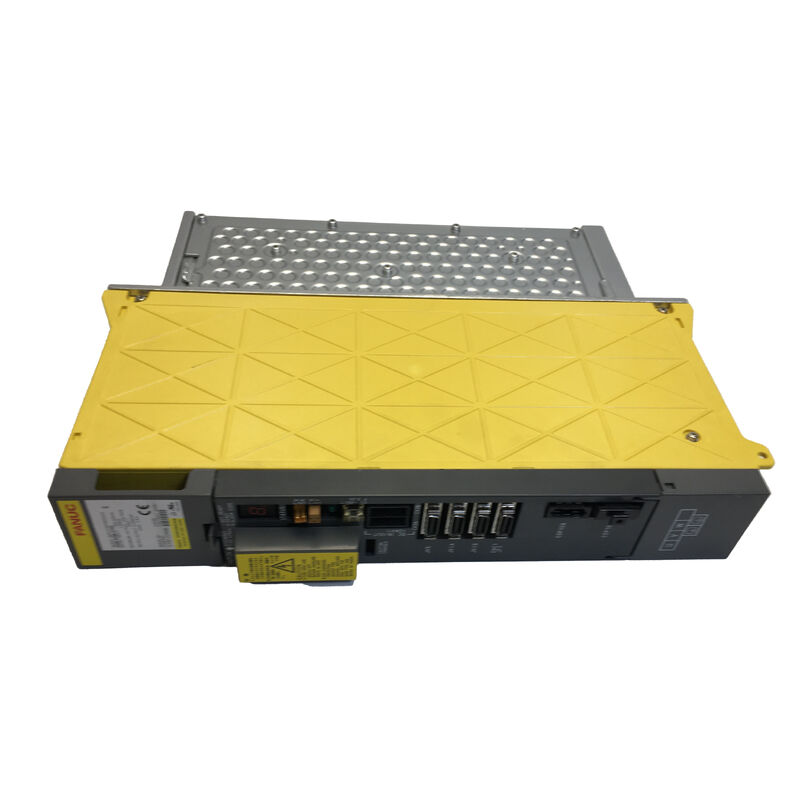
Fanuc A06B-6096-H307 | Alpha Servo Amplifier Module — SVM3-20/20/40, 3-Axis FSSB, 283–325V / 4.35kW, L/M: 5.9A + N: 12.5A / 230V Output
Overview
The Fanuc A06B-6096-H307 is the SVM3-20/20/40, a three-axis alpha servo amplifier module from the A06B-6096 FSSB series, providing asymmetric output across its three channels: 5.9A on the L and M axes and 12.5A on the N axis, from a 4.35kW / 283–325V DC bus.
This module is the FSSB-interface equivalent of the A06B-6079-H307 (PWM Type B version) — both share the SVM3-20/20/40 model designation and identical electrical ratings, differing only in the CNC interface type that makes one compatible with i-series controls and the other with older non-i-series controls.
The asymmetric three-axis configuration that defines the H307 — two equal mid-range channels (5.9A each) and one heavier channel (12.5A) — reflects a frequently encountered real-world machine axis grouping.
On machining centres and turning centres where two axes carry similar motor sizes and one axis is heavier, the SVM3-20/20/40 eliminates the need for a separate higher-current module to cover the N axis alone, consolidating three axes into one module with individually optimised channel ratings.
The 4.35kW DC bus input reflects the combined peak simultaneous demand of all three channels: approximately 1.25kW each for L and M (at 5.9A), and 1.85kW for N (at 12.5A), totalling 4.35kW.
This aggregate is comfortably supplied by a small alpha PSM, making the SVM3-20/20/40 an efficient three-axis solution that adds minimal load to the drive rail's PSM.
Key Specifications
| Parameter |
Value |
| Module Model |
SVM3-20/20/40 |
| Interface |
FSSB (fiber optic) |
| Axes |
3 (L, M, N channels) |
| Rated Input |
283–325V DC bus, 4.35kW |
| Max Output Voltage |
230V AC |
| L Axis Current |
5.9A rated |
| M Axis Current |
5.9A rated |
| N Axis Current |
12.5A rated |
| Wiring Board |
A16B-2202-0786 |
| Control Card |
A20B-2100-0260 |
| L/M Motor Class |
αM2.5/α3/αC6 |
| N Motor Class |
α12/2000 class |
| Compatible Controls |
FANUC 15i/16i/18i/21i |
| Manual |
B-65162 |
Asymmetric Three-Axis Logic — 20/20/40 Channel Design
The SVM3-20/20/40 designation encodes the current class of each channel: "20" maps to the 5.9A continuous output class and "40" maps to the 12.5A class. This three-channel asymmetry serves machines where the application load is genuinely different on the three axes — a design reality that a symmetric SVM3-20/20/20 (H304) would handle incorrectly for the N axis, and that a symmetric SVM3-40/40/40 would over-specify for L and M.
On a CNC machining centre with a standard X/Y axis configuration and a heavier Z axis, or on a five-axis machine where two rotary axes are lighter than a primary linear axis, the SVM3-20/20/40 places the 5.9A channels on the lighter axes (L and M) and the 12.5A channel on the heavier axis (N).
This correct current matching avoids the risk of M or N axis overcurrent alarms under full cutting load, and avoids wasting the PSM budget on over-specified channels.
The N axis IPM transistor is a different, larger device than the L and M channel transistors — three distinct IPM devices coexist in the single module to implement the asymmetric current capability.
FSSB Operation — Three Axes, One Ring Position
As with all three-axis FSSB modules, the A06B-6096-H307 presents three axis nodes to the CNC's FSSB ring from a single physical ring position. The CNC's FSSB amplifier setting screen shows the three axes (L, M, N) as separate entries under this module's ring address, with their current class ratings visible.
The FSSB ring daisy-chains through the module at COP10A (input) and COP10B (output) — a FSSB disconnect on either connector affects all three axes simultaneously.
The wiring board A16B-2202-0786 and control card A20B-2100-0260 handle FSSB decoding and servo algorithm execution for all three channels in real time, at the servo cycle rate dictated by the CNC's parameter settings.
FAQ
Q1: What distinguishes the A06B-6096-H307 (FSSB) from the A06B-6079-H307 (PWM Type B)?
Both are SVM3-20/20/40 modules with identical electrical specifications (5.9A L/M, 12.5A N, 4.35kW, 283–325V, 230V output).
The interface differs: H307 from the A06B-6096 series uses FSSB fiber optic for i-series controls (15i, 16i, 18i, 21i), while H307 from A06B-6079 uses PWM Type B for non-i-series controls (0-MD, 16B, 18B, 21B).
They are not interchangeable — each requires the CNC type it was designed for.
Q2: How is the N axis allocated when the machine has only two primary machining axes?
When a three-axis module is used on a two-axis machine (or when one channel is assigned to an auxiliary function), the unused axis channel can be left unconnected, provided the CNC servo parameters for that channel are set to indicate no connected motor (typically by leaving the axis number parameter blank or set to zero).
The module continues operating the two active channels normally. An unused channel does not generate alarms unless the CNC actively commands it and expects feedback that is not present.
Q3: Can the N axis channel (12.5A) on the SVM3-20/20/40 also drive the same motor class as L and M?
Yes. The N channel at 12.5A continuous can drive any motor within or below that current class, including αM2.5 or α3 class motors that draw only 5.9A. The module simply operates that channel at a fraction of its capacity.
Servo parameters must be set correctly for the actual motor connected to N.
The L and M channels at 5.9A cannot drive an α12-class motor at full rated torque — fitting a motor that demands more than 5.9A continuous on these channels will trigger overcurrent alarms under full machining load.
Q4: What is the PSM sizing consideration when using the A06B-6096-H307?
The H307 draws 4.35kW from the DC bus at simultaneous full load across all three channels. Add the PSM contributions of all other connected SVM and SPM modules to calculate the total bus demand.
A machine with one SVM3-20/20/40 (4.35kW) and an SPM-11 spindle (13.2kW) has a combined peak demand of 17.55kW — requiring at least a PSM-18.5 (A06B-6087-H118 or equivalent) to sustain this without DC link undervoltage alarms during simultaneous full-axis and full-spindle operation.
Q5: What is the recommended action when all three channels show simultaneous alarm E (L+M+N overcurrent)?
Alarm E indicates all three channels have simultaneously tripped overcurrent protection. This is unusual for independent motor fault events and more commonly indicates a DC bus fault — check the DC link voltage (Alarm 5: LVDC indicates bus undervoltage) or a PSM fault that has destabilised the bus voltage rather than individual motor faults.
Verify the PSM status and DC bus voltage first. If the bus is healthy, sequentially disconnect each motor's U/V/W cables and test motor insulation resistance for all three axes, starting with the axis most recently involved in a machining operation or having recently changed tools.
A bus fault masquerading as multi-axis overcurrent is a common diagnostic pitfall.


 Your message must be between 20-3,000 characters!