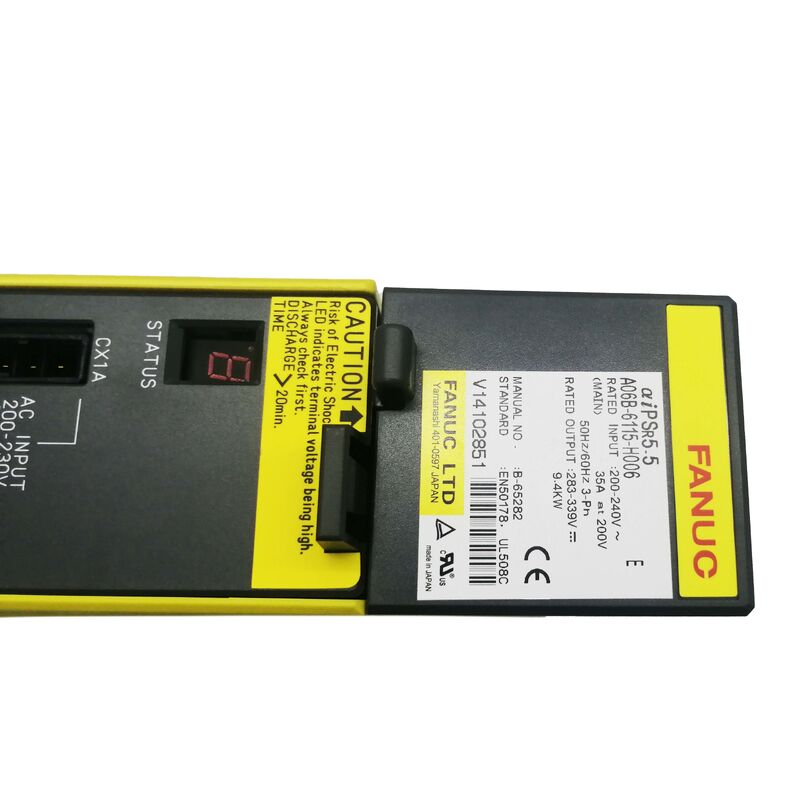
A06B-6115-H006 Fanuc Servo Amplifier Module A06B6115H006 A06B-6115-H006
Product Overview
The Fanuc A06B-6115-H006 is the PSMR-5.5i — the resistor regeneration variant of Fanuc's alpha i series power supply module lineup, converting three-phase 200-240V AC mains input to a 283-339V DC bus at 9.4kW rated output capacity.
The "R" in PSMR distinguishes this unit from the PSM (standard regeneration) version: where a PSM actively feeds deceleration energy back into the AC mains supply, the PSMR dissipates this energy through an external resistor unit connected to the module's regenerative discharge terminals.
The 9.4kW DC bus output establishes the total power budget available to all αi series SVM and SPM modules connected to this PSM's bus. All servo axis modules (A06B-6114 SVM series) and spindle modules (αi SP series) draw their operating power from this shared 283-339V bus.
The PSMR-5.5i at 9.4kW is correctly sized for small-axis-count αi installations — typically two to four light servo axes plus a smaller spindle, or configurations where the combined peak module demand does not exceed 9.4kW at simultaneous full load.
Key Specifications
| Parameter | Value |
|---|
| Module Model | PSMR-5.5i |
| Input Voltage | 200-240V AC, 3-phase |
| Input Current | 35A at 200V |
| Input Frequency | 50/60 Hz |
| Output Voltage | 283-339V DC bus |
| Output Power | 9.4kW rated |
| Regeneration Type | Resistor discharge (external unit required) |
| Wiring Board | A16B-2203-0782 |
| Cooling Fan | A90L-0001-0441 (internal) |
| Manual | B-65282E |
PSMR vs PSM — Resistor Regeneration vs Power Regeneration
The distinction between the PSMR (resistor regeneration) and PSM (power regeneration back to the AC line) types determines how braking energy is handled during motor deceleration.
In a PSM installation, regenerated energy from decelerating servo motors and the spindle is actively converted and returned to the three-phase AC supply — this reduces total energy consumption and keeps the DC bus voltage stable during heavy deceleration cycles. The PSM requires a more sophisticated power electronics stage to achieve this bidirectional energy flow.
The PSMR takes a simpler approach: regenerated energy is directed to an external resistor unit where it is dissipated as heat. This eliminates the active regeneration circuitry from the power supply module itself, reducing the module's cost and complexity.
The trade-off is the requirement for an external discharge resistor unit — without it, the PSMR cannot handle any regenerated energy, and DC bus overvoltage alarms (AL-7: DC voltage abnormally high) will occur during motor deceleration.
For machines with light deceleration duty — low motor inertia, infrequent or slow deceleration, modest axis speeds — the PSMR with an appropriately sized discharge resistor is a cost-effective alternative to the PSM. For machines with frequent high-speed axis reversals or high-inertia spindle deceleration requirements, the PSM's active regeneration provides better DC bus voltage stability and eliminates the thermal management of a continuously loaded discharge resistor.
Alarm Codes and Diagnostic Reference
The A06B-6115-H006 communicates alarm states through a numeric display on its front panel. The principal alarm codes for the PSMR-5.5i follow the B-65282E manual's αi PSR series alarm table:
- AL-1: Overcurrent in the main power module
- AL-2: Cooling fan stopped — requiring immediate attention as 35A input current generates substantial heat that the cooling fan must manage
- AL-3: Heat sink over-temperature
- AL-4: DC bus undervoltage — check AC input supply and input fuses
- AL-7: DC bus overvoltage, the characteristic alarm for an undersized or missing discharge resistor during motor deceleration
- AL-E: Input power supply fault with open-phase detection — verify all three input phases are present and balanced
Frequently Asked Questions
Q1: What external discharge resistor is required with the A06B-6115-H006 PSMR-5.5i?
Fanuc specifies a dedicated regenerative discharge unit matched to the PSMR's capacity rating. The discharge unit connects to the PSMR's external resistor terminals and dissipates braking energy as heat during motor deceleration. The minimum discharge resistor capacity is calculated from the machine's highest deceleration energy event — typically the spindle decelerating from maximum speed. Without the discharge unit, the PSMR will generate AL-7 (DC bus overvoltage) during any significant deceleration cycle. Consult the B-65282E manual's appendix for the discharge resistor sizing method and Fanuc's discharge unit part number for the PSMR-5.5i.
Q2: Can the A06B-6115-H006 PSMR-5.5i power the same SVM modules as the A06B-6110-H006 PSM-5.5i?
Both the PSMR-5.5i (H006 from the A06B-6115 resistor regeneration series) and the PSM-5.5i (H006 from the A06B-6110 power regeneration series) provide the same 283-339V DC bus at similar power ratings and connect to the same αi series SVM and SPM module bus connectors. The SVM modules see the same bus voltage from either PSM variant. The difference is purely in how regenerated energy is handled: PSMR routes it to an external resistor; PSM feeds it back to the AC mains. The total bus power capacity must still not be exceeded by the combined module demands.
Q3: The PSMR-5.5i draws 35A at 200V — what AC circuit breaker rating is required?
The AC input circuit breaker must be rated above 35A at 200V to protect the PSMR's input wiring without nuisance tripping during normal start-up inrush. Fanuc's installation guidelines typically specify a breaker rated at 1.25-1.5× the module's rated input current, giving a minimum breaker rating of 44-53A for the 35A PSMR-5.5i. The exact breaker type (thermal-magnetic, electronic trip) and breaking capacity must comply with the machine's local electrical code and installation standard. An undersized breaker trips during PSMR start-up; an oversized breaker may not provide adequate short-circuit protection for the input wiring.
Q4: How is the PSMR-5.5i physically integrated into the αi series drive stack?
The A06B-6115-H006 mounts on the αi series drive rail, positioned at the input end of the amplifier stack. The DC bus bar connections from the PSMR pass to all connected SVM and SPM modules in the stack. The three-phase AC input connects to the PSMR's power terminals via the main contactor and AC line filter. The discharge resistor unit connects via dedicated terminals. The CNC control power and enable signals connect via the PSMR's control connectors, and the PSMR's status output signals feed back to the CNC's servo system interface to communicate ready state and alarm conditions.
Q5: What maintenance actions are most important for the A06B-6115-H006 in service?
The internal cooling fan (A90L-0001-0441) requires periodic inspection — a stopped or degraded fan is the most common cause of thermal overload alarms (AL-3) in PSMR units operating in warm machine environments. Fan replacement is a field-serviceable task and should be scheduled based on the machine's production hours and ambient temperature. The input filter capacitors and DC bus capacitors age in service, particularly in high-temperature environments; capacitor degradation manifests as DC bus regulation anomalies or increased AL-4 (undervoltage) frequency. The external discharge resistor unit should be inspected for secure connection and resistance value stability — a degraded resistor may allow DC bus overvoltage during heavy deceleration even with the resistor physically present.



 Your message must be between 20-3,000 characters!