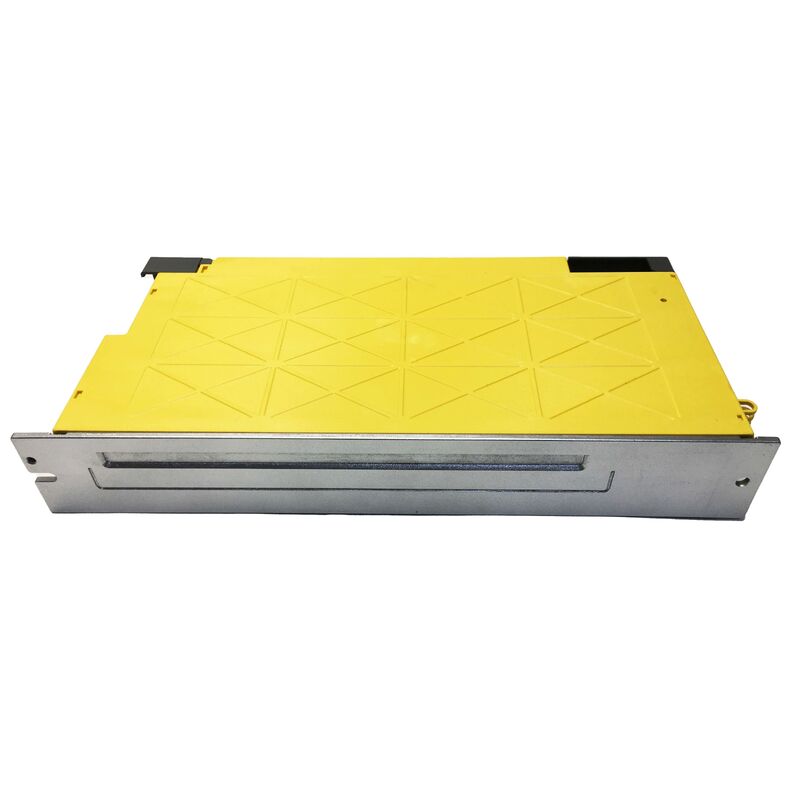
Fanuc A06B-6117-H106 | Alpha i Servo Amplifier Module — AiSV-160, Single-Axis, HRV3, FSSB, 283–339V / 11kW, 45A / 240V Output, 400V HV Series
Overview
The Fanuc A06B-6117-H106 is the AiSV-160, the highest-output single-axis module in Fanuc's A06B-6117 high-voltage (HV) alpha i FSSB series, rated at 45A continuous output from an 11kW / 283–339V HV DC bus.
At 45A, this module serves the most demanding single-axis applications in Fanuc's alpha i HV portfolio — the αiS30/3000HV and αiF40/3000HV motors, which produce 30N·m and 40N·m continuous torque respectively at their rated operating speeds.
These are among the heaviest standard servo motors in Fanuc's HV alpha i range, used on the largest axis drives of heavy-duty machining centres, large-frame turning centres, and precision boring mills where axis inertia and cutting forces require sustained high servo torque.
The 400V HV infrastructure context of the A06B-6117 series means the AiSV-160 draws from a DC bus generated by a 400V three-phase supply through a high-voltage alpha i PSM. At 45A output from a 400V-sourced HV bus, the motor receives 45A at 240V — the same mechanical power that a 200V system would deliver at nearly double the current. This halved supply current at 400V is the system-level advantage of HV architecture for heavy-axis applications: the supply conductors, bus bars, and input circuit breakers are sized for the 400V current levels, which are substantially more manageable than the equivalent 200V current at this power level.
The AiSV-160 is characterised by specialists as less common on CNC machine tools than lower-current HV modules — it appears primarily on high-end machining systems equipped with the heaviest HV servo motors and 30i/31i-A5 series controls.
This limited installed base makes it one of the more technically demanding components to source, test, and repair in the alpha i HV series.
Key Specifications
| Parameter |
Value |
| Module Model |
AiSV-160 (SVM1-160i HRV) |
| Control Algorithm |
HRV3 |
| Interface |
FSSB (fiber optic) |
| Axes |
Single (L channel) |
| Rated Input |
283–339V DC bus, 11kW |
| Max Output Voltage |
240V AC |
| Rated Output Current |
45A |
| Voltage Series |
HV (400V infrastructure) |
| Compatible Motors |
αiS30/3000HV, αiF40/3000HV |
| Compatible Controls |
FANUC 30i/31i-A5, 30i/31i |
45A Output — Heavy Axis Motor Pairing
The αiS30/3000HV motor produces 30N·m of continuous torque at 3000rpm rated speed. At full continuous rated torque, this motor draws current approaching the 45A continuous output of the AiSV-160.
The αiF40/3000HV at 40N·m continuous is the more demanding companion — at full continuous rated torque it draws current that the AiSV-160's 45A rating is specifically designed to sustain without triggering IPM protection alarms.
These motors appear on the largest axis drives of five-axis machining centres, pallet shuttle drives with high workpiece mass, large rotary table B-axis drives, and gantry-type machining systems where the servo axis moves substantial structural mass.
On any application where sustained 30–40N·m servo torque is required for extended machining sequences, the AiSV-160 at 45A is the correct specification — a smaller AiSV module would produce sustained overcurrent alarms under full production load conditions.
HRV3 at 45A — High-Current Precision Control
HRV3's impact on current regulation quality is particularly relevant at 45A output.
The current waveform sinusoidal quality at 45A determines the torque smoothness of heavy motors driving large machine components — any torque ripple at this scale shows up as velocity variation in the axis motion, and on large machining centres or boring mills, axis velocity variation during cutting directly affects the surface finish on large-diameter bores or facing operations.
The 30i/31i-A5 control's full HRV3 software capability, combined with the AiSV-160's HRV3 control hardware, provides the current regulation bandwidth needed to maintain torque smoothness at 45A across the αiS30/αiF40 motor's operating speed range.
For precision boring and milling operations on large parts — where tight cylindricity and flatness tolerances are design requirements — this combination is the correct technical choice.
FAQ
Q1: Is the A06B-6117-H106 a particularly rare module, and what does that mean for replacement planning?
Yes. The AiSV-160 HV appears on fewer machine models than smaller HV modules like the AiSV-80 (H105) or AiSV-40 (H104), because the αiS30/αiF40 motors it drives are used only on the heaviest machine axes.
The smaller global installed base means fewer exchange units circulate in the aftermarket.
Customers operating machines fitted with the H106 should maintain a tested spare module if production continuity is critical — sourcing a replacement under machine-down conditions is more challenging than for more common alpha i modules.
Q2: The module is for 400V HV infrastructure — what PSM generates the 283–339V HV DC bus?
The HV DC bus is generated by an alpha i HV PSM (from the A06B-6110 HV variant, A06B-6115 HV variant, or A06B-6200 HV variant, depending on the machine generation). These HV PSM modules rectify 380–480V three-phase AC input to produce the 283–339V HV DC bus.
The AiSV-160 connects to this bus via the standard HV module bus bar system. Never connect an HV series module to a standard 200V PSM bus — the bus voltage and current levels differ, and the modules' motor output voltages are calibrated for their respective bus levels.
Q3: Can the AiSV-160 (A06B-6117-H106) drive standard 200V-rated alpha i motors?
No. The AiSV-160 is part of the 400V HV series and is designed for HV-rated motors with 400V motor windings.
Standard 200V-rated alpha i motors (αiS series without HV designation) have lower voltage winding insulation and different electrical parameters.
Connecting them to the HV amplifier output could cause motor damage. The motor and amplifier voltage series must always match.
Q4: What testing facility is required to verify an A06B-6117-H106 after repair?
Functional testing requires a 400V three-phase supply, an alpha i HV PSM generating the HV DC bus, at least one αiS30HV or αiF40HV servo motor as the load, and a Fanuc 30i or 31i control with HV axis configuration to drive the motor via the FSSB ring.
The test must exercise the module at or near its 45A rated output to verify IPM transistor integrity, current regulation accuracy, and FSSB communication under load.
This HV test infrastructure is not universally available — fewer than standard 200V test facilities — so confirming the service provider's HV test capability before shipping is essential.
Q5: What FSSB alarms are specific to the A06B-6117-H106, and how are they diagnosed?
FSSB disconnect alarms (Alarm L for COP10A, Alarm U for COP10B) indicate fiber connector issues — inspect, clean, and reseat the optical connectors.
Alarm 8 (L-axis overcurrent or IPM fault) is the primary output stage alarm: disconnect the motor power cables and test HV-rated motor insulation resistance using a high-voltage insulation tester appropriate for the motor's voltage class (several hundred megaohms to protective earth is acceptable).
If the alarm clears with cables disconnected, the fault is in the motor or power cable.
If it persists, the IPM in the AiSV-160 has likely failed and the module requires specialist repair.
At 45A rated output, the IPM transistor is under significant sustained thermal load — fan health is a critical preventive maintenance item.


 Your message must be between 20-3,000 characters!