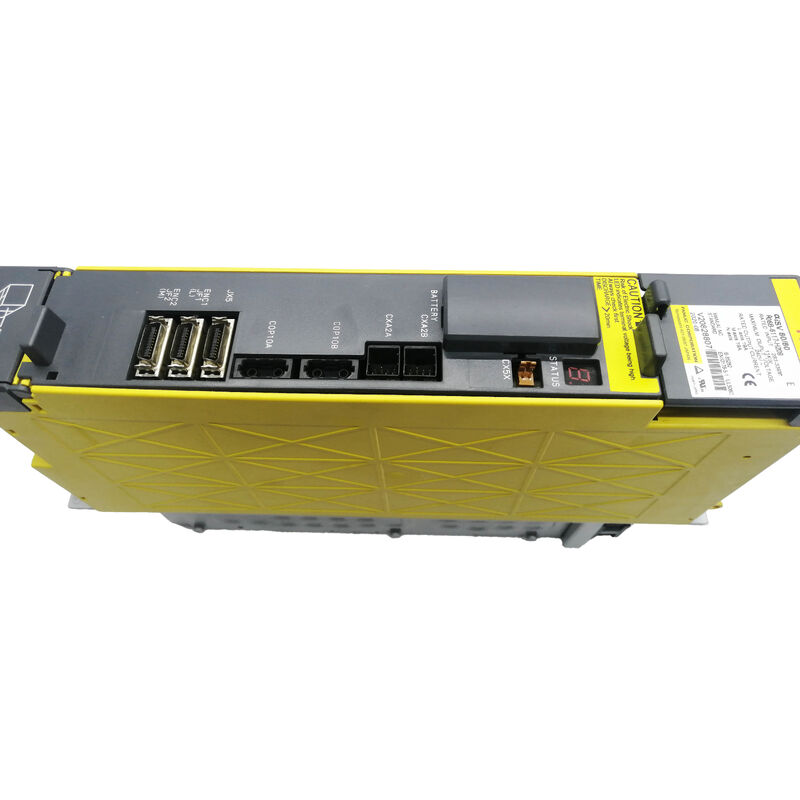
FANUC A06B-6117-H209 Dual-Axis Alpha i Servo Module
Overview
The A06B-6117-H209 is a dual-axis Alpha i servo amplifier module identified as αi SV 80/80 in the public FANUC maintenance manual and as AiSV-80/80 in replacement-market listings.
That combination makes its family position unusually clear: this is a two-axis Alpha i servo module, not a spindle amplifier and not a power-supply unit.
In practical CNC applications, a module like this is selected when the machine uses a symmetrical dual-axis servo arrangement and the original cabinet architecture needs to be preserved.
The model is commonly associated with FANUC Alpha i environments and later CNC control generations, which is why buyers typically search for it as a direct replacement module rather than a broad servo-drive option.
Publicly available specifications also give it a clear technical profile: 283–339 V rated input, 11 kW power context, 240 V maximum output, and 19 A rated current on both L and M axes.
These values show that the amplifier belongs to a symmetrical higher-capacity two-axis class, which is an important distinction when comparing it with mixed-capacity dual-axis modules nearby in the same family.
Key Specifications
| Parameter |
Value |
| Part Number |
A06B-6117-H209 |
| Product Type |
Servo amplifier module |
| Series |
Alpha i |
| Official family table designation |
αi SV 80/80 |
| Common market designation |
AiSV-80/80 |
| Axis Configuration |
2-axis |
| Rated Input |
283–339 V |
| Power Context |
11 kW |
| Maximum Output Voltage |
240 V |
| Rated Output Current |
L axis 19 A / M axis 19 A |
| Manual Reference |
B-65322 |
| Typical Use |
CNC dual-axis servo replacement / support |
Symmetrical Dual-Axis Alpha i Structure
One of the strongest technical points about A06B-6117-H209 is that it is a symmetrical dual-axis servo module.
Both controlled axes share the same 19 A class, which makes the amplifier easier to position in the Alpha i family than mixed-capacity modules such as 40/80 or 20/40 variants.
For technical buyers, this matters because it helps confirm whether the installed machine uses equal-class axes on the same drive module.
The official family-table entry is also a major advantage when writing a product page.
Instead of relying only on resale language, the listing can be grounded in the FANUC maintenance family structure and then reinforced with the market designation AiSV-80/80 that buyers will recognize from service channels.
FAQ
Q1: What kind of product is A06B-6117-H209?
It is a FANUC Alpha i dual-axis servo amplifier module. The public FANUC maintenance manual places it in the αi SV 80/80 family, and replacement listings describe it as AiSV-80/80.
In practical machine use, it drives two servo axes inside an installed FANUC motion system.
Q2: Why is the αi SV 80/80 or AiSV-80/80 designation important?
It confirms the exact family position of the module inside the Alpha i dual-axis servo range.
For replacement work, that is more useful than a broad “servo amplifier” label because it tells the buyer that both axes belong to the same output class.
Q3: Are the 19 A / 19 A ratings significant in practice?
Yes. They show that this is a symmetrical dual-axis amplifier rather than a mixed-capacity one. In practical service work, that distinction helps buyers avoid confusing it with similar-looking Alpha i modules that use different current splits across the two axes.
Q4: Why does the B-65322 manual reference matter?
It provides a documentation anchor for installation and operational context. In real maintenance work, having the correct manual family can help technicians verify compatibility, understand the amplifier’s role in the cabinet, and align service procedures more accurately.
Q5: What should buyers verify before ordering?
Buyers should verify the exact part number, the αi SV 80/80 or AiSV-80/80 designation, the dual-axis architecture, and the original Alpha i cabinet layout.
For FANUC servo amplifier modules, exact family and axis-structure matching are usually more important than broad functional overlap.



 Your message must be between 20-3,000 characters!