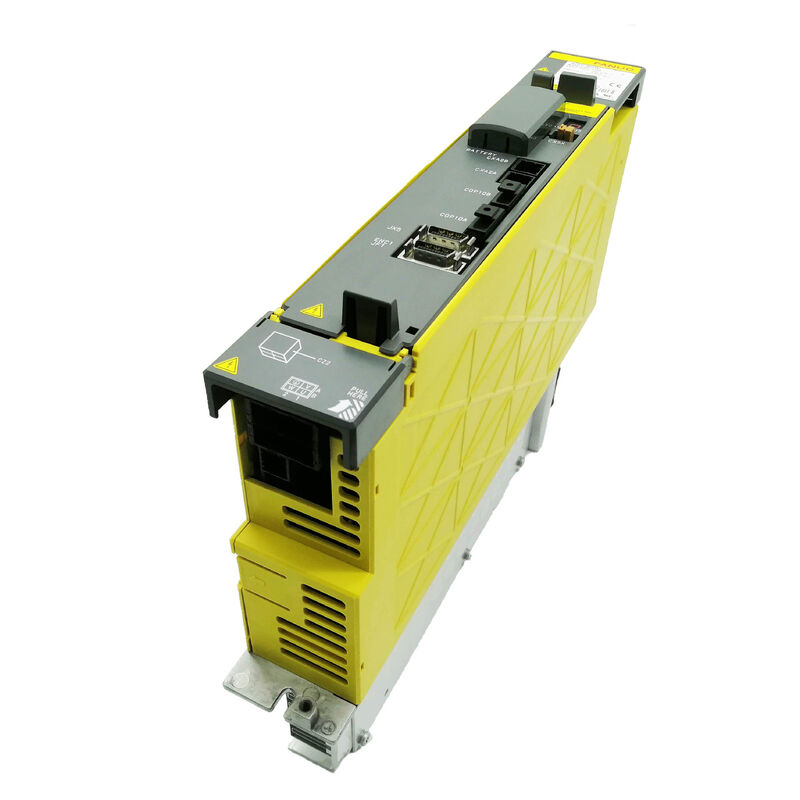
FANUC A06B-6124-H208 Dual-Axis Alpha i Servo Module
Overview
The A06B-6124-H208 is a dual-axis Alpha i servo amplifier module identified in public references as SVM2-40/80HVi. Replacement listings consistently position it as a high-voltage dual-axis FANUC servo unit, with 565–679 V rated input, 8.6 kW power context, 480 V maximum output, and split current ratings of 9.1 A on the L axis and 18.2 A on the M axis.
In practical CNC applications, this is not a standard low-voltage two-axis amplifier.
It belongs to the HVi class, which means it is more appropriate for machines already built around FANUC’s higher-voltage servo architecture.
For industrial buyers, that makes exact family matching especially important, because an HVi amplifier is normally selected as part of a defined cabinet and drive environment rather than as a broad substitute for another dual-axis module.
The mixed-capacity 40/80 structure is also one of the key technical features of this model. It tells the reader immediately that the two axes are not identical in output class, which is often critical in real machine matching.
For product-page writing, the most useful position is clear: A06B-6124-H208 is a FANUC Alpha i dual-axis high-voltage servo module, model SVM2-40/80HVi, intended for exact CNC replacement and motion-system support.
Key Specifications
| Parameter |
Value |
| Part Number |
A06B-6124-H208 |
| Product Type |
Servo amplifier module |
| Series |
Alpha i |
| Model Designation |
SVM2-40/80HVi |
| Axis Configuration |
2 Axis |
| Rated Input |
565–679 V |
| Power Rating |
8.6 kW |
| Maximum Output |
480 V |
| Rated Output Current |
L-axis 9.1 A / M-axis 18.2 A |
| Manual Number |
B-65282 |
| Typical Positioning |
High-voltage dual-axis servo module |
FAQ
Q1: What kind of product is A06B-6124-H208?
It is a FANUC Alpha i dual-axis servo amplifier module. In practical machine use, it drives two servo axes from one amplifier assembly and belongs to the SVM2-40/80HVi class, which places it in the higher-voltage portion of the Alpha i servo range rather than in the standard lower-voltage family.
Q2: Why is the SVM2-40/80HVi designation important?
That designation carries two useful technical meanings at once. First, it shows that the module is dual-axis. Second, it shows that the two axes belong to different output classes, 40 and 80.
In practical service work, this is important because many machines are designed around mixed-capacity axis groupings, and using the wrong symmetry or voltage class can lead to an incorrect replacement decision.
Q3: What does the HVi classification mean in practice?
HVi indicates that the module belongs to a higher-voltage drive environment. That matters because a machine using HVi hardware is usually designed around a specific power architecture, insulation class, and amplifier family.
For buyers, this means the model should be matched carefully to the installed system rather than compared loosely with standard dual-axis Alpha i amplifiers.
Q4: Are the 9.1 A and 18.2 A axis ratings useful during selection?
Yes. Those values are one of the fastest ways to confirm that this is a mixed-capacity high-voltage module rather than a symmetrical one.
In practical maintenance work, that helps engineers compare the amplifier to the installed unit and verify that the axis pairing on the machine matches the amplifier’s intended output structure.
Q5: What should buyers verify before ordering?
Buyers should verify the exact part number, the SVM2-40/80HVi designation, the HVi cabinet environment, the dual-axis arrangement, and the original machine’s power and axis structure.
For this kind of FANUC amplifier, voltage class and family identity are just as important as the order code itself.


 Your message must be between 20-3,000 characters!