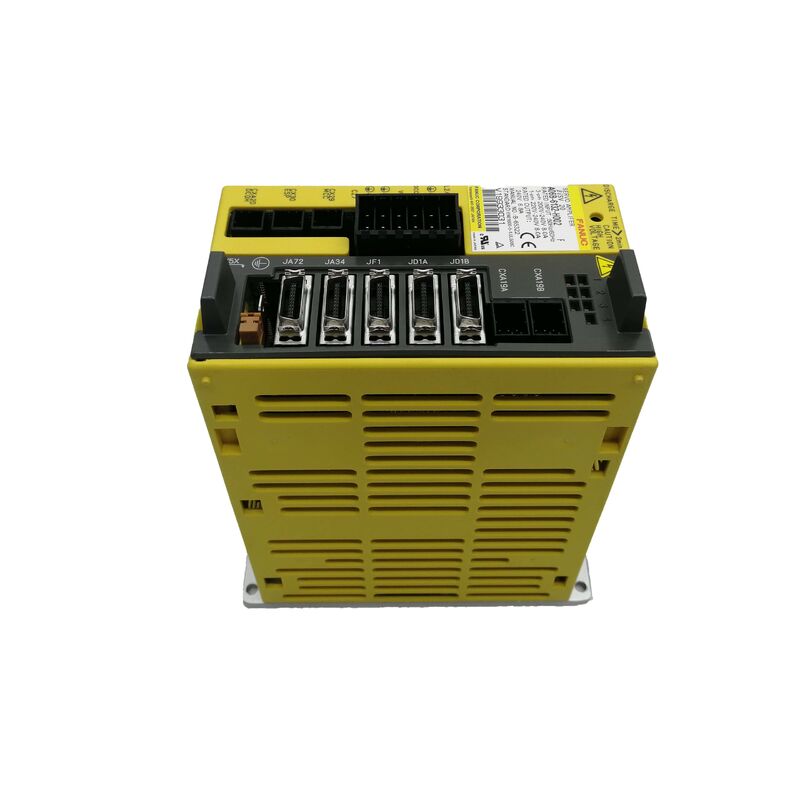
Fanuc A06B-6132-H002 | I/O Link Beta i Servo Module — BSVM1-20i, 200–240VAC, 8A/6.8A, 50/60Hz, βiSV20 Series, CNC
Overview
The Fanuc A06B-6132-H002 is a Beta i series servo amplifier module configured for Fanuc's I/O Link communication interface, rated at 200–240V AC with 8A input and 6.8A output current capacity.
This is the BSVM1-20i configuration — the "20i" identifying the output class within the Beta i series, sized to drive Fanuc βi series servo motors used in auxiliary axis, rotary axis, and peripheral device control on CNC machine tools.
The Beta i servo amplifiers with I/O Link occupy a specific niche in Fanuc's drive architecture.
Where the primary machine axes are typically driven by alpha-series amplifiers communicating with the CNC via FSSB (Fanuc Serial Servo Bus), auxiliary axes, tool changers, pallet systems, and fourth-axis rotary tables frequently use Beta series drives that connect through the I/O Link protocol.
This separates the auxiliary motion control from the primary axis servo bus, allowing the machine builder to locate the auxiliary drive independently and connect it through the PMM (Power Mate Manager) or directly via I/O Link to compatible Fanuc CNC controllers including Series 15, 16, 18, 20, 21, and 0i models.
A key practical consideration with the A06B-6132-H002 is the parameter loading requirement. Unlike drives that come preset and operate immediately upon connection, the BSVM1-20i requires the motor-specific servo parameters to be loaded into the unit before it will function.
This is not a fault — it is by design, allowing the same physical module to be configured for different Beta i motor models by loading the appropriate parameter set via the CNC or dedicated parameter loading software. A replacement unit supplied without its parameters pre-loaded will display alarms and refuse to run until the correct parameter data is transferred.
Key Specifications
| Parameter |
Value |
| Module Model |
BSVM1-20i |
| Interface |
I/O Link |
| Input Voltage |
200–240V AC |
| Input Frequency |
50/60 Hz |
| Input Current |
8 A |
| Output Current |
6.8 A |
| Series |
Beta i (βiSV series) |
| Compatible Motors |
Fanuc βi series |
| Weight |
Approx. 2.65 lbs |
| Note |
Parameters must be loaded before use |
I/O Link Interface — Beta Axis Architecture in Fanuc CNC Systems
Fanuc's I/O Link is a dedicated serial communication protocol that connects peripheral devices, I/O modules, and Beta series servo amplifiers to Fanuc CNC controls without occupying positions on the main FSSB servo bus.
For the A06B-6132-H002, this means the amplifier connects through the I/O Link chain — the CNC communicates motor commands and receives feedback through this interface rather than through the fibre-optic FSSB used by alpha-series amplifiers on primary axes.
In practical machine tool design, the I/O Link Beta servo configuration is the standard solution for fourth axes, turret indexing motors, pallet clamping actuators, and other ancillary axes where position control quality requirements are consistent with Beta motor capabilities and full-bandwidth FSSB communication is not needed.
The CNC controls these axes through the PMM (Power Mate Manager) function, treating them as additional controlled positions within the overall machine motion sequence.
The I/O Link connection also enables communication with other I/O devices on the same link — push-button stations, relay I/O modules, additional Beta drive modules — all sharing the same serial chain and reducing the total cable count in the control cabinet compared to individual hard-wired connections.
Parameter Loading — Essential Before Commissioning
The BSVM1-20i module's parameter dependency is the one operational requirement that distinguishes it from plug-and-play drive replacement.
Parameters define the motor-specific characteristics that the drive needs to control the motor correctly: number of pole pairs, encoder resolution, rated current, maximum current, velocity loop gain, position loop gain, and a range of other motor model-specific values.
On initial commissioning or after replacing a failed unit, the parameters are loaded from the CNC's parameter memory into the BSVM1-20i's internal RAM via the I/O Link communication path.
The procedure involves entering the parameter write mode in the CNC, selecting the Beta drive axis, and executing the parameter initialisation sequence.
Once loaded, the parameters persist through normal power cycles — they are only lost if the backup battery in the module discharges completely or a full parameter initialisation is performed.
FAQ
Q1: What happens if the A06B-6132-H002 is replaced without loading parameters first?
The drive will display servo alarms on the CNC panel and refuse to run. Common alarms include SV-401 (overcurrent alarm) and SV-9001 or similar initialization errors, depending on the control software version. The drive is not faulty — it simply has no motor configuration data.
Parameters must be loaded from the CNC controller before the axis can operate. Have the parameter backup from the original drive, or obtain the correct parameter set for the specific Beta motor type from the machine's parameter documentation before installation.
Q2: Which CNC controls are compatible with the A06B-6132-H002's I/O Link interface?
The A06B-6132-H002 is compatible with Fanuc CNC controls that support I/O Link servo communication, including Series 15 (later versions), 16, 18, 20, 21, and 0i.
The specific PMM (Power Mate Manager) or I/O Link axis control function must be enabled in the CNC's software options and the axis configured in the control parameters. Compatibility with a specific machine should be verified against the machine builder's documentation or Fanuc's drive compatibility matrix.
Q3: What Beta i motor models is the BSVM1-20i rated to drive?
The BSVM1-20i is sized for the βiS 4 and βiS 8 motor range within the Beta i servo motor family, which cover the lower to mid-range output capacity of the Beta series.
The actual motor model compatibility depends on the parameter configuration loaded into the drive — the module can be set to drive different Beta i motor variants within its current envelope by loading the corresponding parameter set. Confirm the target motor model against Fanuc's Beta series servo amplifier selection table.
Q4: The input current is 8A and output is 6.8A — why is input higher than output?
The input current draws from the AC supply, which includes the conversion losses in the rectifier and DC bus capacitor bank, the drive's own logic power supply, and the regenerative discharge capability.
The output current of 6.8A is the sustained AC current delivered to the motor windings.
The difference accounts for the power electronics losses (heat dissipation in the switching transistors) and the overhead of the drive's internal circuitry. Peak current capability during acceleration transients exceeds the rated continuous output.
Q5: Can the A06B-6132-H002 be repaired if the module fails?
Yes. The BSVM1-20i has a well-documented circuit architecture and is routinely repaired by Fanuc-trained service shops. Common failure modes include capacitor degradation on the DC bus, output transistor failure (usually from motor cable insulation failure causing through-fault current), and I/O Link interface circuit failures from electrical transients.
A repaired and tested module with correct parameters loaded is functionally equivalent to a new module.
Exchange programs — where the customer's failed unit is refurbished and returned, or a pre-tested unit is supplied — are the standard commercial model for sourcing A06B-6132-H002 replacements.



 Your message must be between 20-3,000 characters!