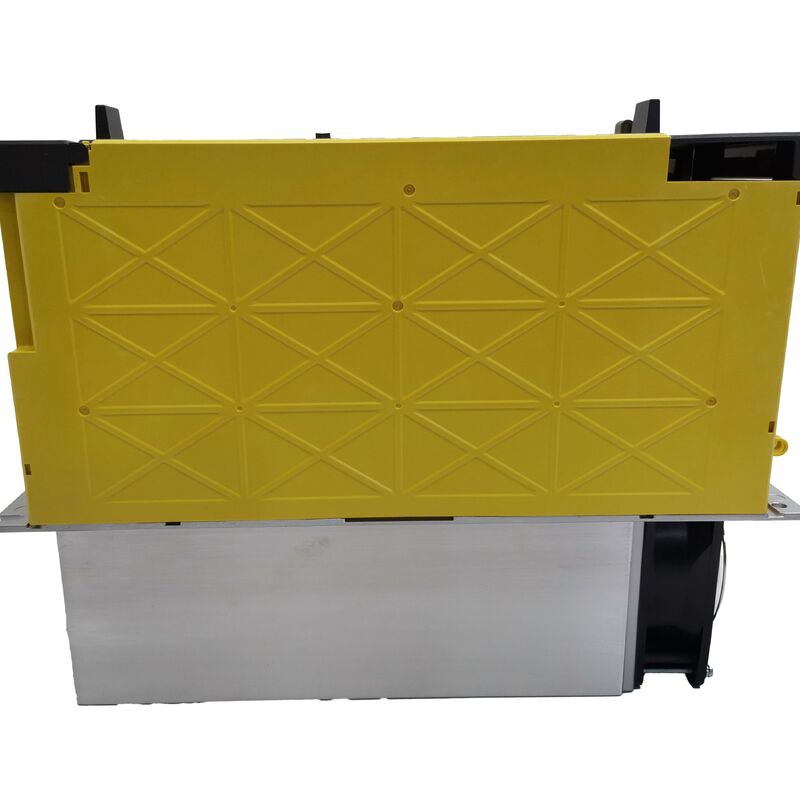
FANUC A06B-6140-H030 | Alpha i aiPS-30 Power Supply Module — 35 kW / 44 kVA / Regenerative / 200–240V
Cabinet Power Foundation — What the aiPS-30 Does
The A06B-6140-H030 is the aiPS-30 — the 35 kW Alpha i Power Supply Module in FANUC's A06B-6140 family. In the Alpha i drive architecture, the PSM is the power foundation for the entire drive cabinet: it converts incoming three-phase AC into the regulated DC bus voltage that every connected Alpha i servo amplifier module (αiSVM) and spindle amplifier module (αiSPM) draws from. The PSM is not a single-axis drive; it is the shared power source that makes all axes possible.
At 35 kW rated output with 44 kVA incoming equipment capacity and support for up to 64 kW of combined motor output, the aiPS-30 occupies the larger end of the Alpha i power supply range. The 64 kW motor output ceiling — substantially above the 35 kW continuous rating — reflects the combined short-term peak demand during multi-axis acceleration, which draws on all connected modules simultaneously.
Regenerative control is what distinguishes the Alpha i PSM from a passive rectifier. During motor deceleration, kinetic energy flows back from the motors through the drive modules to the DC bus. A passive system must dissipate this energy in braking resistors. The aiPS-30's active regenerative stage returns this energy to the AC supply — reducing energy consumption and eliminating the thermal management concerns associated with braking resistor operation.
Key Specifications
| Parameter |
Value |
| Part Number |
A06B-6140-H030 |
| Designation |
aiPS-30 |
| Rated Output |
35 kW |
| Equipment Capacity |
44 kVA |
| Motor Max Output |
64 kW |
| AC Input |
200–240V, 3-phase |
| Control Power |
0.7 kVA |
| Control Method |
Regenerative |
aiPS-30 vs Larger Alpha i PSM Models
The A06B-6140 family covers a range of aiPS modules at different output ratings. The -H030 (aiPS-30 at 35 kW / 44 kVA) is positioned for medium-to-large multi-axis configurations. Selecting the correct PSM rating for a specific drive configuration requires calculating the sum of the connected drive modules' continuous demand — not just their peak ratings. An undersized PSM trips under sustained production loads; an oversized PSM represents unnecessary cost without functional benefit.
FAQ
Q1: What does the aiPS-30 designation indicate?
aiPS identifies this as an Alpha i Power Supply module — the cabinet-level DC bus power source for Alpha i drive systems, not a servo or spindle axis amplifier. The "30" identifies the power class within the aiPS family. At 35 kW rated output and 44 kVA main circuit capacity, the aiPS-30 serves medium-to-large multi-axis drive cabinets.
Q2: Why does regenerative control matter in a PSM?
Regenerative control allows decelerating motors to return braking energy to the AC supply rather than dissipating it as heat in braking resistors. This reduces cabinet cooling requirements and energy consumption. It also simplifies the drive cabinet design — no braking resistor, no thermal cutout, no sizing calculation for resistor wattage. For machines with frequent high-inertia deceleration cycles, the energy savings are measurable.
Q3: What is the difference between the 35 kW rated output and the 64 kW motor output?
The 35 kW is the PSM's continuous sustainable output. The 64 kW motor maximum reflects the combined short-term peak demand supported during simultaneous multi-axis acceleration. The drive system is designed to handle brief peak demand above the continuous rating — from the energy stored in the DC bus capacitors and from short-term supply overload — before thermal protection limits apply.
Q4: How is the correct aiPS rating selected for a specific machine?
Sum the continuous current demand of all connected αiSVM and αiSPM modules under the machine's typical production duty cycle. This total must fall within the PSM's 35 kW rated output. The 64 kW motor output ceiling provides headroom for acceleration peaks but is not the continuous sizing figure. An undersized aiPS will trip on sustained production loads.
Q5: Does replacing the aiPS-30 require any CNC parameter changes?
No. The PSM does not store CNC parameters or axis configuration. After physical replacement, restore power and verify correct DC bus voltage at the connected drive modules before enabling axes. Check the FSSB communication link from the CNC to the drive chain is intact — an aiPS replacement that disturbs cable routing can introduce communication faults that appear unrelated to the PSM swap.


 Your message must be between 20-3,000 characters!