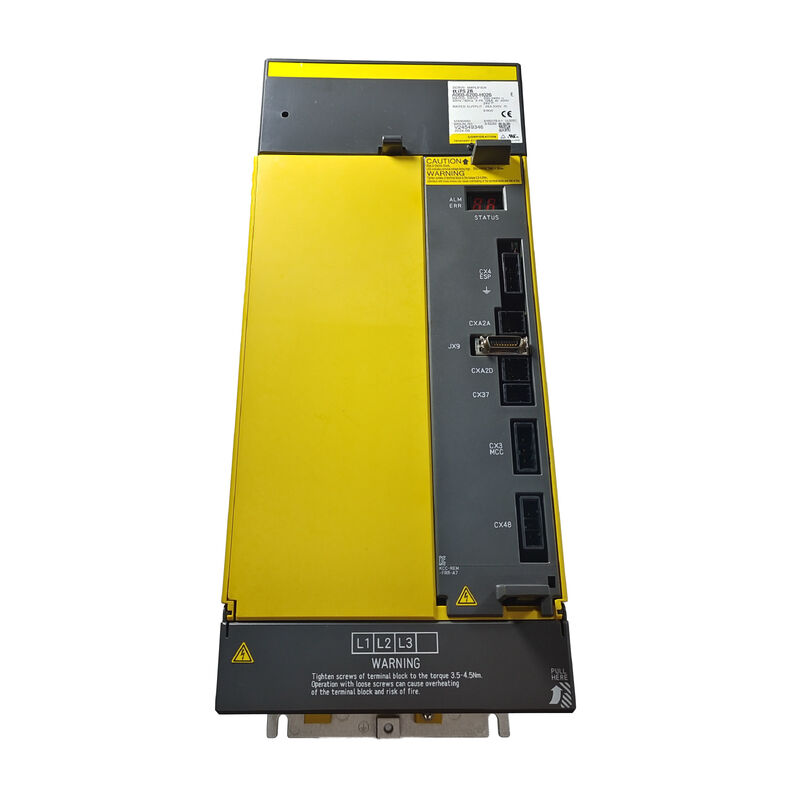
Fanuc A06B-6200-H008 | αiPS-7.5 Power Supply Module — 200–240VAC / 33A Input, 283–339VDC / 9.4kW Output, Power Regeneration, αi-B Series
Overview
The Fanuc A06B-6200-H008 is the αiPS-7.5, a compact αiPS-B series power supply module converting three-phase 200–240VAC at 33A into a 283–339VDC bus at 9.4kW rated output, with active power regeneration.
As the entry-to-mid level offering within the A06B-6200 αiPS-B lineup, the αiPS-7.5 targets small-to-medium CNC machine configurations — a few αiSV-B servo axes at light-to-moderate current plus a smaller αiSP-B spindle module, where the combined peak simultaneous demand stays within the 9.4kW bus capacity.
Two production versions of the H008 exist: the original αiPS-7.5 and the revised αiPS-7.5-B (the "-B" generation matching the αiSV-B and αiSP-B amplifiers).
These two versions share the same part number (A06B-6200-H008) but differ in their internal hardware revisions.
When ordering a replacement, specifying which generation is currently installed — confirmed from the module's label or the machine builder's documentation — ensures the correct revision is supplied and avoids potential compatibility issues with the connected αi-B amplifier modules.
At 9.4kW bus output from a 33A input, the αiPS-7.5 is the most compact PSM in the αiPS-B range that still supports a meaningful multi-axis and spindle combination.
It is appropriately specified for small VMCs (vertical machining centres), compact CNC lathes with moderate spindle power, and drill-and-tap centres where the spindle power is in the 5.5–7.5kW class and two to three light servo axes complete the drive configuration.
Key Specifications
| Parameter |
Value |
| Module Model |
αiPS-7.5 / αiPS-7.5-B |
| Input Voltage |
200–240V AC, 3-phase |
| Input Current |
33A at 200V |
| Input Frequency |
50/60 Hz |
| DC Output Voltage |
283–339V |
| Output Power |
9.4kW rated |
| Regeneration |
Active power regeneration |
| Internal Fan |
A90L-0001-0580#B |
| External Fan |
A90L-0001-0576 |
| Manual |
B65515EN |
αiPS-7.5 vs αiPS-7.5-B — Two Generations, One Part Number
The A06B-6200-H008 covers both the original αiPS-7.5 and the later αiPS-7.5-B revision. Both provide the same 9.4kW / 283–339VDC bus output from the same AC input parameters and carry the same part number.
The "-B" revision aligns the PSM with the B-generation αiSV-B and αiSP-B amplifiers, incorporating hardware revisions that match the interconnect and communication protocols of those amplifiers.
When a machine is equipped with αiSV-B or αiSP-B amplifiers (the current-generation αi-B system), the αiPS-7.5-B variant of the H008 is the correct PSM.
Fitting the original αiPS-7.5 in a -B system — or vice versa — may cause communication alarms or erratic PSM-to-amplifier signalling.
Service providers experienced with Fanuc αi-B systems maintain the ability to identify which generation is physically fitted in a machine, either from the internal hardware revision markings or from the machine's configuration documentation, and can supply the appropriate H008 generation as a replacement.
9.4kW Bus Capacity — Practical Machine Configuration
The 9.4kW DC bus output can support combinations such as: an αiSP-5.5 spindle module (5.5kW spindle rated) plus two to three αiSV servo modules at light to moderate current (e.g., 1.25kW each for mid-range axes), or a higher-power spindle (αiSP-7.5, 7.5kW class) with one to two light servo axes. Configurations that exceed the 9.4kW combined peak demand require the αiPS-11 (A06B-6200-H011) at the next capacity level.
The 9.4kW limit applies to simultaneous peak demand — a machine where the spindle and all axes never simultaneously reach their maximum loads will operate with a higher effective margin than the calculation suggests.
Conservative PSM sizing for full simultaneous peak loads protects against AL-04 (DC link undervoltage) alarms during the most demanding production sequences.
Dual-Fan Cooling — Thermal Management Details
The αiPS-7.5's dual-fan arrangement separates internal and external cooling duties. The internal fan (A90L-0001-0580#B) circulates air across the control PCB and rectifier components inside the module enclosure.
The external fan (A90L-0001-0576) forces air over the external heatsink fins where the main power transistors dissipate their heat load. Both fans are monitored in real time: the module generates AL-02 when the internal fan stops and AL-10 when the external fan stops, regardless of whether thermal overload has yet occurred.
Fan health monitoring provides advance warning before thermal damage occurs — a critical feature at 9.4kW where the sustained power flow through the main transistors generates substantial continuous heat.
Replacing fans on a scheduled maintenance cycle (consistent with the fan's rated bearing life) prevents alarm-driven emergency shutdowns during production.
FAQ
Q1: What is the difference between the A06B-6200-H008 (αiPS-7.5) and the A06B-6115-H006 (PSMR-5.5i)?
The A06B-6115-H006 is from the earlier αi PSR series (resistor regeneration), providing 9.4kW from its DC bus but directing regenerated braking energy to an external discharge resistor.
The A06B-6200-H008 is from the αiPS-B series (active power regeneration), providing the same 9.4kW bus output but actively returning braking energy to the AC power grid. The αiPS-B is a later-generation product with higher efficiency and no requirement for an external discharge resistor unit.
The two are not interchangeable — they use different bus connector systems and 24V distribution schemes appropriate to their respective amplifier generations.
Q2: The αiPS-7.5 and αiPS-7.5-B share the same part number — how do I know which version is in my machine?
The module's front label or internal PCB markings typically show the hardware revision.
The machine builder's electrical documentation or BOM (bill of materials) will specify whether the original installation was the αiPS-7.5 or αiPS-7.5-B. If this documentation is unavailable, a Fanuc-trained service provider can identify the installed version through the module's physical inspection.
Always communicate which generation you require when sourcing a replacement — a competent supplier will confirm the revision before shipping.
Q3: What input circuit breaker rating is needed for the A06B-6200-H008?
With 33A rated input at 200V on three-phase, the AC branch circuit breaker should be rated above 33A to avoid nuisance tripping during PSM startup inrush and normal operation. Fanuc's installation guidelines typically recommend 1.25 to 1.5 times the rated input current as the minimum breaker rating, giving a 41–50A minimum for the αiPS-7.5.
The exact breaker type, breaking capacity, and thermal-magnetic or electronic trip characteristic must comply with the installation's local electrical code. Coordinate with the machine builder's electrical specification document for the original breaker selection.
Q4: Can the A06B-6200-H008 power a machine configuration that previously used the A06B-6110-H008 (αi PS-7.5)?
The A06B-6110-H008 and A06B-6200-H008 both provide 9.4kW from a 283–339VDC bus. However, they serve different amplifier generations: the A06B-6110 series is designed for the first-generation αi servo amplifiers (A06B-6114 SVM series), while the A06B-6200 series is designed for the αi-B generation (A06B-6220/6221 SVM-B series).
The bus connector hardware and 24V distribution differ between generations. Substituting the -B generation PSM in a machine with first-generation αi amplifiers is not a supported configuration — match the PSM generation to the installed amplifier generation.
Q5: What is the correct diagnostic sequence when the A06B-6200-H008 shows AL-04 (DC bus undervoltage)?
AL-04 indicates the DC bus voltage has fallen below the minimum threshold.
Start by checking the three-phase AC input: measure each phase voltage to confirm all three phases are present and balanced. Check that the input circuit breaker has not tripped. Verify that the AC line reactor (if fitted) is intact and that its connections are secure.
If the AC supply appears healthy, check the DC bus capacitor charge by observing the module's LED status — the module normally indicates "charge complete" before enabling. If the pre-charge sequence (AL-05) has previously been alarm-logged, the pre-charge circuit or DC bus capacitors may have degraded and require specialist investigation.
Do not power-cycle repeatedly to clear AL-04 without first verifying the AC supply condition.


 Your message must be between 20-3,000 characters!