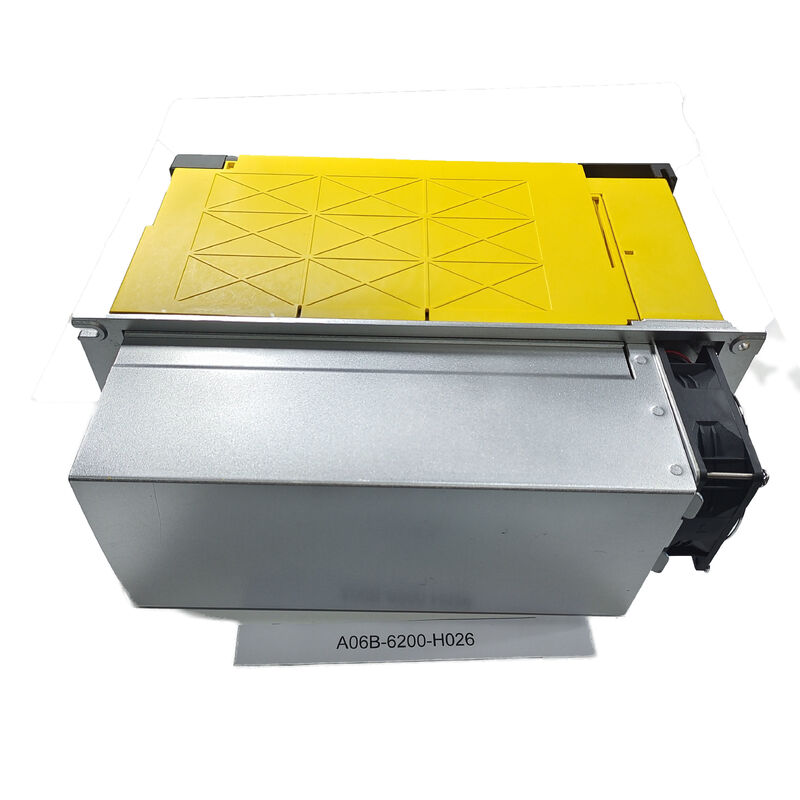
Fanuc A06B-6200-H026 | αiPS-26-B Power Supply Module — 200–240VAC / 108A Input, 283–339VDC / 31kW Output, Power Regeneration, αi-B Series
Overview
The Fanuc A06B-6200-H026 is the αiPS-26, the highest-capacity standard module in Fanuc's A06B-6200 αiPS-B power supply series, converting three-phase 200–240VAC at 108A into a 283–339VDC bus at 31kW rated output.
As the largest entry in the αiPS-B (B-series) power supply family before stepping up to the level-up A06B-6202 series, the aiPS-26 is specified for machine tool installations with heavy combined servo and spindle amplifier demand — large machining centres with multiple mid-to-heavy servo axes and a significant spindle drive, where the total simultaneous peak DC bus demand approaches or reaches the 31kW capacity.
The "B" designation in the αiPS-B series name is significant: the A06B-6200 series represents the current-generation αi power supply platform used alongside the αiSV-B servo modules (A06B-6220/6221 SVM series) and αiSP-B spindle modules (A06B-6220/6222 SPM series).
This is a later-generation architecture than the earlier αi series A06B-6110/6115 PSM modules, with improved efficiency and a more compact physical profile that integrates with the B-series amplifier rail system's tighter packaging.
Active power regeneration is the αiPS-26's most energetically significant feature.
During motor deceleration — when servo axes decelerate from rapid traverse speeds, or when the spindle brakes from high RPM — the motors act as generators, feeding energy back into the DC bus.
The αiPS-26's bidirectional converter stage actively converts this DC regenerated energy back to three-phase AC and returns it to the plant's power grid, reducing the machine's net energy consumption compared to resistor-based regeneration designs that dissipate this energy as heat.
Key Specifications
| Parameter |
Value |
| Module Model |
αiPS-26 (AiPS-26) |
| Input Voltage |
200–240V AC, 3-phase |
| Input Current |
108A at 200V |
| Input Frequency |
50/60 Hz |
| DC Output Voltage |
283–339V |
| Output Power |
31kW rated |
| Low Voltage Output |
24V DC |
| Regeneration |
Active power regeneration |
| Internal Fan |
A90L-0001-0581 |
| External Fan |
A90L-0001-0577 |
| Manual |
B-65412 / B65515EN |
31kW Bus Capacity — Machine Configuration Sizing
The 31kW DC bus output determines which combination of αiSV-B and αiSP-B amplifier modules can be simultaneously supported. Selecting the αiPS-26 requires calculating the peak simultaneous demand of all connected amplifiers.
A typical heavy-duty machining centre configuration might include a 22kW αiSP spindle module (αiSP-22) drawing perhaps 17kW under cutting conditions, plus three to five αiSV servo axes drawing a combined 8–12kW at simultaneous peak — a total that approaches 30kW and makes the αiPS-26 the minimum PSM that handles this configuration without DC bus undervoltage alarms during the most demanding simultaneous motion and cutting sequences.
The 24VDC low-voltage output distributes control power to all connected αiSV-B and αiSP-B amplifier modules, eliminating the need for a separate 24V power supply for the drive stack. This integrated 24V distribution is a feature of the αiPS-B series architecture and simplifies cabinet wiring compared to earlier PSM designs.
Active Power Regeneration — Energy Efficiency in Production
The distinction between active regeneration (as in the αiPS-26) and resistor-based regeneration (as in the αiPSR series) is most visible on machines with high-cycle, high-speed operation.
A machining centre producing small parts at high cycle rates — frequent rapid axis traverses, frequent spindle accelerations and decelerations — generates substantial regenerated energy per production hour.
In a resistor regeneration system, all of this energy becomes waste heat in the discharge resistors and in the cabinet cooling system. In the αiPS-26, this energy goes back into the plant power grid.
For high-volume production environments running two or three shifts daily, the energy savings from active regeneration can meaningfully reduce the machine's operating cost per part over its production lifetime.
The AC reactor (A81L-0001-0186) recommended for use with the αiPS-26 provides input line harmonics filtering — important for facilities with other sensitive power electronics on the same distribution branch.
FAQ
Q1: What alarm codes are most critical on the A06B-6200-H026?
AL-01 (PS overcurrent) indicates a fault in the main power conversion stage — power off immediately.
AL-02 (internal fan failure) and AL-10 (external fan failure) require prompt fan inspection and replacement; continued operation with failed cooling causes AL-03 (overload/overheat). AL-04 (low DC link voltage) points to AC input supply issues — check all three phases for voltage and balanced phase presence; AL-14 (open phase) specifically indicates an input phase missing.
AL-07 (over voltage DC link) during motor deceleration may indicate the regeneration stage has faulted. AL-A2 (communication error) indicates a problem in the serial communication between the PSM and the first connected amplifier module.
Q2: What is the AC reactor specified for the A06B-6200-H026, and is it mandatory?
The AC line reactor A81L-0001-0186 is specified by Fanuc for use with the αiPS-26. It limits the harmonic current fed back into the AC supply during active regeneration and suppresses input current spikes during initial power-up charging of the DC bus capacitors.
In facilities with strict power quality standards or where multiple drives share the same transformer secondary, the reactor helps prevent interference between the αiPS-26's regeneration pulses and other sensitive equipment.
Omitting it may cause AL-01 (overcurrent) alarms on power-up or nuisance tripping of upstream circuit breakers during deceleration events.
Q3: The A06B-6200-H026 has both an internal and external cooling fan — what happens when only one fails?
The internal fan (A90L-0001-0581) cools the control electronics and rectifier stage; its failure generates AL-02. The external heatsink fan (A90L-0001-0577) cools the main power switching transistors; its failure generates AL-10.
Either alarm requires immediate attention — at 31kW input capacity, the thermal load on the power stage is substantial.
If only AL-10 appears (external fan), the unit may continue operating briefly while AL-02 (internal fan) is absent, but sustained operation without the external fan causes rapid heat buildup in the main converter transistors. Replace both fans as a set during any scheduled maintenance to avoid sequential failures.
Q4: Can the A06B-6200-H026 be used with the older αi series amplifiers (A06B-6114, A06B-6117)?
The A06B-6200 αiPS-B series is specifically designed for the αiSV-B (and αiSP-B) series amplifiers used with the 30i/31i/32i generation controls.
The earlier αi series amplifiers (A06B-6114 SVM for 0i/16i/18i controls) use the A06B-6110 or A06B-6115 PSM series.
While the DC bus voltage range (283–339V) is the same across these PSM generations, the bus connector hardware and the 24V control power distribution scheme differ between the αiPS-B and the earlier αi PS series.
Do not mix αiPS-B modules with αi-series amplifiers without verifying hardware and connector compatibility.
Q5: How is PSM sizing calculated for a machine that uses the A06B-6200-H026?
Sum the peak simultaneous DC bus power demands of all connected SVM and SPM modules. For servo modules, use each module's rated input kW at full load. For the spindle module, use the motor's 30-minute rated power as the peak spindle demand.
The αiPS-26's 31kW must exceed this sum with a margin — Fanuc's system configuration guides recommend the PSM capacity exceed the calculated peak demand.
If the sum approaches or exceeds 31kW, a larger PSM (or the level-up αiPS-B series A06B-6202-H026, also 31kW with enhanced performance) should be considered.
Never undersize the PSM — DC bus undervoltage alarms under load are the direct consequence.



 Your message must be between 20-3,000 characters!